

Sufficient context means the AI knows enough to provide relevant guidance without requiring employees to explain their situation from scratch. This includes role, career goals, team relationships, communication patterns, and daily challenges.
Without this baseline, AI coaching becomes generic advice managers ignore. The difference between "try having regular 1-on-1s" and "Sarah showed disengagement signals in your last three 1-on-1s around the Q2 project—here's how to address it tomorrow" is context.
Five context categories:
• Role and organizational position (function, level, team structure, reporting relationships)
• Performance and development data (goals, review history, skill gaps, career aspirations)
• Team dynamics (who they work with, communication patterns, collaboration frequency)
• Real-time interaction signals (meeting participation, communication style, decision patterns)
• Company culture (behavioral competencies, leadership frameworks, organizational priorities)
Data Breakdown:
• Generic AI Chatbot: Knows nothing about your organization | Purpose-Built AI Coach: Understands your company values and leadership framework
• Generic AI Chatbot: Requires manual context every session | Purpose-Built AI Coach: Gathers context from meetings and interactions
• Generic AI Chatbot: Provides one-size-fits-all advice | Purpose-Built AI Coach: Adapts guidance to role, level, and team dynamics
• Generic AI Chatbot: No awareness of team relationships | Purpose-Built AI Coach: Maps communication patterns and collaboration networks
• Generic AI Chatbot: Generic responses | Purpose-Built AI Coach: Specific recommendations based on observed behavior
Context-aware coaches eliminate the "cold start problem" that kills most AI tools. When managers must repeatedly explain their situation, team dynamics, and organizational context, they abandon the tool.
The context-quality relationship breaks into three tiers:
High context = specific, actionable advice. The AI references recent conversations, team patterns, and ongoing projects to provide guidance that feels like it came from someone in the room.
Low context = generic platitudes. The system knows you're a manager but nothing about your work, so it defaults to textbook responses that don't account for your team's reality.
No context = chatbot responses. You're talking to a search engine that can't distinguish between your situation and anyone else's.
Four elements provide the foundation: role clarity, active goals, team relationships, and communication baseline.
The four-pillar minimum:
• Role clarity: Function, level, direct reports, key stakeholders
• Active goals: Current quarter objectives, development priorities, career aspirations
• Team relationships: Regular collaborators, reporting structure, cross-functional partners
• Communication baseline: Meeting participation patterns, style, interaction frequency
These four give the AI enough information to understand what success looks like for this person, who they need to influence, and how they operate.
The alternative (asking managers to manually document team dynamics, communication patterns, and ongoing challenges) creates friction that tanks adoption. If the system doesn't have sufficient information, it provides bland responses managers learn to ignore.
Yes, with strict privacy controls and user consent. Performance data and 360 feedback improve coaching relevance by helping the AI understand development areas, behavioral patterns, and growth opportunities.
This data must be isolated to each individual's private coach instance. No aggregation for management reporting without explicit consent and anonymization.
Performance data that enhances coaching:
• Development goals and skill gaps from recent reviews
• Behavioral competency ratings (leadership, communication, collaboration)
• Manager feedback themes and patterns
• Career progression discussions and aspirations
• 360 feedback on working style and impact
Critical privacy safeguards:
• Each employee controls which meetings the coach joins and can remove it anytime
• No individual-level data flows to management dashboards
• Only anonymized, aggregated insights inform organizational trends
• SOC2 compliance ensures enterprise-grade data protection
• Customer data is never used to train models
Melinda Wolfe (former CHRO at Bloomberg, Pearson, and GLG): "No one will trust their coach if it's going to report on them to management."
Companies receive anonymized, aggregated insights into trends across employee interactions. This reveals what challenges employees face so you can stage interventions. Individual coaching conversations stay private.
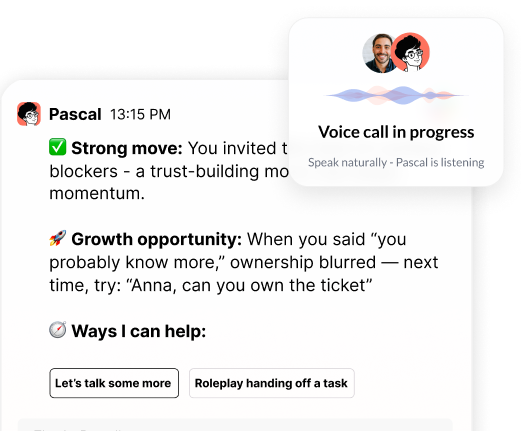
Pascal lives where work happens (embedded in Slack, Teams, and meetings) and gathers context automatically. Generic AI tools like ChatGPT operate in isolation, forcing users to explain their situation every time.
Pascal builds a knowledge graph of each person's interactions, relationships, and communication patterns. This enables guidance that feels like it knows your organization.
Pascal's context advantage:
• Proactive presence: Joins meetings, observes interactions, provides real-time feedback
• Perceptive understanding: Tracks relationships, communication patterns, team dynamics
• Personalized guidance: Adapts to individual values, competencies, and company culture
• Plugged-in everywhere: Native integrations with Slack, Teams, Zoom, Google Meet
• Protected by design: SOC2 compliant, never trains on customer data, user-controlled privacy
The embedded approach solves the "cold start problem." Instead of requiring managers to document their world, Pascal learns by being present in it. This reduces the adoption barrier from "I need to spend 30 minutes explaining my situation" to "I can ask a question and get a relevant answer immediately."
Certain categories require explicit opt-in consent: compensation details, health information, legal matters, and performance improvement plans. These sensitive areas require human judgment and create legal exposure if mishandled by AI.
Data categories requiring strict boundaries:
• Compensation and equity: Salary, bonuses, stock grants, raise history
• Health and accommodation: Medical conditions, disability accommodations, leave requests
• Legal and compliance: Investigations, complaints, disciplinary actions
• Performance improvement: PIPs, corrective action plans, termination discussions
AI coaching platforms should include moderation flags and escalation protocols for sensitive topics. When a conversation touches harassment, discrimination, mental health crises, or legal issues, the system should surface resources and recommend involving appropriate specialists.
Pascal's guardrails include organization-specific controls that CHROs can customize based on risk tolerance and regulatory environment. Heavily regulated industries (healthcare, financial services) typically require tighter data boundaries than technology companies.
The goal isn't to prevent AI coaches from being useful in complex situations. It's to ensure appropriate human expertise gets involved when stakes are high. An AI coach can help a manager prepare for a difficult performance conversation. When that conversation escalates to potential termination, HR needs to be in the loop.
• Minimum viable context includes four elements: role clarity, active goals, team relationships, and communication baseline
• Context-aware AI coaches eliminate the friction of repeatedly explaining situations and team dynamics
• Performance data and 360 feedback improve coaching relevance, but must be isolated to individual instances with strict privacy controls and user consent
• Embedded AI coaches that learn from meetings and interactions outperform generic chatbots that require manual context input every session
• Certain data categories require strict boundaries: compensation, health information, legal matters, and PIPs should remain off-limits or require explicit opt-in
The difference between an AI coach that transforms manager effectiveness and one that collects digital dust comes down to context. Too little, and you get generic advice managers ignore. Too much without proper safeguards, and you create privacy concerns that tank trust.
The right balance (minimum viable context with progressive learning and strict privacy controls) enables AI coaching to deliver personalized guidance at scale while protecting both your organization and your people.
See how Pascal works inside Slack to deliver context-aware coaching without manual input.
Header photo by JIRAN FAMILY on Unsplash

.png)
.webp)
“Thank you for setting the great foundation for my promotion; now I have a plan!"

Curious to see how AI Coaching can 10X the impact and scale of your development initiatives. Book a demo today for: