

An AI coach learns your company culture through three processes: ingesting organizational documentation (values, competencies, frameworks), analyzing behavioral patterns from workplace interactions, and refining its understanding through feedback loops. Effective systems combine pre-training on your cultural artifacts with observation of how work actually happens.
An AI coach understands company culture when it recognizes your organization's values in workplace situations, recommends actions aligned with your leadership frameworks, and distinguishes between generic best practices and what works in your environment.
Here's what that looks like in practice: When a manager at a tech company asks about handling a team conflict, the AI references their "Disagree and Commit" value and suggests a specific approach from their internal feedback framework—not generic conflict resolution advice. The system applies cultural context to individual coaching moments, just as a human coach would reference "how we do things here."
SHRM's 2023 research found that workplace culture plays a major role in AI adoption success (https://www.shrm.org/topics-tools/research/navigating-ai-in-the-workplace/full-report). Organizations that customize AI tools to reflect their cultural norms see higher engagement than those deploying generic solutions.
But how does the system actually learn this? The technical process works like this:
Document ingestion: The AI processes your culture deck, competency models, and training materials, converting them into vector embeddings (mathematical representations that capture meaning and relationships between concepts).
Knowledge graph construction: These embeddings form a knowledge graph—a network that maps relationships between people, values, and behaviors. When your values deck says "customer obsession," the graph connects that principle to specific behaviors from your competency model (responds to customer requests within 24 hours, escalates product issues to engineering).
Contextual retrieval: When a manager asks a question, the system searches this knowledge graph for relevant context. It doesn't just keyword-match "feedback"—it understands the manager's level, department, and which frameworks apply to their situation.
Response generation: The AI generates coaching that weaves together your cultural principles, the manager's specific context, and the immediate situation they're facing.
This requires multiple data layers: organizational artifacts (culture decks, competency models), individual context (performance data, role expectations), and behavioral observation (meeting dynamics, communication patterns). The system must distinguish between universal coaching principles and company-specific approaches. Feedback frameworks vary widely—some organizations use Situation-Behavior-Impact, others prefer radical candor, and some have proprietary models.
Pascal by Pinnacle builds this knowledge graph by mapping relationships between people, values, and behaviors across your organization. The system observes which guidance resonates, which gets ignored, and how different teams interpret the same values differently.
This is the right question to ask. Culture is nuanced, contextual, and often unwritten. Can an algorithm capture that?
The honest answer: AI can't replicate human cultural intuition, but it can learn pattern recognition at scale. It won't understand why your engineering team's interpretation of "move fast" differs from your sales team's—but it can observe that difference across hundreds of interactions and adjust its coaching accordingly.
The limitation matters. AI coaching works best for translating explicit cultural frameworks into everyday situations (how to give feedback using your company's model, how to run a 1:1 that reflects your values). It struggles with implicit cultural nuances (when to break a rule, how to read political dynamics, when "move fast" means "ship it now" versus "get alignment first").
Organizations see the best results when they use AI for scalable, framework-based coaching while reserving human coaches for complex cultural navigation. The AI handles "how do I apply our feedback model to this situation?" A human coach handles "my skip-level is undermining me in meetings—how do I navigate this politically?"
Before implementing any AI coaching system, consolidate all materials that define how your organization approaches leadership, management, and employee development. The quality and completeness of this foundation determines how well the AI can align with your culture.
Most organizations discover gaps during this audit—they realize their stated values aren't operationalized in manager training, or their competency models haven't been updated in years.
Gather core cultural artifacts: mission/vision/values documents, culture decks, employee handbooks, code of conduct.
Compile leadership frameworks: competency models, leadership principles, management expectations by level, career progression frameworks.
Collect training materials: existing manager training content, onboarding materials, feedback frameworks, communication guidelines.
Document processes and policies: performance review processes, escalation pathways, decision-making frameworks, meeting norms.
Identify department-specific variations: different teams may interpret company values differently or have specialized frameworks (engineering versus sales leadership).
Once documentation is prepared, upload and structure this content within the AI coaching platform. Advanced systems create a semantic layer that allows the AI to retrieve relevant context based on the specific coaching situation. When a manager asks about giving difficult feedback, the system surfaces your organization's specific feedback framework, not generic advice.
Pascal's admin portal allows HR teams to tag content by department, function level, and topic. A first-time manager in engineering sees coaching grounded in your technical leadership competencies, while a sales director receives guidance aligned with your customer-facing values.
Upload foundational documents through the admin interface: most platforms accept PDFs, Word documents, and text files.
Tag content by relevance: department, function level, topic area, priority level.
Define hierarchies: which frameworks supersede others when there's potential conflict.
Set visibility rules: some content may be relevant company-wide, other materials only for specific teams.
Establish update protocols: who can modify organizational content, how often it's reviewed, version control processes.
Cultural alignment alone isn't enough—the AI must understand each person's role, goals, performance history, and development needs. A new manager needs different guidance than a senior director, even when facing similar challenges.
The most effective systems integrate with Human Resources Information System (HRIS) platforms, performance management tools, and goal-tracking systems to pull individual context automatically. This data layer includes role and level, performance review history, career aspirations, personality assessments, 360 feedback results, and current development goals.
Connect to your HRIS: automated data sync ensures the AI always has current information about roles, reporting structures, and organizational changes.
Import performance data: past reviews, ratings, and feedback help the AI understand each person's strengths and development areas.
Incorporate assessment results: personality typing (DISC, Myers-Briggs), leadership assessments, and 360 feedback provide additional context for personalization.
Track development goals: when the AI knows someone is working on delegation skills, it can proactively surface relevant guidance during meetings where delegation opportunities arise.
The most powerful cultural learning happens when the AI observes real work, not just reads about it. Advanced AI coaching platforms join meetings, analyze communication patterns, and build a knowledge graph of how people actually interact across your organization. This behavioral data reveals the gap between stated culture and lived culture—the difference between what your values deck says and how managers actually lead.
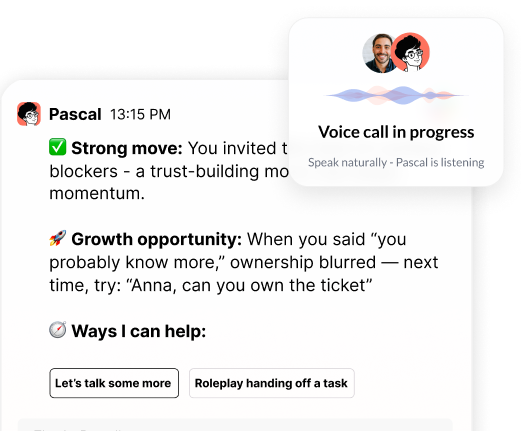
When Pascal joins a Zoom or Teams meeting (with participant consent), it transcribes the conversation and analyzes communication dynamics: who speaks most, how feedback is delivered, whether the manager asks open-ended questions or dominates the discussion, how conflict gets addressed. After the meeting, it provides feedback aligned with both your cultural values and the individual's development goals.
Here's a concrete example: Your culture deck emphasizes "psychological safety," and your manager training teaches the "ask, don't tell" coaching model. The AI joins a manager's 1:1 and observes them spending 40 of 45 minutes talking, offering solutions before understanding the problem, and interrupting twice when the employee tried to share concerns. Post-meeting, Pascal flags this gap between stated values and observed behavior, referencing specific moments and suggesting questions the manager could have asked instead.
Over time, this creates a dataset about how leadership actually happens in your organization—which managers exemplify your values, where cultural misalignment occurs, and how different teams interpret the same principles.
Meeting observation provides real-time cultural data: the AI sees how managers give feedback, run 1:1s, facilitate team discussions, and handle conflict.
Communication pattern analysis reveals cultural norms: does your organization value direct communication or diplomatic phrasing? Do managers interrupt frequently or wait for pauses?
Relationship mapping builds organizational context: the AI learns who works with whom, team dynamics, reporting structures, and collaboration patterns.
Privacy matters here. Employees must consent to AI observation. The system should anonymize and aggregate data when providing organizational insights to HR. Individual coaching remains private unless the conversation involves harassment, discrimination, or other issues requiring escalation.
Your organizational values and frameworks always supersede generic coaching principles. If your company has a proprietary feedback model, the AI should reference that model, not default to Situation-Behavior-Impact or other standard frameworks.
The most sophisticated platforms allow you to explicitly define these priorities in the configuration phase. You can specify which frameworks take precedence, which policies are non-negotiable, and where the AI should defer to company-specific approaches over general best practices.
Establish clear hierarchies: company values, then department frameworks, then role-specific competencies, then general coaching principles.
Define non-negotiable policies: legal requirements, escalation procedures, compliance standards that the AI must always respect.
Allow for contextual flexibility: some situations require adapting company frameworks to specific circumstances, and the AI should recognize when to apply judgment versus strict adherence.
Measuring cultural alignment requires both quantitative metrics and qualitative assessment. Track adoption rates and engagement patterns, but also conduct regular spot-checks of actual coaching conversations to ensure the AI applies your frameworks correctly.
Monitor adoption metrics: daily active users, conversation frequency, feature utilization across different teams and levels.
Analyze conversation quality: are managers receiving guidance that references your specific competencies and values? Does the coaching feel personalized or generic?
Collect user feedback: regular surveys asking whether coaching aligns with company culture, feels relevant to their role, and provides actionable guidance.
Review coaching transcripts: HR teams should periodically audit conversations to verify the AI applies frameworks correctly and respects organizational boundaries.
Track behavioral outcomes: the ultimate measure is whether managers actually change behavior based on AI coaching—improved feedback quality, better 1:1 conversations, increased team engagement.
One mid-sized tech company implemented AI coaching in Q1 2024. After three months, they audited 50 random coaching conversations. They found the AI correctly referenced their "Radical Transparency" value in 47 of 50 conversations, but in 3 cases suggested diplomatic phrasing that contradicted their direct communication norm. They updated the system's configuration to prioritize directness, then re-audited the following month. Accuracy improved to 49 of 50.
Even well-configured systems need guardrails to prevent inappropriate guidance or cultural misalignment. The most critical safeguard is human oversight for sensitive topics—the AI should recognize when a situation requires HR expertise and escalate appropriately.
Pascal includes moderation flags that detect potentially sensitive conversations, escalation protocols for topics requiring human expertise, organization-specific controls that enforce your policies, and anonymous aggregated insights that protect individual privacy while providing organizational visibility.
Implement content moderation: automated flags for discussions involving harassment, discrimination, mental health, or legal issues.
Create escalation pathways: clear procedures for routing sensitive situations to HR business partners or legal teams.
Respect privacy boundaries: ensure the AI doesn't share information inappropriately across teams or levels.
Maintain audit trails: log all coaching interactions for compliance and quality assurance purposes.
Company culture evolves, and your AI coach needs regular updates to stay aligned. Establish a quarterly review cycle for organizational content, with more frequent updates when major changes occur—new leadership frameworks, updated values, organizational restructuring, or shifts in strategic priorities.
Quarterly content reviews: assess whether existing documentation still reflects current priorities and practices.
Event-driven updates: immediately update the AI when launching new initiatives, changing policies, or introducing new frameworks.
Continuous feedback integration: use insights from coaching conversations to identify gaps in the AI's cultural understanding.
Version control: maintain clear records of what changed, when, and why to track cultural evolution over time.
AI coaches learn company culture through organizational documentation, behavioral observation from workplace interactions, and continuous refinement through feedback loops. The technical process involves document ingestion, knowledge graph construction, contextual retrieval, and response generation—converting your culture deck into coaching that applies to specific situations.
Effective implementation requires thorough preparation. Audit and consolidate all cultural artifacts, competency models, and training materials before configuration. Most organizations discover gaps during this process—stated values that aren't operationalized, outdated competency models, or inconsistent frameworks across departments.
The most powerful cultural learning happens when AI observes actual work through meeting attendance and communication analysis. This reveals gaps between stated and lived culture—what your values deck says versus how managers actually lead. The system learns which guidance resonates, which gets ignored, and how different teams interpret the same values differently.
Your organizational frameworks must supersede generic coaching principles. Configure explicit hierarchies so company-specific approaches always take precedence. If your company uses a proprietary feedback model, the AI should reference that model, not default to standard frameworks.
Measure cultural alignment through both quantitative metrics (adoption rates, engagement patterns) and qualitative assessment (spot-checking conversations, user feedback, behavioral outcomes). The ultimate measure is whether managers actually change behavior based on AI coaching.
Pascal learns your company culture by joining meetings, analyzing real interactions, and integrating with your organizational frameworks—delivering coaching that reflects how work actually happens in your organization. See how Pascal works or schedule a demo to explore how AI coaching can scale your leadership development while staying true to your culture.

.png)
.webp)
“Thank you for setting the great foundation for my promotion; now I have a plan!"

Curious to see how AI Coaching can 10X the impact and scale of your development initiatives. Book a demo today for: