
AI coaches learn company culture through three mechanisms: ingesting your values documents and leadership frameworks, observing how your teams actually communicate and make decisions, and adapting based on what guidance managers apply. Systems that combine all three deliver coaching that matches how your organization works.
Managers ignore advice that contradicts how their company operates. Tell a Google manager to "move fast and break things" and they'll dismiss you. Tell a healthcare manager to "ask forgiveness, not permission" and you've lost credibility.
Generic AI tools fail because they lack organizational context. ChatGPT suggests feedback approaches that might work at Netflix but contradict your company's frameworks. Your managers need coaching that references your competency models, speaks your language, and accounts for your team dynamics.
The gap between knowing and doing kills most training programs. Managers attend workshops, nod along, then return to their desks and revert to old habits. AI coaches that understand your culture can intervene in real moments with guidance that fits your reality.
AI coaches start by learning your explicit cultural materials: leadership competencies, values documents, performance criteria, and behavioral frameworks. During setup, you upload these materials so the coach references them in every interaction.
What organizations typically provide:
• Leadership competency models with behavioral indicators at each level
• Company values with concrete examples of each value in practice
• Performance review rubrics and evaluation criteria
• Training materials and internal playbooks
• Communication guidelines and escalation processes
• Role-specific expectations and career ladders
This creates baseline understanding. When a manager asks for feedback advice, the coach knows whether your organization uses SBI (Situation-Behavior-Impact), COIN (Context-Observation-Impact-Next Steps), or another framework and coaches to that standard.
Pascal allows customization at company and department levels. Engineering teams and sales teams operate differently even within the same organization. The system pulls context from your HRIS and performance management platforms to understand not just what you say your culture is, but how you measure and reinforce it.
Written policies describe aspirational culture. Observed behavior reveals actual culture. AI coaches that monitor real workplace interactions capture how work happens and how people communicate in your organization.
Pascal joins meetings and monitors Slack and Teams channels. This observation captures:
• Meeting participation patterns (who speaks, who gets interrupted, how decisions get made)
• Communication style norms (direct vs. diplomatic, formal vs. casual)
• Conflict resolution approaches (escalation patterns, consensus-building methods)
• Feedback delivery styles (public recognition vs. private correction)
When a manager asks for advice, Pascal knows the team dynamics, recent tensions, and communication patterns—not just the stated values. This contextual awareness separates useful coaching from generic suggestions.
The system observes patterns without exposing individual interactions. Pascal provides aggregated insights to HR leaders about cultural trends while protecting individual privacy through SOC2 compliance. HR sees "Managers in sales struggle with performance conversations" without seeing who said what in which meeting.
AI coaches improve by tracking which guidance managers apply and which they ignore. This feedback reveals gaps between the coach's understanding and organizational reality.
Pascal monitors application patterns. If managers consistently dismiss certain advice, the system flags a potential misalignment. If specific guidance drives behavior change, the system reinforces that approach.
Organizations refine the coach's understanding by:
• Collecting manager feedback on coaching quality
• Testing scenarios with managers across departments
• Updating cultural materials as the organization evolves
• Adjusting department-level customization based on usage patterns
Mergers, leadership changes, and strategic shifts require recalibrating what the coach knows. Continuous refinement ensures the coaching stays aligned with current reality, not last year's culture deck.
Data Breakdown:
• Capability: Cultural knowledge | Generic AI: Public internet data | Context-Aware AI Coach: Your documents + observed behavior
• Capability: Feedback framework | Generic AI: Generic best practices | Context-Aware AI Coach: Your specific models (SBI, COIN, etc.)
• Capability: Situational awareness | Generic AI: Requires manual context each time | Context-Aware AI Coach: Knows team dynamics and recent interactions
• Capability: Integration | Generic AI: Standalone tool | Context-Aware AI Coach: Embedded in Slack/Teams/meetings
• Capability: Privacy | Generic AI: Consumer-grade | Context-Aware AI Coach: SOC2 compliant, never trains on your data
The difference shows up in trust. Managers abandon tools that require leaving their workflow to explain context every time. They apply guidance that accounts for their team's reality and their company's frameworks.
Individual interactions remain private. When a manager asks Pascal for coaching, that conversation stays between the manager and the coach. The system uses observed patterns to inform guidance without revealing who said what in which meeting.
HR leaders see aggregated trends, not individual data. "Engineering teams show strong alignment with collaboration values" provides strategic insight without compromising privacy.
Pascal maintains SOC2 Type II certification with controls around data access, encryption, and retention. Your cultural information never trains the underlying AI models. Employees know when Pascal joins meetings and understand what data the system observes.
Transparency builds adoption. Clear communication about privacy protections reduces resistance and increases manager engagement.
Start by uploading comprehensive cultural materials: your leadership competency framework with behavioral indicators, values statements with concrete examples, performance review templates, communication guidelines, and recent training materials.
Test cultural accuracy before full rollout. Run pilot scenarios with managers across departments. Ask the coach to provide feedback on common situations—difficult conversations, performance issues, team conflicts. Evaluate whether the guidance matches how your best managers handle these situations.
Collect feedback during the pilot. Track which guidance gets applied and which gets ignored. Use this data to identify gaps in cultural understanding and refine inputs before expanding access.
Plan for continuous updates. Your culture evolves. The coach's understanding must evolve with it. Assign ownership for keeping cultural materials current and monitoring coaching quality over time.
• AI coaches learn culture through three mechanisms: ingesting your frameworks and values, observing real workplace behavior, and adapting based on which guidance managers apply.
• Context-aware coaches deliver culturally aligned guidance that managers trust, while generic tools provide disconnected advice that gets ignored.
• Real-time observation captures how culture manifests in daily work, not just what the culture deck says.
• Privacy safeguards (anonymized data, aggregated insights, SOC2 compliance) protect individuals while providing organizational value.
• Continuous refinement keeps coaching aligned as your organization evolves through mergers, leadership changes, and strategic shifts.
Cultural understanding separates AI coaching platforms that drive behavior change from those that collect digital dust. The depth of integration—from explicit artifacts to observed behavior to continuous adaptation—determines whether managers trust the guidance enough to change how they lead.
See how Pascal learns your company culture.
Header photo by Christina @ wocintechchat.com M on Unsplash

.png)
.webp)
“Thank you for setting the great foundation for my promotion; now I have a plan!"

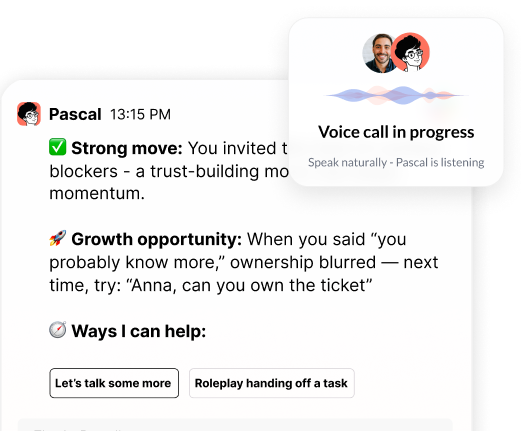
Curious to see how AI Coaching can 10X the impact and scale of your development initiatives. Book a demo today for: