
AI coaching embeds into Slack, Teams, and Zoom—delivering guidance during actual work moments instead of requiring separate logins or scheduled sessions. This transforms development from a scheduled event into continuous support that meets managers where decisions happen.
In-the-flow AI coaching observes your actual work—meetings, Slack conversations, team interactions—then delivers specific feedback immediately after. No scheduling sessions. No remembering to ask for help. The guidance appears automatically when it matters.
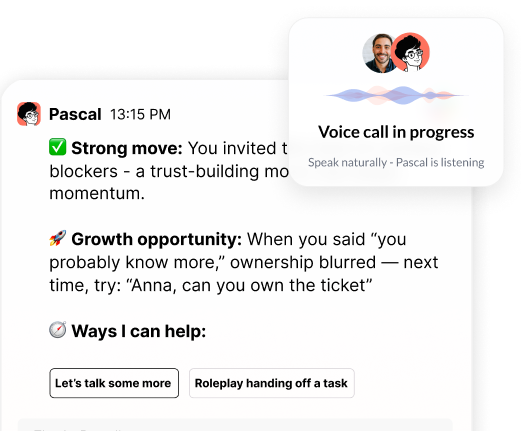
An AI coach joins your Zoom meeting as a silent participant, watches how you delegate a project to Sarah, then sends a Slack message five minutes later: "You skipped success criteria when delegating to Sarah. You've done this in your last three delegation conversations. Try: 'Success looks like X by Y date.'" The coaching happens without leaving Slack, without scheduling, without activation energy.
The integration spans everywhere work happens: Slack channels where you give feedback, Teams conversations where conflicts emerge, Zoom recordings of one-on-ones, calendar events that trigger pre-meeting prep. Traditional LMS platforms require logging into a separate portal. Human coaches need scheduling weeks in advance. Both miss the teachable moment.
Where AI Coaching Lives vs. Where Traditional Development Lives
Data Breakdown:
• AI Coaching (Flow-Integrated): Slack, Teams, Zoom | Traditional Development: LMS portal, separate platform
• AI Coaching (Flow-Integrated): Real-time, post-meeting | Traditional Development: Scheduled sessions, quarterly reviews
• AI Coaching (Flow-Integrated): Contextual to actual work | Traditional Development: Generic scenarios
• AI Coaching (Flow-Integrated): 24/7 availability | Traditional Development: Business hours only
AI coaching observes passively during work, then delivers bite-sized guidance asynchronously. Managers engage when they have cognitive space, not when it interrupts focus. The coach joins meetings as a silent participant, analyzes interactions, then sends a 2-3 sentence Slack message with one actionable insight.
Managers receive feedback 5-10 minutes post-meeting—enough time for analysis, but soon enough that conversation details remain vivid. Each coaching moment requires 1-2 minutes. Managers can defer, dismiss, or dive deeper based on current workload.
The proactive delivery means managers don't need to remember to ask. The coach surfaces what matters based on observed patterns across dozens of interactions.
Contextual AI coaching builds a persistent knowledge graph of your team relationships, communication patterns, past challenges, and organizational culture. When it observes you delegating a project to Sarah, it knows Sarah prefers detailed written instructions from past interactions, that you tend to under-communicate timelines based on 12 previous meetings, and that your company values transparency.
The resulting coaching isn't "here's how to delegate"—it's "based on Sarah's preference for detail and your pattern of timeline ambiguity, try this: 'Sarah, I need this by Friday EOD. Success means the client can review it Monday morning. Questions on scope?'" Generic LMS content says "set clear expectations." Contextual AI coaching says "you skip timeline clarity with technical projects—here's the exact phrase to use with Marcus."
The advantage comes from being embedded in meetings and Slack. The system accumulates behavioral data from every interaction, enabling deeper personalization. The knowledge graph tracks individual communication styles, team dynamics, historical interactions, company values, and role-specific competencies. Every interaction feeds the model, making subsequent coaching more precise.
Meeting-integrated AI coaching uses secure API connections to join virtual meetings as a participant, transcribes conversations with speaker identification, analyzes communication patterns, then delivers feedback via Slack or Teams within minutes.
The technical flow: Calendar integration auto-joins the coach to scheduled meetings. Real-time transcription captures the conversation with speaker attribution. Pattern analysis identifies coaching opportunities: Did you interrupt? Did you ask open-ended questions? Did you acknowledge concerns? The system applies coaching frameworks. Feedback delivery happens 5-10 minutes post-meeting via Slack.
Privacy architecture: SOC2 compliance, data encryption, and strict policies against training models on customer data protect sensitive conversations. Moderation layers detect sensitive topics—legal issues, harassment, mental health—and trigger human HRBP escalation. Anonymous aggregation provides organizational insights without exposing individual conversations.
Example output: "In today's sprint planning, you interrupted Jamie twice when she raised concerns about timeline feasibility. This pattern appeared in 3 of your last 5 meetings. Try: pause 3 seconds after someone finishes speaking before responding."
Proactive AI coaching eliminates the "remembering to ask" problem. Managers receive guidance automatically at teachable moments when learning sticks.
The difference: reactive chatbots require managers to recognize they need help, articulate the problem, and initiate contact. Proactive coaches observe the moment, identify the learning opportunity, and surface guidance before the manager realizes they needed it. Teachable moment capture matters. Coaching arrives while context is fresh—within 10 minutes—not days later when the manager remembers to ask.
Behavioral reinforcement happens through consistent touchpoints. When the coach observes you handling conflict well, it reinforces: "Great job pausing before responding to Marcus's pushback. That created space for him to explain his concerns." When patterns emerge, it intervenes: "You've cut off three team members mid-sentence this week. This impacts psychological safety."
On-demand tools become another thing to remember. Proactive tools become a trusted companion.
Flow-integrated coaching scales by meeting every manager where they already work. When coaching lives in Slack and Zoom instead of a separate portal, it reaches frontline managers, new team leads, and individual contributors preparing for leadership roles—not just executives who can afford human coaches.
Traditional coaching costs $15,000-$50,000 per executive annually. AI coaching delivers 24/7 support at a fraction of that cost. Organizations can extend development to 500 managers for the price of coaching five executives.
The scalability comes from automation without losing personalization. Each manager receives coaching tailored to their specific patterns, team dynamics, and development goals. The AI doesn't get tired, doesn't have scheduling conflicts, and doesn't forget what happened in your last meeting. It's available across time zones, languages, and organizational levels.
The coaching adapts to each company's culture, values, and leadership principles—not generic best practices disconnected from how work actually happens.
Human coaches remain critical for emotionally charged situations, political navigation, and values-based decisions that require nuanced judgment. AI handles day-to-day coaching functions, but human expertise matters for career transitions, interpersonal conflicts, ethical dilemmas, and moments requiring empathy beyond pattern recognition.
The most effective model combines AI for continuous, contextual guidance with human coaches for complex situations. AI flags sensitive topics and escalates to HRBPs when conversations involve legal concerns, harassment, or mental health issues. This hybrid approach maximizes both scale and quality.
AI excels at pattern recognition, behavioral feedback, and skill reinforcement. It catches the small moments: "You interrupted three times in that meeting." "You forgot to set success criteria again." "You handled that conflict well—here's why it worked." Human coaches excel at strategic thinking, emotional intelligence, and helping managers navigate ambiguous situations where there's no clear right answer.
Organizations using this hybrid model report higher satisfaction than those relying solely on human or AI coaching. Managers get daily support from AI for routine challenges, with human coaches available for moments that require human judgment. The AI becomes a force multiplier, extending human coaching capacity instead of replacing it.
• AI coaching embedded in Slack, Teams, and Zoom drives higher adoption than standalone portals by eliminating the "remembering to use it" problem
• Proactive coaching that observes meetings and delivers feedback automatically works better than on-demand chatbots that require managers to initiate contact
• Contextual guidance grounded in your actual team dynamics, communication patterns, and organizational culture drives measurable behavior change
• Meeting-integrated AI coaching captures teachable moments within 5-10 minutes, when context remains fresh and learning sticks
• Flow-integrated coaching scales manager development to every level at lower cost than traditional executive coaching
AI coaching isn't about replacing human coaches—it's about making continuous development accessible to every manager, not just senior executives. When coaching lives where work happens, it transforms from a scheduled event into a trusted companion that helps managers think clearly, act decisively, and grow through real situations.
Pascal is Pinnacle's AI coach that works inside Slack, Teams, and your meetings. See how it works at heypinnacle.com.
Header photo by Vitaly Gariev on Unsplash

.png)
.webp)
“Thank you for setting the great foundation for my promotion; now I have a plan!"

Curious to see how AI Coaching can 10X the impact and scale of your development initiatives. Book a demo today for: