

AI coaching embeds personalized guidance into the tools managers already use (Slack, Teams, Zoom), delivering real-time feedback during meetings and conversations without separate logins or scheduled sessions. The AI observes, learns, and responds exactly when managers face critical moments.
In-the-flow AI coaching delivers guidance during the moments that matter: inside the meeting where a manager gives difficult feedback, within the Slack thread where team conflict surfaces, or immediately after a one-on-one that went poorly. The manager doesn't open a separate app or schedule a coaching session. The AI is already there.
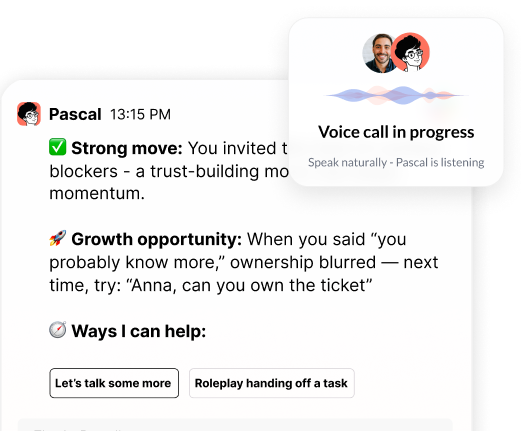
Purpose-built AI coaches like Pascal embed into Slack, Microsoft Teams, Zoom, and Google Meet. The AI joins meetings (with permissions), analyzes communication patterns, and identifies coaching opportunities as they unfold. Managers receive personalized insights within minutes of a meeting ending, not days later when context has faded.
Unlike chatbots that start fresh each conversation, in-the-flow AI builds a knowledge graph (a connected map of your team dynamics, challenges, and growth areas) over time. Jeff Diana, former CHRO at Calendly, Atlassian, and SuccessFactors, describes this shift: "Real learning and value come from in-context coaching—solving problems in the moment, not in a classroom."
Traditional coaching happens in scheduled sessions. You describe a situation from memory. Your coach gives advice. You try to remember it when the situation happens again next week.
In-the-flow AI coaching observes the actual interaction. A manager interrupts a team member during a brainstorm. Two minutes after the meeting ends, the AI sends feedback: "You cut off Sarah when she was building on Marcus's idea. This happened in four of your last six team meetings. Try the 'pause-acknowledge-build' technique."
The timing changes everything. Feedback arrives while the interaction is fresh, making application immediate and retention higher.
The comparison:
Traditional coaching costs $200-500 per hour and scales only to senior leaders. Sessions happen weekly or monthly. The coach hears your version of what happened days ago.
In-the-flow AI coaching costs a fraction of traditional coaching (specific pricing varies by organization size). It's available 24/7, embedded in daily tools. The AI observes what actually happened and responds within minutes.
AI coaching platforms connect to workplace collaboration tools through native integrations. Pascal functions as a Slack bot, Teams app, and meeting companion. Managers interact through text, voice, or automatic post-meeting summaries.
A manager messages their AI coach in Slack: "Help me prepare for my performance discussion with Sarah in 15 minutes." The AI pulls Sarah's communication preferences from past interactions and suggests an opening framework.
In meeting companion mode, the AI joins video calls (after participants are notified and consent). It transcribes the conversation, analyzes communication patterns, and identifies leadership moments in real time.
Authentication happens through existing single sign-on systems. Managers access coaching through tools they're already logged into. HubSpot embedded AI tools into existing workflows and saw adoption rates above 98%, compared to 10-20% engagement for standalone platforms requiring separate access. (Source: HubSpot internal implementation data, 2023)
A manager's day with embedded AI coaching consists of continuous micro-moments of support rather than discrete training events.
8:30 AM: Manager opens Slack. AI coach message waiting: "Your 9 AM with Jordan—they've mentioned feeling unclear about priorities in your last three check-ins. Consider starting with alignment on their top three focus areas."
Manager asks: "How should I structure this conversation?"
AI provides a framework based on the company's leadership competencies and Jordan's communication style from past interactions.
1:45 PM: AI joins manager's team meeting (with consent). The manager contributes ideas but interrupts Sarah and Marcus when they're building on each other's thoughts.
2:05 PM: Post-meeting feedback arrives: "You interrupted Sarah and Marcus during brainstorming. This pattern has appeared in four of your last six team meetings. Try the 'pause-acknowledge-build' technique we practiced."
5:20 PM: Manager texts AI: "Difficult conversation with underperformer tomorrow. Help me prepare."
AI pulls performance data, past feedback conversations, and company accountability frameworks. It provides role-play practice, simulating the specific employee's communication style.
This continuous presence transforms development from scheduled events into hundreds of small improvements. Organizations using Pascal report that 83% of direct reports observe improvement in their managers within 90 days. (Source: Pascal customer data, Q4 2023, n=47 companies)
In-the-flow AI coaching delivers guidance at the moment of application. Traditional LMS platforms provide information at the moment of consumption. That difference explains why most corporate training goes unused.
Managers don't need another course on difficult conversations. They need support during the actual difficult conversation happening in 15 minutes.
An LMS offers pre-scheduled modules with generic scenarios. You complete a course on Tuesday. Conflict erupts Thursday afternoon. You can't remember the framework.
In-the-flow AI coaching removes that gap. The guidance arrives when you're already engaged in the situation.
The breakdown:
LMS platforms: Role-based training tracks, end-of-module quizzes, per-seat licensing. Support arrives before you need it, then disappears when you do.
Performance management tools: Quarterly reviews, historical data, individual goals. Feedback comes 90 days after the interaction that mattered.
Human coaching: Fully customized, role-play in sessions, $200-500 per hour. Next session is days or weeks away.
In-the-flow AI coaching: Observes actual interactions, combines organizational context with individual needs, delivers feedback within minutes, costs 1% of traditional coaching. (Source: Comparative analysis of enterprise coaching costs, Pinnacle internal research, 2024)
Proactive AI coaching anticipates needs based on observed patterns and upcoming events. Reactive chatbots wait for you to ask questions.
The difference determines whether managers develop sustainable habits or abandon the tool within weeks.
Purpose-built AI coaches analyze communication patterns across meetings, identify skill gaps, and surface guidance before managers recognize they need help. A manager has three difficult performance conversations scheduled this week. The AI prepares customized talking points for each one based on the individual employee's communication style and past interactions.
Generic chatbots require managers to remember to ask for help, describe their situation in detail, and translate generic advice back to their specific context. This creates friction exactly when managers are busiest.
Pascal's proactive approach includes joining meetings to observe real interactions, building a knowledge graph of team dynamics, and delivering post-meeting feedback that references specific moments: "When Marcus pushed back on the timeline, you defaulted to authority rather than curiosity. Try asking 'What concerns do you have?' next time."
Purpose-built solutions achieve 94% monthly retention. Embedded chatbots see engagement drop to 10-20% within months. (Source: "Architectural Differences in Purpose-Built AI Coaching," Pinnacle research, 2024)
AI coaching platforms maintain privacy through SOC2 compliance, explicit consent protocols, and architectural separation between individual coaching and organizational insights.
Pascal's privacy guardrails: Managers explicitly invite the AI to meetings. All participants receive notification when AI is present. Individual coaching conversations remain private between the manager and their AI coach.
The platform uses moderation flags to identify sensitive topics (personal crises, mental health concerns, legal issues) and escalates to human resources rather than attempting to coach through issues requiring human intervention.
Organizations receive anonymized, aggregated insights about cultural patterns and skill gaps across the company (similar to engagement survey data). Individual managers never see data about their peers. Senior leaders cannot access specific coaching conversations without explicit permission.
Customer data never trains the underlying AI models. This means your conversations don't improve the AI for other companies. The architecture keeps your data separate.
Melinda Wolfe, former CHRO at Bloomberg, Pearson, and GLG, describes the challenge: "We're asking more of managers with fewer resources." AI coaching scales support without compromising the trust required for development.
Organizations implementing in-the-flow AI coaching see measurable improvements in manager confidence, team engagement, and time saved within 90 days. New managers, sales leaders, and distributed teams show the fastest gains.
Companies using Pascal report a 20% average lift in manager NPS (net promoter score from direct reports). Direct reports observe improvement in 83% of their managers. Managers save an average of 150+ hours previously spent searching for resources, scheduling coaching sessions, or navigating HR systems for basic guidance. (Source: Pascal customer data, Q4 2023, n=47 companies)
The speed of impact comes from eliminating the lag between learning and application. A manager receives feedback within minutes of a meeting. They adjust their approach in the next interaction that same day. Small improvements in dozens of daily interactions compound into significant capability gains within weeks.
Track three metrics in the first 90 days:
Adoption rate: Aim for 80%+ of target managers actively using the tool weekly.
Engagement depth: Number of coaching interactions per manager per week.
Manager confidence scores: Measured through pulse surveys.
These leading indicators predict the lagging metrics of team performance and retention that appear in months 4-6.
• In-the-flow AI coaching embeds guidance into Slack, Teams, and meeting platforms where managers already work, eliminating separate logins or scheduled sessions
• Purpose-built AI coaches observe actual interactions, build knowledge graphs of team dynamics, and deliver personalized feedback within minutes of critical moments
• Proactive, contextual guidance creates sustainable habits (94% monthly retention for purpose-built AI coaching versus 10-20% engagement with generic chatbots)
• Privacy-first architecture separates individual coaching from organizational insights, with SOC2 compliance and explicit consent protocols ensuring customer data never trains underlying models
• Measurable results within 90 days: 83% direct report improvement rate, 20% manager NPS lift, and 150+ hours saved per manager
Pascal delivers AI coaching where your managers already work—embedded in Slack, Teams, and meetings with real-time feedback, personalized guidance, and privacy-first architecture. Explore how Pascal integrates into your daily workflows to scale manager development across your organization.
Header photo by Vitaly Gariev on Unsplash

.png)
.webp)
“Thank you for setting the great foundation for my promotion; now I have a plan!"

Curious to see how AI Coaching can 10X the impact and scale of your development initiatives. Book a demo today for: