

Picture this: You're a manager preparing for a tough conversation with an underperforming team member. Two hours before your meeting, a message appears in Slack: "Your 1:1 with Sarah is at 2 PM. Based on your last three conversations, here's a framework for addressing the missed deadline while maintaining psychological safety."
During the meeting, an AI observes the conversation (with permission). Afterward, you get specific feedback: "You acknowledged Sarah's concerns before addressing performance—that worked. Follow up on her request for clearer project priorities within 24 hours."
This is AI coaching in the flow of work. No separate login. No generic advice. No remembering to seek help. The guidance arrives exactly when you need it, inside the tools you already use.
Traditional learning platforms fail because they require managers to stop working, consume generic content, and translate abstract concepts into specific situations. LinkedIn Learning might have excellent courses, but managers must remember to log in, dedicate time away from their teams, and figure out how general advice applies to their unique dynamics.
Basic AI chatbots like ChatGPT improve on this—you can ask questions anytime. But you still initiate every conversation, provide full context manually, and receive advice that doesn't account for your company culture or specific team relationships.
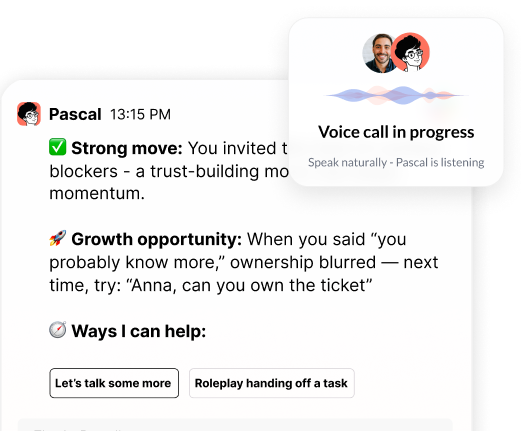
Flow-of-work AI coaching works differently. The system observes your actual interactions (with appropriate permissions), builds understanding of your team dynamics over time, and delivers proactive guidance without you asking. Pascal by Pinnacle, for example, joins your meetings, references previous conversations, understands individual team member concerns, and aligns recommendations with your company's leadership principles—all inside Slack or Teams.
The privacy concern is real and worth addressing directly: Pascal maintains SOC2 compliance, never trains its models on customer data, and provides organization-specific controls for sensitive topics. You control what the AI sees. Your boss doesn't get reports on your coaching interactions. The system exists to help you, not surveil you.
According to Melinda Wolfe, former CHRO at Bloomberg and Pearson: "Managers rarely need help in a workshop—they need it when preparing for a tough 1:1 or in the middle of a team conflict."
Four technical capabilities separate effective flow-of-work coaching from basic chatbots:
Persistent memory. The AI builds a knowledge graph of your workplace relationships, communication patterns, and development areas over time. Unlike chatbots that treat each conversation as isolated, Pascal remembers your previous meetings, understands relationship nuances, and tracks progress toward your goals. When you ask about handling conflict with a specific team member, the system recalls your last three interactions with that person and tailors advice accordingly.
Proactive delivery. The system identifies teachable moments—upcoming difficult conversations, patterns indicating team friction, opportunities to practice specific skills—and initiates support. Calendar integration flags your performance conversation with Sarah two hours in advance. Pattern recognition notices you've cut three team members off mid-sentence in the last week and suggests techniques for active listening.
Contextual awareness. The AI draws from multiple sources to understand your full situation: calendar events, communication patterns (in channels you've granted access to), team structure, company values, and your individual preferences. This comprehensive context enables personalized recommendations aligned with your organizational culture and specific relationship dynamics.
Privacy-first architecture. Pascal never trains its models on your data. The system provides anonymous aggregated insights to leadership (like "managers are asking more questions about delegation this month") while maintaining individual privacy. You control what meetings the AI joins and what channels it can access.
The underlying technology uses large language models (similar to GPT-4) fine-tuned on ICF-certified coaching frameworks and organizational psychology research. The system doesn't just pattern-match—it applies structured coaching methodologies to your specific situations.
Sarah is a product manager on your team. She missed a deadline last week, and you need to address it. Here's how AI coaching changes that conversation:
8:00 AM. You check Slack. Pascal has sent a message: "Your 1:1 with Sarah is at 2 PM. She mentioned feeling overwhelmed in your last conversation. Here's a framework: acknowledge her workload concerns first, then address the missed deadline, then problem-solve together on prioritization."
8:15 AM. You ask Pascal: "What if she gets defensive?" The AI responds with specific de-escalation techniques based on what's worked in your previous conversations with Sarah.
2:00 PM. The meeting happens. You've enabled Pascal to join (Sarah sees the AI is present). You acknowledge her concerns before addressing performance. You ask questions instead of lecturing. The conversation goes better than expected.
2:30 PM. Pascal sends feedback: "You effectively acknowledged Sarah's concerns before addressing performance. You asked three open-ended questions—that's up from zero in your last difficult conversation. Consider following up on her request for clearer project priorities within 24 hours."
Friday, 9:00 AM. Pascal sends your weekly summary: "This week you held five 1:1s. Your average speaking time dropped from 65% to 52%—you're asking more questions and listening more. Three team members mentioned feeling heard. Your follow-through on commitments improved: you completed 8 of 9 action items within 48 hours."
This continuous support cycle drives behavior change because guidance arrives at moments when you can apply it immediately.
We track three categories of metrics:
Adoption metrics. Successful implementations see 60-80% of managers actively using the system weekly, with multiple interactions per week. This far exceeds typical learning platform utilization (which hovers around 5-15% according to internal HR benchmarks from mid-market companies).
Behavior change indicators. Pascal customers report that 83% of direct reports notice positive changes in their manager's approach within 90 days. This comes from post-implementation surveys asking direct reports: "Have you noticed changes in how your manager communicates, delegates, or provides feedback?" The methodology: anonymous surveys sent to direct reports of managers using Pascal for 90+ days, with a control group of direct reports whose managers don't use the system.
Business impact measures. Organizations track manager NPS increases (Pascal customers average 20-point improvements), reduced HR escalations, and time savings. The 150+ hours saved per manager annually comes from reduced time in formal training sessions (40 hours), faster resolution of team conflicts (60 hours), and more efficient 1:1 preparation (50 hours).
The most sophisticated organizations combine quantitative metrics with qualitative feedback, tracking both usage data and manager testimonials about specific situations where coaching made a difference.
Four factors determine whether AI coaching becomes a used tool or shelfware:
Executive sponsorship. When senior leaders actively use and reference the coaching system, managers feel permission to invest time in development. The most successful implementations start with the executive team using Pascal for 30 days before rolling out to the broader organization.
Integration depth. Organizations achieving 70%+ adoption rates embed AI coaching into existing processes—performance reviews, goal-setting rituals, leadership development programs—rather than treating it as a standalone tool. Pascal connects to your HRIS (Workday, Lattice, BambooHR), pulls in performance data and development goals, and ensures coaching aligns with formal development plans.
Communication strategy. Clear messaging about what the AI can do, how it protects privacy, and when to use it drives engagement. Organizations with high adoption rates communicate coaching capabilities multiple times through multiple channels, with specific use cases and manager testimonials. The privacy question must be answered explicitly and repeatedly: what does the AI see, what doesn't it see, who controls access, how is data protected.
Measurement framework. Defining metrics before launch—active usage targets, behavior change indicators, business impact goals—enables course correction and demonstrates value to stakeholders. Regular reporting maintains momentum and justifies continued investment.
Organizations treating AI coaching as a strategic initiative rather than a technology purchase see dramatically better results. The difference between 15% and 75% adoption comes down to these implementation fundamentals.
Flow-of-work AI coaching embeds leadership development directly into Slack, Teams, and Zoom—delivering guidance at teachable moments without requiring managers to leave their workflow or visit separate platforms.
Purpose-built systems maintain persistent memory of relationships and interactions, enabling proactive support that generic chatbots cannot match. Pascal customers report 83% of direct reports noticing positive changes in their manager's approach within 90 days (measured through anonymous post-implementation surveys comparing managers using Pascal to control groups).
Effective integration requires four technical capabilities: persistent memory (knowledge graphs of workplace relationships), proactive delivery (identifying teachable moments before you ask), contextual awareness (drawing from calendar, communication patterns, and company values), and privacy-first architecture (SOC2 compliance, no model training on customer data, organization-specific controls).
Success depends on executive sponsorship, deep integration with existing HR processes, clear communication about capabilities and privacy, and measurement frameworks tracking adoption, behavior change, and business impact. Organizations achieve 60-80% weekly active usage when AI coaching connects to performance reviews and leadership development programs.
See how Pascal works inside Slack to deliver real-time coaching at the moments that matter most. Learn more about Pascal by Pinnacle.
Header photo by Zulfugar Karimov on Unsplash

.png)
.webp)
“Thank you for setting the great foundation for my promotion; now I have a plan!"

Curious to see how AI Coaching can 10X the impact and scale of your development initiatives. Book a demo today for: