

AI coaching transforms leadership development from scheduled events into continuous, contextual support embedded directly in the tools managers use every day—Slack, Teams, Zoom—delivering guidance at the exact moments when learning sticks and application is immediate. Rather than waiting for managers to seek help or attend training, effective AI coaching proactively surfaces opportunities for growth within existing workflows, creating consistent habits that drive sustained behavior change.
Quick Takeaway: AI coaching in the flow of work eliminates the friction that kills adoption in standalone platforms by meeting managers where they already work. Organizations embedding coaching into daily collaboration tools achieve 65-85% adoption rates compared to 10-20% for standalone portals, with managers averaging 2.3 coaching sessions per week and 94% monthly retention.
AI coaching in the flow of work means guidance arrives inside the tools managers already use—Slack, Teams, Zoom, email—so coaching becomes part of daily routine rather than an additional task. Proactive feedback appears within minutes of meetings, before difficult conversations, and during moments when context is fresh and learning sticks best.
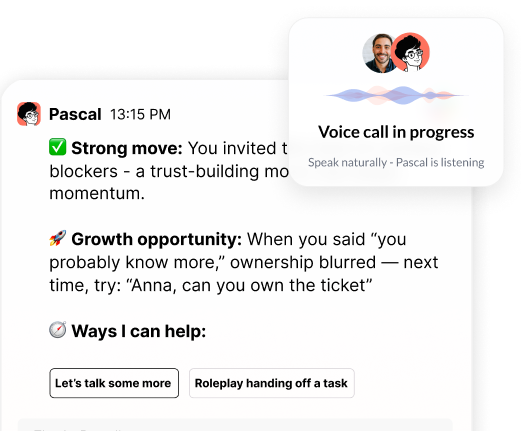
This integration eliminates context-switching friction that kills adoption in standalone platforms. Managers don't need to remember they have a coaching tool available or log into a separate application. Instead, Pascal, Pinnacle's AI coach, delivers guidance in the same channels where team discussions happen, the same tools where calendars live, and the same platforms where meetings occur. When a manager finishes a challenging team meeting, Pascal surfaces specific feedback within minutes: "Strong move inviting the team to surface blockers. Growth opportunity: when you said 'you probably know more,' ownership blurred. Next time, try: 'Anna, can you own the ticket.'"
This approach creates consistent touchpoints that build coaching relationships over time. Rather than sporadic engagement when managers remember to seek help, embedded coaching provides regular, proactive guidance that becomes habitual. Organizations embedding AI coaching throughout the employee lifecycle see adoption rates above 80%, demonstrating that meeting employees where they work drives fundamentally different engagement patterns than asking them to adopt new tools.
Embedded AI coaching achieves 65-85% adoption rates compared to 10-20% for standalone portals because it eliminates the remembering problem—managers receive coaching in tools they check dozens of times daily without requiring separate logins or scheduled sessions.
Workflow integration drives 3-5x higher adoption than standalone solutions. Managers using embedded coaches average 2.3 coaching sessions per week with 94% monthly retention, compared to less than one session monthly for portal-based tools that see engagement drop after initial novelty. This sustained engagement reflects how adults actually learn and work. People don't set aside dedicated time for development when they're managing competing priorities. They engage with tools that reduce friction and fit naturally into existing routines.
Proactive engagement creates habit loops that sustain behavior change long-term. Rather than waiting for managers to recognize they need help and take action to get it, embedded systems identify coaching moments automatically. Managers rarely need help in a workshop—they need it when preparing for a tough 1:1 or in the middle of a team conflict. Real-time feedback after meetings grounds coaching in actual leadership moments, not hypothetical scenarios. This observation-based approach creates guidance managers trust because it reflects what actually happened.
Proactive coaching surfaces guidance automatically based on observed patterns and upcoming moments, delivering support before managers realize they need help. Reactive coaching waits for managers to remember to ask, which rarely happens during operational chaos.
Proactive systems maintain 94% monthly retention; reactive tools see engagement drop to less than one session monthly. Timing advantage is critical—guidance arrives when context is fresh and motivation to improve is highest. Consistent touchpoints create the repeated practice that drives sustained behavior change. Pattern recognition across team interactions surfaces issues managers might miss. Feedback delivered at moment of need sticks better than advice received days later.
Pascal demonstrates proactive engagement by joining meetings through Zoom and Google Meet integration, analyzing team dynamics in real time, and delivering specific feedback within minutes. After a standup meeting where a manager interrupted team members three times, Pascal surfaces this pattern with concrete suggestions: "You've interrupted your engineers in three meetings this week. Try asking questions instead of completing their thoughts." This observation-based feedback creates accountability and drives behavior change more effectively than generic advice.
AI coaching drives behavior change by providing specific, timely feedback grounded in actual work situations, then reinforcing new patterns through consistent practice in real contexts where managers apply learning immediately.
83% of direct reports report measurable improvement in their managers when coaching is embedded in daily workflows. Organizations see average 20% lift in Manager Net Promotee Score among highly engaged users. Continuous reinforcement transforms one-time learning events into sustained habit formation. Context-aware guidance tailored to specific relationships and organizational culture increases manager trust and application rates. Real-time observation of team dynamics enables feedback managers recognize as accurate and relevant, creating the credibility that drives behavior change.
The measurement advantage of embedded coaching extends beyond individual behavior to organizational patterns. Pascal provides aggregated, anonymized insights to HR teams about where managers struggle most, which competencies need development across the organization, and how coaching engagement correlates with team performance. This visibility enables strategic intervention before challenges escalate.
Purpose-built AI coaching platforms include escalation protocols that recognize sensitive topics and route them to HR while helping managers prepare for appropriate human conversations, ensuring human judgment remains involved in complex situations.
Moderation systems detect toxic behavior or mental health concerns and flag them appropriately. Sensitive employee topics—harassment, medical issues, terminations—automatically escalate to HR teams. Organization-specific controls let you define which topics the AI coach won't respond to. Data stored at user level prevents cross-account information leakage. Platforms never train AI models on customer data, maintaining privacy while delivering personalized guidance.
These guardrails don't limit coaching effectiveness. They enhance trust. Managers engage more deeply with an AI coach when they know inappropriate requests will be handled properly and sensitive situations involve appropriate human expertise. When Pascal detects a conversation touching on potential harassment or termination, it immediately escalates to HR while helping the manager prepare for that conversation appropriately. This architecture protects both the organization and employees while ensuring coaching remains available for appropriate situations.
AI coaching enhances rather than replaces existing learning investments by providing just-in-time reinforcement that increases utilization of training libraries and frees human coaches to focus on complex, emotionally charged situations requiring judgment and empathy.
AI handles up to 90% of day-to-day coaching functions; humans focus on values-based decisions and transformational work. Hybrid model extends coaching to every manager at 1/20th to 1/100th the cost of traditional coaching. AI reinforcement bridges the knowing-doing gap where training content is forgotten without application support. Purpose-built platforms provide organizational insights that help HR allocate resources strategically. When a manager completes training on delegation, Pascal reinforces those concepts in real situations, helping the manager practice new skills repeatedly until they become habit.
Purpose-built coaching systems provide the measurement capabilities that weren't possible with traditional approaches. Rather than relying on self-reported satisfaction surveys weeks after training, embedded platforms track actual behavior change in real time. Organizations can see which managers are applying training concepts, which teams are improving, and how coaching engagement correlates with business outcomes like retention and performance.
The most critical distinction in AI coaching effectiveness isn't the platform's technical sophistication but whether it understands your organization's specific context. Generic AI tools provide broad knowledge disconnected from your people, culture, and actual work situations.
Pascal demonstrates contextual advantage by integrating with your HRIS, performance systems, and communication platforms. When a manager asks for help preparing feedback, Pascal already knows that employee's communication style, recent performance reviews, career aspirations, and team dynamics based on actual interactions. This eliminates the friction of repeatedly explaining context and enables coaching that feels immediately relevant rather than generic.
Organizational context shapes guidance equally. Your company's values, competency frameworks, and leadership expectations should inform coaching. A feedback approach effective at a fast-moving startup differs fundamentally from what works at an established financial services firm. Purpose-built platforms adapt to your specific culture, ensuring coaching reinforces your leadership model rather than introducing conflicting approaches.
Pascal delivers continuous, contextual guidance directly within your team's existing workflows—no separate logins, no context-switching, just coaching where and when managers need it most. The platform joins meetings, observes actual team dynamics, and provides specific feedback grounded in real situations, all while integrating with your HRIS and performance systems to ensure personalization without requiring managers to re-explain context.
Book a demo to see how Pascal transforms manager effectiveness through embedded, proactive coaching that drives sustained behavior change and measurable improvements in leadership quality across your organization.

.png)
.webp)
“Thank you for setting the great foundation for my promotion; now I have a plan!"

Curious to see how AI Coaching can 10X the impact and scale of your development initiatives. Book a demo today for: