
AI coaching bridges the gap between knowing what to say and actually saying it by meeting managers in the moment they need help most, with personalized guidance grounded in real team dynamics and organizational culture. Rather than generic advice delivered weeks after the conversation, purpose-built AI coaches provide just-in-time support that turns challenging interactions into genuine development opportunities. The difference between transformative AI coaching and expensive shelfware comes down to whether the system understands context deeply enough to recognize when intervention adds value.
Quick Takeaway: Most difficult conversations fail because managers lack real-time support and don't understand the specific person they're talking to. AI coaching solves this by providing contextual guidance at the exact moment managers need it, integrated into their daily workflow, with proactive feedback that transforms conversations into learning moments rather than crises.
Only 25% of managers are considered highly effective at coaching and feedback delivery, yet these conversations determine whether teams engage or disengage. Traditional annual training programs see adoption drop dramatically after the first week because guidance doesn't connect to real situations. Managers rarely need help in a workshop. They need it when preparing for a tough one-on-one or in the middle of team conflict. When those moments go wrong, the costs ripple: broken trust, bad decisions, legal exposure, or disengaged teams.
Purpose-built AI coaching eliminates the friction that kills adoption by integrating directly into Slack, Teams, and meeting tools, delivering guidance at the moment it matters most. As former CHRO Melinda Wolfe explains, "Managers rarely need help in a workshop—they need it when preparing for a tough 1:1 or in the middle of a team conflict." The gap between when managers need help and when they can access it has always been the core problem that training programs fail to solve.
Purpose-built AI coaching platforms integrate performance data, communication patterns, and team dynamics to provide guidance specific to each relationship, not generic talking points. This personalization transforms feedback from theoretical exercise into actionable conversation strategy grounded in the actual people involved.
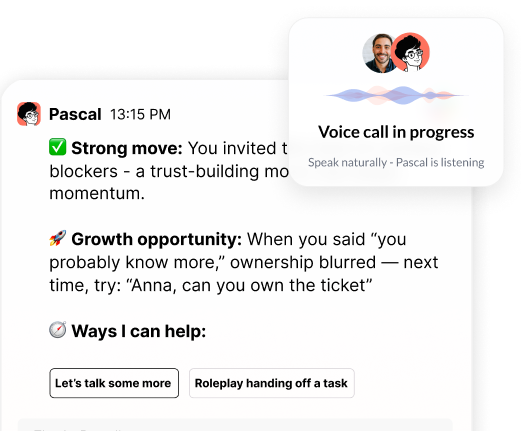
Context-aware platforms access performance reviews, 360 feedback, meeting transcripts, and career aspirations to understand both the manager and the employee involved in a conversation. Rather than generic advice like "be direct but supportive," contextual coaching provides specific language: "When you said 'you probably know more,' ownership blurred. Next time, try: 'Anna, can you own the ticket?'" This guidance reflects that specific employee's communication style, their recent performance, and the organizational context where the conversation happens.
Managers receive guidance calibrated to their communication style, team culture, and organizational values, not one-size-fits-all best practices. Real-time feedback after actual meetings helps managers reflect on what worked and what to adjust next time, creating a feedback loop that drives behavior change far beyond what annual training programs achieve.
Coaching that waits for managers to ask for help rarely drives lasting change. Proactive AI coaches identify moments when guidance would help and surface it automatically, creating consistent development habits rather than crisis-only support.
Pascal joins meetings, analyzes team dynamics, and delivers feedback immediately after interactions while context is fresh. Proactive nudges after challenging conversations help managers reflect and adjust their approach for next time. Consistent weekly check-ins and goal tracking create habits that traditional quarterly coaching misses. 83% of direct reports report measurable improvement in their managers when those managers engage regularly with purpose-built AI coaching.
The engagement data tells the story. 94% monthly retention rate and 2.3 average coaching sessions per week demonstrate sustained engagement that drives actual behavior change. This frequency of interaction builds the consistent practice that transforms knowledge into changed behavior, something episodic training programs can never achieve.
AI coaching handles 90% of routine feedback and conversation preparation. The remaining 10%—situations requiring legal awareness, deep emotional complexity, or organizational context—requires human expertise. The best organizations build clear protocols for when to escalate rather than treating escalation as a failure.
Routine feedback, delegation challenges, career development conversations, and communication skill-building are ideal for AI coaching. Performance issues with legal implications, harassment concerns, and complex interpersonal dynamics involving power imbalances require human HR involvement. Clear decision frameworks help managers understand which conversations benefit from AI coaching and which need escalation, building trust in the system rather than creating friction.
When conversations touch terminations, harassment, or medical issues, AI coaching escalates to HR while helping managers prepare for those conversations appropriately. This human-in-the-loop design protects organizations from the scenario where managers receive dangerous guidance without HR oversight, while still providing support for the preparation work that makes those difficult conversations more effective.
Traditional coaching delivers expert guidance episodically through scheduled sessions; AI coaching provides consistent, contextual support integrated into daily work. A 2025 meta-analysis of 41 studies (n=4,813) found no statistically significant differences in learning outcomes between AI-generated feedback and human-provided feedback (Hedge's g = 0.25, CI [−0.11; 0.60]), but AI excels at scalability, timing, and proactive engagement, while humans maintain advantage in emotional complexity and judgment calls.
AI-powered assessment tools deliver feedback 10 times faster than traditional methods, enabling micro-assessments for timely interventions. A June 2025 peer-reviewed RCT showed AI tutors outperformed traditional in-class learning with effect sizes of 0.73–1.3 standard deviations; AI group median time on task was 49 minutes vs. 60 minutes for in-class. The most effective implementations treat AI coaching as augmentation to human expertise, not replacement. Managers use AI for skill development and real-time guidance, while HR professionals focus on complex situations requiring judgment.
| Coaching Type | Timing | Context Awareness | Scalability | Cost |
|---|---|---|---|---|
| Human Coaching | Episodic (bi-weekly) | Session-dependent | Limited to executives | $300-500/hour |
| AI Coaching | Just-in-time (daily) | Integrated data | Every manager | $50-150/user/month |
| Hybrid Model | Continuous + episodic | Both layers | Tiered by role | $100-300/user/month |
Implementation success depends on change management, integration into existing workflows, and clear communication about how AI coaching complements existing programs. Organizations should start with specific use cases where AI provides obvious value, measure both adoption and behavioral outcomes, and iterate based on real feedback.
Start with a specific high-value task like "preparing for one-on-ones" or "practicing difficult feedback conversations" rather than attempting organization-wide launches without testing. Invest in change management before rolling out technology; communicate clearly about data practices, provide hands-on training, and create feedback channels where employees can voice concerns. Measure leading indicators like coaching session frequency and lagging indicators like manager effectiveness scores to track whether behavior change translates to team impact.
Integration into daily workflow eliminates friction; platforms that require managers to log into separate applications see dramatically lower engagement than those meeting managers in Slack, Teams, or meeting tools. Pascal integrates directly into the communication tools managers already use, delivering guidance within the flow of work rather than as another task competing for attention.
"It makes it easier not to make mistakes. And it gives you frameworks to think through problems before you act."
Pascal, Pinnacle's AI coach, meets your managers in the moment—before meetings, during conflicts, when stakes are highest—with personalized guidance grounded in their actual team dynamics and company culture. Rather than generic talking points, managers get specific language calibrated to each relationship, practice opportunities to build confidence through roleplay, and real-time feedback after actual conversations to drive continuous improvement. Book a demo to see how Pascal transforms feedback conversations into genuine learning moments that stick.

.png)
.webp)
“Thank you for setting the great foundation for my promotion; now I have a plan!"

Curious to see how AI Coaching can 10X the impact and scale of your development initiatives. Book a demo today for: