

Managers at headquarters get weekly workshops, executive access, and same-day HR support. Managers in satellite offices get quarterly webinars and three-day email response times. This gap creates inconsistent management quality across distributed teams. AI coaching platforms close this gap by delivering the same frameworks and feedback to every manager, regardless of location, removing the human resource constraint: one HRBP can't be in Austin and Singapore simultaneously, but an AI system can.
Key Takeaways:
• Development resources concentrate at headquarters, leaving satellite offices with generic training that shows 12% completion rates
• AI coaching delivers identical frameworks to every manager, 24/7, through existing tools like Slack and Teams
• The technology handles routine scenarios (performance conversations, delegation, goal setting) while complex cases requiring human judgment still need HRBP support
• Organizations should measure variance reduction in manager effectiveness scores across locations, not just adoption rates
AI coaching works for standardizable management scenarios. It fails when situations require deep organizational context, political navigation, or emotional intelligence from years of experience.
Situations requiring human coaches:
• Layoffs and restructuring conversations
• Executive-level stakeholder management
• Cultural conflicts requiring nuanced understanding of team relationships
• Mental health concerns needing professional counseling
• Legal gray areas where wrong guidance creates liability
Privacy concerns in distributed environments require SOC2 compliance and clear data governance. Managers need to understand what data the system collects and how it's used. Over-reliance on AI can atrophy managers' judgment if they default to the system instead of developing their own thinking.
Development resources concentrate at headquarters. Training budgets, executive coaching, and HR headcount cluster where senior leadership sits. Satellite offices get webinar recordings and generic eLearning.
One HRBP covering three states can't match the support of dedicated HR teams at headquarters. West Coast managers miss East Coast workshops. APAC teams work asynchronously, disconnected from real-time guidance. DDI's 2023 Global Leadership Forecast (https://www.ddiworld.com/global-leadership-forecast) found only 48% of organizations report consistent leadership quality across locations, with distributed teams showing 30% lower manager effectiveness scores than headquarters-based teams.
The financial impact compounds over time. Employee turnover rates in satellite offices run 15-25% higher than headquarters locations. Exit interviews reveal that employees in remote locations cite lack of manager support and unclear expectations as primary departure reasons. At a replacement cost of $75,000 per employee (recruiting, onboarding, lost productivity), a mid-sized company with 60% of employees in satellite offices faces millions in geography-driven turnover costs annually.
AI platforms deliver the same coaching logic to every manager, 24/7, regardless of geography. The system integrates into existing tools (Slack, Teams, Zoom) and provides guidance based on consistent frameworks—structured approaches like Situational Leadership or Radical Candor that define how managers should handle common scenarios.
Human coaches vary in quality, availability, and approach. AI systems don't. Once the platform learns specific frameworks and organizational competencies, it applies identical logic whether the manager is in headquarters or a home office.
This solves three problems traditional training can't:
Timing: Managers attend a workshop on difficult conversations, then face an actual difficult conversation three months later with zero recall. The Ebbinghaus forgetting curve (https://www.ncbi.nlm.nih.gov/pmc/articles/PMC4492928/) shows people forget 70% of training content within 48 hours without reinforcement. AI coaching delivers frameworks at the exact moment managers need them, in the context of their specific situation.
Access: Real-time availability replaces waiting for HRBP callbacks or time zone alignment. A first-time manager in Austin at 4pm Friday gets the same quality guidance as a senior leader in Singapore at 9am Monday.
Scale: Traditional coaching costs $5,000-15,000 per manager annually and requires human headcount that doesn't scale. AI coaching reaches unlimited managers at a fraction of the cost.
Organizations define their management competencies using models like Situational Leadership, Radical Candor, or proprietary frameworks developed internally. The AI system learns these specific frameworks—the language, principles, and application guidance that reflect the organization's management philosophy. When a manager in Tokyo asks about delegating a project, they receive guidance based on the same framework a manager in Chicago would receive, using identical principles and terminology.
The system doesn't just retrieve static articles. It applies frameworks to the manager's specific situation. A manager preparing for a performance conversation provides context: the employee's tenure, performance history, specific issues, and desired outcomes. The system processes this information and generates guidance tailored to the situation while maintaining framework consistency.
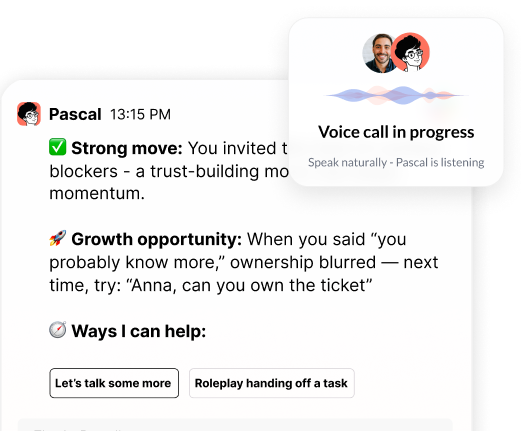
Managers interact with AI coaching through Slack messages, Teams chats, or email rather than logging into a separate platform. This removes friction and enables just-in-time support. A manager can request guidance during the 15 minutes between meetings, receive structured coaching, and apply it immediately in their next conversation.
A first-time manager in Austin needs to deliver critical feedback to an underperforming team member. She messages the system: "I need to talk to Jordan about missing deadlines. He's been here 18 months and this is the third project he's delivered late. How do I approach this?" The system responds with a structured framework: prepare specific examples, focus on impact rather than intent, collaborate on solutions, and document the conversation. It provides question templates, helps her anticipate responses, and offers guidance on tone and setting.
Simultaneously, a manager in Singapore faces a similar situation with different details. He asks: "My team member keeps delivering work that needs significant revision. How do I address quality issues without demotivating her?" The system applies the same feedback framework but adapts the guidance to quality concerns rather than timeliness, maintains the same structural approach, and ensures both managers receive coaching rooted in identical principles.
After a manager receives coaching on a topic, the system follows up days or weeks later with reinforcement questions, scenario practice, or reflection prompts. This distributed practice improves retention. Research on spaced repetition (https://www.gwern.net/Spaced-repetition) shows retention rates improve from 30% with one-time training to 70-80% with spaced reinforcement.
The consistency extends beyond individual coaching moments. Both managers receive follow-up support: preparation help before the conversation, real-time guidance if they need it during the discussion, and debrief support afterward to reflect on what worked and what to adjust next time.
Successful AI coaching implementation requires clear boundaries that define when human intervention becomes necessary. Organizations should establish escalation protocols that automatically route certain topics to human HRBPs or coaches.
References to discrimination, harassment, mental health crises, suicidal ideation, violence, or legal violations should immediately escalate to human support. The system should recognize these triggers across various phrasings and cultural expressions to ensure no critical situations slip through automated responses.
Complexity thresholds help identify situations beyond AI capability. When conversations involve multiple stakeholders with competing interests, long-standing interpersonal conflicts with extensive history, or situations where the manager expresses high uncertainty or emotional distress, human coaches provide better support.
Manager discretion always remains paramount. Every AI coaching interaction should include clear options for managers to request human support. Some managers prefer human coaching for all significant situations; others use AI coaching extensively and rarely escalate. Both approaches are valid.
Track consistency, not just usage. Standard metrics (adoption rates, session counts) miss the point. The goal is reducing quality variance across locations.
| Metric | What to Measure | Why It Matters |
|---|---|---|
| Manager effectiveness scores by location | Variance reduction, not just average improvement | Shows whether quality gaps between locations are closing |
| Time to first coaching interaction by office | Should be identical across geographies | Indicates equal access regardless of location |
| HRBP capacity freed up | Hours saved on routine questions | Demonstrates efficiency gains and resource reallocation |
| Direct report feedback on manager improvement | Compare across locations | Validates that coaching translates to behavior change |
| Employee retention rates by location | Variance should narrow | Measures business impact of consistent management quality |
One tech company with 12 offices across 8 time zones reduced manager effectiveness variance from 34% to 11% within six months of implementing AI coaching. One professional services firm saved 150+ HRBP hours per quarter by routing routine questions to AI first, allowing three HR people to support 800 employees across 6 offices.
Leading indicators help identify problems before they impact outcomes. If managers in a particular location show low engagement with AI coaching, HR can investigate barriers (technical issues, language concerns, or cultural resistance) before those barriers affect manager effectiveness scores.
| Approach | Traditional Coaching | AI Coaching |
|---|---|---|
| Availability | Limited by time zones, HRBP schedules, and geographic proximity | 24/7 access regardless of location or time zone |
| Consistency | Varies by coach quality, experience, and personal approach | Identical frameworks and logic applied to every manager |
| Timing | Scheduled sessions weeks after training, disconnected from real situations | Just-in-time guidance delivered at moment of need |
| Scale | Limited by human headcount; typically reaches only senior leaders | Unlimited reach across all management levels |
| Cost | $5,000-15,000 per manager annually | Fraction of traditional coaching cost with broader reach |
| Best for | Complex situations requiring deep context, political navigation, emotional intelligence | Standardizable scenarios like performance conversations, delegation, goal setting |
Budget considerations shift from per-person to per-organization. AI coaching replaces underutilized LMS platforms or unfilled HRBP positions. The ROI calculation: reach every manager for less than the cost of coaching 10 senior leaders.
Direct cost replacement includes eliminated or reduced expenses. Organizations might reduce external coaching contracts, decrease travel budgets for centralized training, or avoid hiring additional HRBPs to support growing distributed teams. A company spending $300,000 annually on executive coaching for 20 leaders might redirect $200,000 of that budget to AI coaching that reaches 200 managers—10x the reach at two-thirds the cost.
Indirect cost avoidance captures expenses prevented through better management. Improved manager effectiveness reduces turnover, and each prevented departure saves recruitment, onboarding, and productivity ramp costs. If AI coaching reduces satellite office turnover by 5 percentage points across 600 employees, that prevents 30 departures annually. At $75,000 per replacement, the avoided cost totals $2.25 million.
Ready to create consistent management quality across your distributed teams? Contact Pinnacle (https://www.pinnacle.us.com/contact) to learn how AI coaching can standardize development at scale while freeing your HR team to focus on complex, high-value work.
Header photo by Sable Flow on Unsplash

.png)
.webp)
“Thank you for setting the great foundation for my promotion; now I have a plan!"

Curious to see how AI Coaching can 10X the impact and scale of your development initiatives. Book a demo today for: