

A manager in your Singapore office handles a performance conversation one way. A manager in Austin handles it differently. A manager in London uses a third approach. Each learned from different trainers, different coaches, different local HR teams. Your company values say one thing. Your managers do twelve different things.
This variance costs you. Distributed teams experience 23% higher attrition when manager quality varies between sites (Gallup, 2023). High performers hesitate to transfer to locations known for weaker management. Strategic initiatives that work at headquarters fail to scale because managers lack common frameworks.
The traditional solutions don't work. In-person training varies by instructor quality and location budget. LMS platforms achieve scale but suffer single-digit engagement rates. Human coaching delivers deep personalization at $3,000-$15,000 per person annually, creating access inequality between headquarters and regional offices. Standardized playbooks sit unread. Train-the-trainer programs create new variance as each trainer adapts the material.
AI coaching offers a different approach: identical frameworks delivered to every manager, embedded in tools they already use, available 24/7 without scheduling across time zones. But only when implemented correctly.
AI coaching creates consistency only when trained on your organization's specific competencies, values, and leadership frameworks. Generic coaching advice increases variance because each manager interprets it through their own local context.
Here's how it works. You upload your competency models, training materials, and leadership principles. The AI learns how your company defines effective leadership. A manager in Tokyo receives feedback on a difficult conversation using the same framework, language, and values as a manager in London.
Without company-specific training, AI coaching becomes another source of inconsistency. A manager asks, "How do I handle an underperformer?" Generic AI provides broad leadership advice that each manager filters through personal interpretation. Customized AI grounds the answer in your organization's performance management framework, using your language, referencing your competencies.
The difference shows up in adoption. Organizations using customized AI coaching report 2.3 times higher engagement than those using generic tools (Bersin by Deloitte, 2024).
Consistency doesn't mean identical responses. A first-time manager in a satellite office needs more scaffolding on feedback conversations than a senior leader at headquarters. The coaching logic stays identical (both develop toward the same leadership model), but the delivery adjusts to experience level and context.
This happens through what engineers call a knowledge graph: a system tracking every manager's interactions, team dynamics, and development goals. The AI adapts its communication style and level of detail while maintaining fixed company frameworks.
Traditional training can't do this. Personalization in classroom settings means different content for different locations, creating fragmentation. Recorded sessions offer consistency but zero personalization. AI coaching threads the needle.
The most common failure mode is headquarters-centric rollout treating distributed locations as afterthoughts.
Effective implementations involve managers from all locations in the pilot phase. Test with managers in headquarters and satellite offices simultaneously. Gather feedback on what works in different contexts. Assign champions at each site who understand local context and can drive adoption.
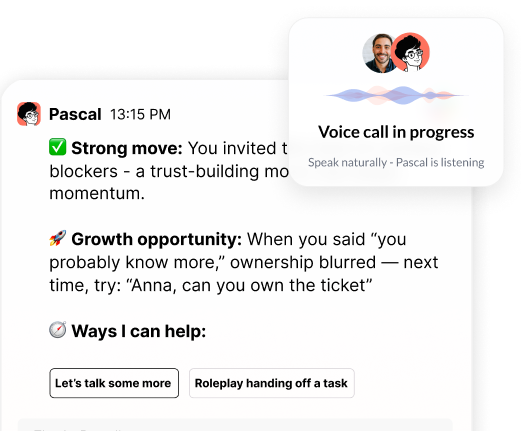
Integration matters more than features. Embed coaching in Slack, Teams, and Zoom. Eliminate the adoption barrier of remembering to use a separate platform. The best systems join meetings, provide real-time feedback, and surface relevant guidance when managers need it.
Monitor adoption data by location weekly. Track engagement depth (are managers asking substantive questions or just completing required modules?), skill development by competency, and behavior change (are managers implementing what they learn?). Address lagging sites immediately.
A 500-person life sciences company with labs in Boston, San Diego, and Research Triangle Park piloted this approach. They trained AI coaching on their competency model and embedded it in Slack. Within six months, manager Net Promoter Score increased 20 points across all locations. The CHRO reported measurable improvement in cross-site collaboration as managers adopted a common leadership language.
AI coaching platforms must recognize when conversations move into territory requiring human HR expertise. Without guardrails, managers in remote locations might receive AI guidance on situations needing legal review or HR business partner involvement.
Enterprise-grade platforms include moderation flags and escalation protocols. Sensitive topic detection identifies when conversations involve performance improvement plans, employee relations issues, or legal matters. Automatic escalation routes these situations to human HR support.
These guardrails ensure AI coaching enhances rather than replaces human judgment on matters requiring expertise. They also address the privacy concerns that kill adoption. SOC2-compliant platforms never use customer data to train models. Organization-specific controls allow HR teams to define which topics require human involvement based on company policy and local law.
AI coaching won't fix broken management systems. If your competency models are vague, your AI coaching will be vague. If your leadership principles contradict each other, your AI coaching will surface those contradictions.
But if you have clear frameworks that aren't reaching managers in satellite offices, AI coaching solves a real problem. It costs $30-$100 per manager annually (1% of traditional coaching) while maintaining 24/7 availability across all time zones.
The manager in Singapore gets the same guidance as the manager in Austin, grounded in your company's specific competencies and values. No instructor variance. No budget-driven quality gaps. No scheduling across time zones.
That's how AI coaching creates consistent management quality across locations.
• Management quality variance costs you 23% higher attrition in distributed teams and breaks down talent mobility between locations
• AI coaching creates consistency by delivering identical frameworks trained on your specific competencies, not generic leadership advice each manager interprets differently
• Customization drives consistency (the paradox: only company-specific training eliminates variance)
• Implementation determines outcomes: pilot with multiple geographies simultaneously, embed in existing tools, monitor adoption data by location weekly
• Guardrails must escalate sensitive topics (performance improvement plans, employee relations, legal matters) to human HR support
Pascal delivers coaching trained on your organization's specific competencies and values, embedded in Slack, Teams, and Zoom. Every manager receives the same development support, whether at headquarters or in your smallest satellite office. See how Pascal works.
Header photo by Vitaly Gariev on Unsplash

.png)
.webp)
“Thank you for setting the great foundation for my promotion; now I have a plan!"

Curious to see how AI Coaching can 10X the impact and scale of your development initiatives. Book a demo today for: