

A manager in Austin gets stuck on a difficult performance conversation at 4pm. Her HRBP is in New York, already offline. She delays the conversation until tomorrow, then the next day, then next week. By the time she acts, the problem has metastasized.
Her counterpart at headquarters walks down the hall and gets immediate guidance from a senior leader. Same company, same role, different outcomes.
AI coaching closes this gap by delivering the same expert guidance to every manager, regardless of location or time zone.
Development resources concentrate at headquarters. Executive coaches, senior HR business partners, and training facilitators work from HQ. Time zones exclude remote managers from live training. Mid-sized companies (200–4,000 employees) typically staff 1 HRBP per 100–150 employees at headquarters versus 1 per 200+ at satellite offices.
This 33% resource gap creates measurable disparities. Satellite office managers delay critical conversations because they lack immediate support. They interpret policies inconsistently because they can't quickly verify guidance. They take longer to reach effectiveness because they miss the informal mentoring that happens at headquarters.
The impact compounds. A first-time manager who handles a performance conversation poorly creates engagement risk, potential legal exposure, and team performance damage. Multiply this across dozens of satellite managers and the cost becomes material.
AI coaching platforms learn your organization's competency frameworks, values, and leadership principles. When you upload these materials, the platform references them to provide guidance. A manager in Tokyo receives feedback based on the same frameworks as a manager in New York.
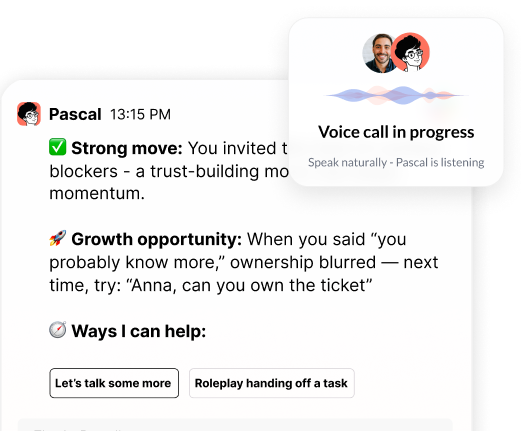
The mechanism: A manager opens Slack and types "I need to give difficult feedback to Sarah about missing deadlines." The AI references your competency framework for "gives clear feedback," your values around directness and respect, and your policy on performance conversations. It drafts feedback aligned with these standards, explains why each element matters, and offers to role-play the conversation.
The same manager in your London office asks the same question and gets guidance based on identical frameworks. The tone might adjust (more formal in London, more casual in Austin), but the coaching logic stays consistent.
When you update a competency model or policy, every manager gets the new guidance immediately. No waiting for training cycles or cascading communications.
The AI integrates into Slack, Teams, and Zoom. Managers get guidance in the tools they already use, without opening a separate platform. In meetings, it observes conversations and provides feedback afterward. In Slack, it answers questions in real-time. The barrier to access drops to zero.
AI coaching addresses three critical failure points that create management quality disparities across locations:
Data Breakdown:
• Problem: Delayed access to guidance | Impact: Satellite office managers wait hours or days for HRBP support. Critical conversations get postponed. Team performance suffers. | AI Coaching Solution: Provides immediate guidance before, during, and after conversations—regardless of time zone or HRBP availability.
• Problem: Inconsistent policy interpretation | Impact: A performance improvement plan written in Boston looks different from one written in Denver because managers interpret policies through different lenses. | AI Coaching Solution: Delivers templated guidance aligned with organizational standards, creating uniform application across all locations.
• Problem: Uneven onboarding | Impact: New managers at headquarters receive informal mentoring from senior leaders. Remote managers don't. They take longer to reach effectiveness and make more early-tenure mistakes. | AI Coaching Solution: Provides structured onboarding support to every new manager, regardless of proximity to headquarters.
Track three metrics: manager behavior uniformity across locations, time-to-competency for new managers, and direct report satisfaction parity.
Manager behavior uniformity measures how consistently managers apply your competency models and leadership principles. Survey direct reports using identical questions across all locations: "My manager gives clear, actionable feedback" (1-5 scale). Calculate the standard deviation between locations. Lower deviation indicates higher consistency.
Time-to-competency reveals onboarding effectiveness. Measure how long new managers in different locations take to complete their first successful difficult conversation, first effective 1:1, and first performance review. Compare satellite offices to headquarters.
Direct report satisfaction parity indicates perceived fairness. Survey direct reports on manager effectiveness using identical questions across all locations. Calculate the standard deviation between locations. A company with strong consistency might see standard deviation of 0.3 points on a 5-point scale. A company with geographic disparities might see 0.8 points.
Start with your highest-variance locations. Identify offices with the largest gap in manager effectiveness scores compared to headquarters. Deploy AI coaching there first with explicit messaging that you're closing the development gap.
Embed into existing workflows. Integrate AI coaching into Slack, Teams, or Zoom—wherever managers already work. Managers adopt tools they don't have to remember to open.
Create location-specific champions. Identify 2–3 respected managers at each location who will openly share how they use AI coaching. Have them demonstrate in team meetings and share specific examples in Slack. This normalizes asking the AI coach for help.
Share location-level consistency metrics monthly. Celebrate locations showing improvement. Make the goal parity, not competition.
AI coaching maintains core consistency in frameworks while adapting communication style to regional context. The key is separating universal leadership principles from culturally-specific application.
Core competencies like "gives clear feedback" and "delegates effectively" apply globally. AI coaching evaluates managers against these standards uniformly.
The AI adjusts tone and formality based on regional preferences while maintaining the same coaching logic. A manager in Tokyo might receive more formal, context-rich guidance. A manager in San Francisco gets more direct, action-oriented coaching. Both address the same competency gap.
The AI uses region-appropriate examples. A manager in London receives scenarios involving UK employment law. A manager in Singapore sees examples relevant to their regulatory environment. The underlying principle being taught remains identical.
AI coaching handles routine guidance: preparing for 1:1s, drafting feedback, practicing difficult conversations, applying company frameworks. This frees HRBPs from repetitive questions.
Career transitions, serious performance issues, interpersonal conflicts, and leadership crises require human judgment. AI coaching platforms flag sensitive topics and route managers to human support when appropriate.
The AI surfaces patterns across managers—common challenges, skill gaps, cultural issues. HRBPs use these insights to design targeted interventions, update policies, and coach senior leaders. The AI provides the data. Humans provide the strategy.
• Geographic resource concentration creates a 33% HRBP staffing gap between headquarters and satellite offices, causing measurable management quality disparities that damage remote team performance.
• AI coaching delivers identical frameworks and feedback criteria to every manager globally by learning your competency models, values, and policies, then referencing them to provide guidance.
• The platform solves three failure points: delayed guidance access during critical moments, inconsistent policy application across locations, and uneven onboarding support for new managers.
• Fastest consistency gains come from starting with high-variance locations, embedding AI coaching into existing workflows like Slack and Teams, and creating location-specific champions who model adoption.
• AI coaching handles routine guidance while human HRBPs focus on complex situations, creating a division of labor that scales expertise without replacing human judgment.
Ready to create consistent management quality across all your locations? See how Pascal works inside Slack, Teams, and your existing tools to deliver the same expert coaching to every manager, everywhere: https://www.heypinnacle.com/product
Header photo by Annie Spratt on Unsplash

.png)
.webp)
“Thank you for setting the great foundation for my promotion; now I have a plan!"

Curious to see how AI Coaching can 10X the impact and scale of your development initiatives. Book a demo today for: