

AI coaching provides scalable, real-time support for everyday management challenges while human coaches focus on transformational growth and complex leadership development. Together, they create continuous development where AI handles high-frequency coaching moments and human experts address strategic, high-stakes situations.
AI coaching provides on-demand guidance for managers navigating daily leadership challenges (difficult conversations, delegation decisions, team dynamics) while human coaches focus on deeper work like career transitions, executive presence, and strategic leadership development. AI coaching scales coaching principles by making them accessible 24/7. Human coaches handle nuanced, high-stakes situations that require empathy, accountability, and relationship depth.
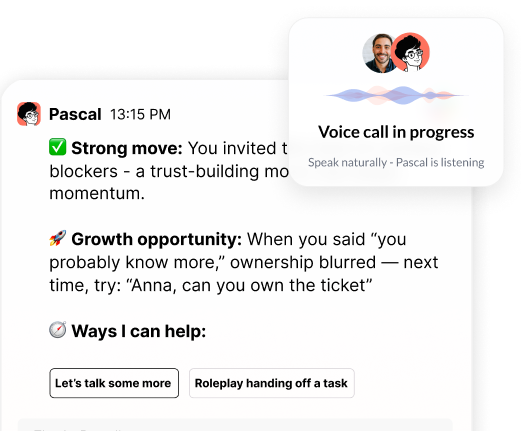
AI coaching platforms attend meetings, provide real-time feedback, and offer guidance in Slack or Teams. Human coaches remain essential for senior leaders, career pivots, and situations requiring emotional holding space. According to Training Magazine's 2025 survey, 58% of L&D professionals believe AI enhances leadership training through adaptive content and 24/7 availability.
What AI Coaching Handles vs. What Human Coaches Handle Best:
Data Breakdown:
• AI Coaching Excels At: Real-time meeting feedback | Human Coaches Excel At: Career transitions and pivots
• AI Coaching Excels At: Daily feedback conversations | Human Coaches Excel At: Executive presence development
• AI Coaching Excels At: Delegation frameworks | Human Coaches Excel At: Complex political navigation
• AI Coaching Excels At: Consistent application of principles | Human Coaches Excel At: Emotional holding space
• AI Coaching Excels At: Scaling to all managers | Human Coaches Excel At: Transformational breakthroughs
• AI Coaching Excels At: 24/7 availability | Human Coaches Excel At: Strategic accountability
AI coaching addresses three gaps: timing (coaching happens when managers need it, not weeks later), scale (every manager gets support, not just executives), and application (guidance is tied to work situations, not theoretical scenarios). Traditional L&D programs deliver content in classrooms or LMS platforms with low utilization rates. Human coaching is cost-prohibitive to extend beyond senior leaders.
Managers forget 70% of training content within 24 hours without application, according to Groowise research. AI coaching integrated into workflows (Slack, Teams, Zoom) eliminates the need to access a separate platform. This provides "just-in-time" support that prevents mistakes before they happen.
The gap isn't just access—it's application. Managers attend a two-day leadership workshop, return to their desks, and face a difficult conversation that afternoon. The frameworks from the workshop are already fading. AI coaching surfaces the right framework at the right moment.
Companies should use both, allocating human coaching to high-value, transformational situations while deploying AI coaching for continuous development across all management levels. Organizations aren't choosing between human and AI coaching—they're extending capabilities. HR leaders provide AI coaching to all managers while reserving human coaching for executives and high-potential leaders.
Human coaching excels at holding accountability, navigating complex political dynamics, career transitions, and creating transformational breakthroughs. AI coaching excels at real-time feedback, consistent application of frameworks, scaling coaching principles, and reinforcing training content.
Traditional executive coaching costs $15,000+ per person annually and serves only the top tier. AI coaching costs less and serves everyone. Organizations can maintain their investment in human coaching for senior leaders while democratizing access to coaching principles across the management population.
AI coaching transforms L&D programs from one-time events into continuous learning by reinforcing training content in work situations, providing practice opportunities, and surfacing insights about where training sticks. Instead of replacing L&D programs, AI coaching closes the application gap between classroom learning and on-the-job performance.
AI coaching can be customized with company-specific frameworks, values, and training content. This ensures managers apply what they've learned in leadership programs. AI coaching provides L&D teams with aggregated, anonymized insights showing which competencies managers struggle with most, informing future program design. This creates a feedback loop that traditional training lacks.
The shift isn't just about engagement metrics—it's about behavior change. Organizations need to measure whether direct reports notice improvement, not just whether managers completed modules.
CHROs should evaluate three factors: contextual awareness (does the AI understand your culture and competencies?), privacy architecture (is data protected and never used for model training?), and integration depth (does it work in existing tools or require behavior change?). The most successful implementations treat AI coaching as infrastructure (embedded in daily workflows) rather than another standalone platform managers must remember to use.
Purpose-built AI coaches trained by ICF-certified coaches (International Coaching Federation, the industry's primary credentialing body) deliver different outcomes than chatbots repurposed for coaching. Managers trust AI coaching more when it demonstrates understanding of company-specific context, not just generic leadership principles.
The integration question matters. If managers need to leave their workflow to access coaching, adoption drops. A proactive approach (joining meetings, providing real-time feedback in Slack) eliminates the friction that kills traditional learning tools.
CHROs should also consider the data insights AI coaching generates. Aggregated, anonymized patterns reveal which leadership competencies need reinforcement, which teams struggle with specific challenges, and where L&D investments should focus.
Organizations measure AI coaching ROI through three categories: efficiency gains (time saved, reduced HR support requests), behavior change (direct report feedback, manager effectiveness scores), and business impact (retention, team performance, promotion readiness). Track leading indicators (coaching engagement and framework application) alongside lagging indicators (retention and performance).
The Edge of Work Podcast research shows that organizations experimenting with AI coaching in 2025 focus on measurable behavior change, not just engagement metrics. The shift from "Did they complete the module?" to "Did their direct reports notice improvement?" represents an evolution in how L&D measures success.
The ROI case strengthens when organizations compare AI coaching costs to alternatives. Replacing underutilized learning platforms, reducing spending on low-impact training programs, and extending coaching access beyond executives creates a financial argument even before measuring behavior change.
HR leaders should anticipate three challenges: manager adoption (overcoming skepticism about AI coaching), cultural fit (ensuring AI coaching aligns with organizational values), and change management (integrating AI coaching into existing development programs). The most successful implementations address these challenges through pilot programs, executive sponsorship, and clear communication about what AI coaching is and isn't.
Manager skepticism stems from experiences with chatbots or AI tools that lack context. Demonstrating that AI coaching understands their specific challenges, team dynamics, and organizational culture overcomes initial resistance. A knowledge graph approach (a system that maps relationships between people, topics, and past interactions to provide contextual understanding) creates trust that generic AI tools can't match.
Cultural fit requires customization. Organizations with strong coaching cultures adopt AI coaching faster because managers already value coaching principles. Organizations without established coaching cultures need to position AI coaching as accessible development, not surveillance. The framing matters: "Your personal leadership coach" resonates differently than "AI performance monitoring."
Change management involves integrating AI coaching into existing rhythms (leadership development programs, onboarding, performance cycles). Standalone tools fail. Embedded tools succeed. HR leaders should identify specific use cases where AI coaching solves immediate pain points, then expand from there.
• AI coaching and human coaching create a development system where AI handles high-frequency, scalable support while human coaches focus on transformational growth and complex leadership challenges.
• The three gaps AI coaching fills are timing (real-time support), scale (access for all managers), and application (guidance tied to work situations, not theoretical scenarios).
• Organizations should deploy AI coaching to all managers while reserving human coaching for executives and high-potential leaders, creating a hybrid approach that maximizes both reach and impact.
• AI coaching transforms L&D programs from one-time events into continuous learning by reinforcing training content in work situations and providing data-driven insights about competency gaps.
• Successful implementations require evaluating contextual awareness, privacy architecture, and integration depth (treating AI coaching as embedded infrastructure rather than another standalone platform).
Pascal by Pinnacle delivers AI coaching where your managers already work (in Slack, Teams, and meetings). Purpose-built by ICF-certified coaches and trusted by enterprise HR leaders, Pascal makes coaching accessible to every manager, not just executives. Learn more about Pascal or schedule a demo to see how AI coaching complements your existing development programs.
Header photo by Amy Hirschi on Unsplash

.png)
.webp)
“Thank you for setting the great foundation for my promotion; now I have a plan!"

Curious to see how AI Coaching can 10X the impact and scale of your development initiatives. Book a demo today for: