

AI coaching builds fluency by embedding guidance into daily work, enabling practice with immediate feedback, and creating safe spaces to experiment. This transforms abstract concepts into applied skills managers use in real situations.
The problem: While AI tools proliferate across organizations, most managers can't use them effectively. They attend training, understand the concepts, then return to work and freeze when facing real decisions. Knowledge doesn't become action.
The solution: AI coaching closes this gap by providing guidance at the moment of application, not just the moment of learning. When a manager faces a decision that AI could inform, the system recognizes the pattern and surfaces relevant guidance in real time.
AI fluency is the ability to recognize when and how to use AI effectively, interpret outputs critically, and make sound decisions based on AI-generated insights. This differs from AI literacy (knowing what AI is). Fluency means knowing when to use it, how to prompt effectively, and when to override recommendations.
The fluency gap is widening. While AI tools spread across organizations, managers struggle to apply them. This creates risk: managers deploy tools they don't understand, teams resist adoption, and organizations fail to capture ROI.
Manager fluency creates multiplier effects. When managers understand AI capabilities, they guide teams to use tools appropriately, avoid common pitfalls, and identify high-value applications. A fluent manager can identify when a customer service issue requires AI-assisted analysis versus human empathy, craft prompts that generate actionable insights rather than generic outputs, and coach team members through their own AI learning curves.
The urgency intensifies as AI capabilities expand. New models and tools emerge monthly, each with distinct strengths and appropriate use cases. Managers need continuous fluency development that evolves alongside the technology itself. Static knowledge becomes obsolete quickly.
AI coaching builds fluency through contextual integration, personalized scaffolding, and safe experimentation.
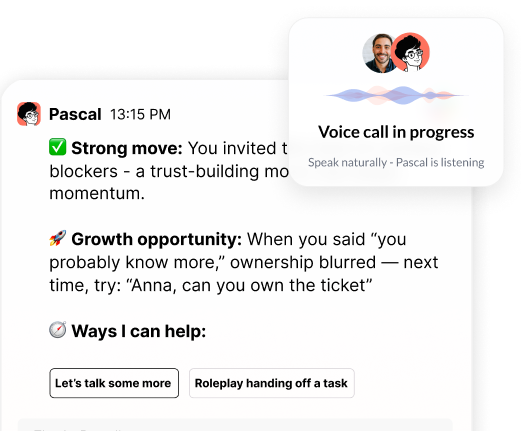
Contextual integration means the coaching system observes actual work situations and surfaces relevant AI applications in real time. Pinnacle's Pascal integrates with Slack, Teams, Zoom, and Google Meet, joining conversations where managers already spend their time. When a manager faces a decision that AI could inform, the system recognizes the pattern and suggests appropriate tools or approaches.
When a manager discusses quarterly planning in a Slack channel, the AI coaching system might recognize this as an opportunity to use predictive analytics tools. Rather than waiting for the manager to remember training from weeks ago, the system provides immediate guidance: "This planning conversation could benefit from trend analysis. Would you like help structuring a prompt for forecasting based on last quarter's data?"
The integration extends beyond simple reminders. The system learns organizational context, understanding which AI tools the company has licensed, which data sources are available, and which use cases align with company policies. A manager at a healthcare company receives different AI suggestions than one at a retail organization, even when facing structurally similar decisions.
Personalized scaffolding adapts to each manager's context and skill level. The platform builds a knowledge graph of interactions, communication patterns, and development areas, then tailors guidance accordingly. A new manager learning to delegate receives different support than a senior leader navigating hybrid human-AI team structures.
The scaffolding adjusts intensity based on manager readiness. Early in the fluency journey, the system provides detailed step-by-step guidance for each AI application. As competence grows, it shifts to lighter-touch prompts that encourage independent problem-solving. Eventually, it functions primarily as a safety net, intervening only when managers face novel situations or potential misapplications.
Safe experimentation creates practice opportunities without risk. Managers can rehearse AI-assisted decision-making, receive feedback, and iterate before applying approaches with their actual teams. This functions like a flight simulator for AI usage—building confidence through repetition in a controlled environment.
The experimentation space allows managers to test different prompting strategies, compare AI outputs from various tools, and explore edge cases without consequences. A manager can practice delivering AI-generated performance feedback to a simulated employee, refining both the AI prompts and delivery approach before the actual conversation.
The system also creates scenarios that accelerate learning. It presents a manager with a realistic business situation and asks: "How would you use AI to address this?" The manager proposes an approach, the system simulates outcomes, and immediate feedback highlights what worked and what didn't. This compressed learning cycle allows managers to gain experience equivalent to months of real-world trial and error in weeks.
Traditional training front-loads information in isolation, then expects managers to remember and apply concepts weeks later when relevant situations arise. This approach ignores how adults learn complex skills: through repeated practice with immediate feedback.
AI coaching embeds learning directly into workflow. Pascal joins meetings, observes interactions, and surfaces guidance at the exact moment a manager could benefit from AI assistance. This timing transforms abstract concepts into concrete applications.
To illustrate the contrast, consider two managers attending the same AI training workshop. Manager A returns to work and relies solely on workshop materials—a slide deck and reference guide. When facing a situation where AI could help, she must remember the training, locate the relevant materials, interpret how the general concepts apply to her specific situation, and implement the approach—all while managing her regular workload. The cognitive load is high, the time delay is long, and the likelihood of successful application is low.
Manager B has AI coaching support. When the same situation arises, the coaching system recognizes the opportunity and provides contextual guidance: "This is a good use case for the sentiment analysis approach covered in last week's training. Here's how to apply it to your specific data." The cognitive load is reduced, the time to application is immediate, and the likelihood of success is higher. Manager B receives feedback on her application, reinforcing correct approaches and correcting mistakes before they become habits.
Data Breakdown:
• Dimension: Timing | AI Coaching: Guidance at moment of application | Traditional Training: Information weeks before use
• Dimension: Personalization | AI Coaching: Adaptive to individual skill levels, roles, and organizational context | Traditional Training: One-size-fits-all content
• Dimension: Practice | AI Coaching: Daily opportunities with immediate feedback | Traditional Training: Limited to training event duration
• Dimension: Scalability | AI Coaching: Every manager receives consistent guidance simultaneously | Traditional Training: Limited by facilitator availability
• Dimension: Cost | AI Coaching: Lower per-manager cost at scale; one-time platform investment | Traditional Training: High recurring costs for facilitators, venues, and time away from work
• Dimension: Retention Rates | AI Coaching: 70-80% retention through spaced repetition and application | Traditional Training: 10-20% retention after 6 weeks without reinforcement
• Dimension: Impact | AI Coaching: Measurable behavior change and skill application in daily work | Traditional Training: Knowledge gain with limited transfer to performance
The knowing-doing gap manifests in three ways that AI coaching addresses directly.
First, there's the recognition gap: managers know AI tools exist but fail to recognize situations where they'd be valuable. The coaching system bridges this by pattern-matching current situations to known use cases and alerting managers to opportunities.
Second, there's the confidence gap: managers understand conceptually how to use AI but lack confidence to apply it in high-stakes situations. The safe experimentation environment builds confidence through low-risk practice, while real-time support provides a safety net during actual application.
Third, there's the translation gap: managers grasp general AI principles but struggle to translate them into specific actions in their unique context. Personalized, contextual guidance bridges this gap by showing exactly how general principles apply to specific situations.
A manager attends training on using AI for performance management. She learns that AI can analyze communication patterns to identify team dynamics issues. Three weeks later, she notices tension in her team but doesn't connect this to the AI training. The knowing-doing gap has prevented application.
With AI coaching, the scenario unfolds differently. The coaching system observes the team's Slack communications and meeting patterns, recognizes emerging tension, and prompts the manager: "Communication patterns suggest increasing team tension. Would you like to use AI analysis to identify the root causes before your next team meeting?" The manager is guided through the analysis, interprets results with coaching support, and addresses the issue proactively. Knowledge becomes action because the gap between knowing and doing has been eliminated.
CHROs should invest in AI coaching as the primary vehicle for building AI fluency, supplemented by targeted traditional training for foundational concepts.
The optimal approach combines both methods strategically. Use traditional training to establish foundational AI concepts and organizational AI policies. Deploy AI coaching to translate those concepts into daily practice, provide ongoing reinforcement, and adapt guidance to individual contexts.
Organizations seeing the strongest results implement AI coaching as infrastructure, not a program. Rather than treating it as a training initiative with a start and end date, they embed coaching into management workflows permanently. This shifts AI fluency from a skill managers acquire once to a capability they continuously develop.
Implementation considerations for CHROs include integration with existing systems, change management, and measurement frameworks. Successful implementations integrate AI coaching with existing communication platforms (Slack, Teams, Zoom) to minimize adoption friction. They communicate the coaching as support, not surveillance, addressing privacy concerns proactively. They establish clear metrics linking coaching engagement to business outcomes.
The change management aspect deserves attention. Managers may initially resist AI coaching, viewing it as intrusive or questioning its value. Organizations that succeed frame coaching as a competitive advantage for individual managers: "This is your personal AI advisor, helping you outperform peers and advance your career." They ensure senior leaders visibly use and endorse the coaching, creating top-down cultural support.
Measurement frameworks should track multiple levels of impact. At the individual level, track coaching engagement, AI tool adoption, and manager-reported confidence. At the team level, measure productivity changes, decision quality improvements, and employee satisfaction with manager support. At the organizational level, assess overall AI ROI, competitive positioning, and innovation velocity.
Organizations should ensure AI coaching systems have appropriate guardrails, preventing them from suggesting AI applications that violate company policy, regulatory requirements, or ethical standards. The coaching should be programmed with organizational values and constraints, so guidance always aligns with company standards.
Managers increasingly expect employers to provide cutting-edge development tools. Organizations offering AI coaching signal investment in manager growth, technological sophistication, and commitment to employee success. This can differentiate employers in competitive talent markets.
• AI coaching embeds learning into daily workflows at the moment managers need guidance, closing the gap between knowing and doing
• Three mechanisms drive fluency: contextual integration that meets managers where work happens, personalized scaffolding adapted to individual skill levels, and safe experimentation spaces for risk-free practice
• Traditional training front-loads information in isolation, then expects managers to remember and apply concepts weeks later—ignoring how adults actually learn complex skills
• Organizations should invest in AI coaching as primary infrastructure for building AI fluency, supplemented by targeted traditional training for foundational concepts only
• The knowing-doing gap manifests as recognition gaps (not seeing opportunities), confidence gaps (hesitating to apply knowledge), and translation gaps (struggling to adapt general principles to specific contexts)
• Successful implementation requires integration with existing systems, proactive change management, multi-level measurement frameworks, and appropriate guardrails to ensure coaching aligns with company standards
Ready to build AI fluency across your management team? Learn how Pinnacle's Pascal integrates into your existing workflows at heypinnacle.com.
Header photo by Vitaly Gariev on Unsplash

.png)
.webp)
“Thank you for setting the great foundation for my promotion; now I have a plan!"

Curious to see how AI Coaching can 10X the impact and scale of your development initiatives. Book a demo today for: