

Measure AI coaching through three levels: adoption metrics (conversation depth, repeat usage), behavioral indicators (direct report feedback, 360 assessments), and business outcomes (retention rates, team performance). The strongest signal comes from direct reports—when 80%+ report measurable improvement in specific behaviors like actionable feedback or conflict resolution, the coaching is working.
Track three distinct levels. Adoption metrics predict sustained use. Behavioral indicators show skill development. Business outcomes justify investment.
Weekly active users mean nothing if managers don't apply what they learn. The framework must capture whether coaching translates into observable behavior change.
Adoption indicators reveal whether the tool will stick. Track conversation depth (multi-turn dialogues versus one-off questions), feature utilization (roleplay completion, meeting feedback review), and time-to-value (days until first meaningful interaction). These signals predict sustained usage beyond initial novelty.
Behavioral metrics demonstrate skill development. Direct report surveys asking "Has your manager improved at giving actionable feedback in the past 60 days?" provide the clearest signal. Pre/post 360 assessments focused on observable behaviors, Manager Net Promoter Score changes, and peer feedback on specific competencies indicate whether coaching changes how managers lead.
Business outcomes connect coaching to financial performance. Compare retention rates for teams with coached managers versus control groups. Track time-to-productivity for new managers, internal promotion rates, employee engagement scores, and reduction in HR escalations. These metrics speak the language CFOs understand.
Data Breakdown:
• Measurement Level: Adoption | Specific KPIs: Conversation depth, feature utilization, time-to-value | Frequency: Weekly | Target Benchmark: 70%+ multi-turn dialogues, under 7 days to first meaningful use
• Measurement Level: Behavior Change | Specific KPIs: Direct report improvement scores, Manager NPS, 360 shifts | Frequency: Monthly/Quarterly | Target Benchmark: 80%+ positive improvement, 15-20% NPS lift
• Measurement Level: Business Impact | Specific KPIs: Retention rates, time-to-productivity, promotion readiness | Frequency: Quarterly | Target Benchmark: 5%+ retention improvement, 30%+ faster manager ramp
AI coaching reduces turnover by making every manager more effective at the moments that matter—performance conversations, career development discussions, conflict resolution. Traditional approaches like annual engagement surveys provide low-fidelity snapshots. AI coaching delivers continuous, contextual support that prevents small frustrations from compounding into resignation decisions.
Real-time intervention catches problems before they escalate. AI coaching provides immediate feedback, identifying communication missteps before they damage relationships. Traditional coaching happens weeks after the critical moment, when the damage is done and the learning opportunity has passed.
Scalable personalization ensures every manager gets support tailored to their team's needs. Traditional programs limit coaching to executives while leaving 80% of managers unsupported. Purpose-built AI coaching reaches all managers at a fraction of the cost.
The cost comparison reveals the scalability advantage. AI coaching costs 1-5% of traditional executive coaching while reaching 100% of managers. When you calculate turnover costs at 1.5-2x salary for knowledge workers, even 5% retention improvement creates substantial ROI.
AI coaching ROI shows up in weeks through observable behavior change and direct report feedback. Traditional L&D programs struggle to demonstrate impact beyond completion rates and satisfaction scores. The measurement shift moves from "did they finish the course" to "did their team notice improvement."
Traditional L&D metrics track the wrong outcomes. Course completion rates show 90% complete but only 10% apply what they learned. Satisfaction surveys capture whether participants enjoyed the workshop, not whether they changed behavior. Time spent in platform becomes a vanity metric with no performance correlation.
AI coaching metrics focus on application and impact. Behavioral application rates track managers practicing difficult conversations through roleplay before real meetings. Direct report improvement scores show whether teams notice change. Manager effectiveness lift appears in NPS increases among engaged users.
Continuous measurement beats episodic snapshots. Traditional programs measure learning at a point in time. AI coaching tracks skill development over weeks and months as managers face real situations. When coaching provides feedback on a specific meeting and the manager's next similar meeting improves, the causal link is clear. Traditional training struggles with attribution because months pass between learning and application.
CFO-friendly data makes the business case straightforward. AI coaching provides quantifiable metrics finance teams understand: hours saved, retention rate changes, promotion readiness acceleration. Soft skills training ROI remains abstract and unconvincing to budget holders who need concrete proof of value.
Measure behavior change through direct report assessments, meeting analysis over time, and specific competency tracking—not through self-reported confidence scores. The most reliable indicator is whether the people being managed notice tangible improvement in how their manager communicates, delegates, and develops them.
Direct report surveys ask specific questions that reveal observable change. "Has your manager improved at giving actionable feedback in the past 60 days?" produces more useful data than generic engagement questions. Target 80%+ positive response rates on these targeted behavioral assessments.
Meeting quality scores track specific behaviors over time. AI coaching platforms that join meetings can measure active listening, inclusive language, and clear action items, then show improvement trajectories over weeks. This longitudinal data reveals whether coaching creates sustained behavior change or temporary performance spikes.
Roleplay completion and application create a closed feedback loop. Track whether managers practice difficult conversations through AI roleplay, then measure whether they have those conversations. Follow-up mechanisms ensure coaching translates into action.
Competency scorecards align coaching to organizational priorities. Define 5-7 critical leadership behaviors aligned to your culture, then track how managers demonstrate those behaviors in real interactions. Aggregate data shows organizational trends while protecting individual privacy. Some organizations use pre/post surveys during mandatory manager training to assess whether someone should be promoted based on demonstrated behavior change.
360 feedback shifts provide comparative data. Run lightweight 360s every 90 days focused on observable behaviors. Compare managers using AI coaching versus control groups to isolate the coaching impact from other variables.
Retention rate improvements, faster time-to-productivity for new managers, reduced HR escalations, and higher team performance scores prove ROI within 90 days. The strongest business case combines hard metrics like turnover cost savings with strategic value like manager bench strength and culture alignment.
Retention economics make the clearest financial case. Calculate turnover cost for your organization (1.5-2x salary for knowledge workers). Measure retention rate differences between teams with coached managers versus control groups. Even 5% retention improvement creates substantial ROI when you account for recruiting, onboarding, and productivity ramp costs.
HR efficiency gains create immediate operational value. AI coaching can save 100+ hours per HR business partner by handling routine manager questions. This allows HR to increase span of control from 100:1 to 150:1 or redirect capacity toward strategic initiatives like succession planning and culture transformation.
New manager acceleration reduces the costly learning curve. First-time managers take 12-18 months to become effective. AI coaching can cut this timeline by 30-40% through just-in-time guidance on delegation, feedback, and conflict resolution. Organizations can promote high performers into management roles earlier without the traditional risk of losing strong individual contributors to poor leadership transitions.
Team performance improvements show up in productivity metrics and quality scores. When managers get better at running meetings, delegating effectively, and removing blockers, their teams ship faster and with fewer defects. Track sprint velocity for engineering teams, sales quota attainment, or customer satisfaction scores to quantify this impact.
Culture alignment becomes measurable rather than aspirational. AI coaching platforms can scorecard every interaction against desired leadership behaviors, providing real-time data on how managers embody company values. This replaces low-fidelity quarterly engagement surveys with continuous cultural health monitoring.
• Measure AI coaching through three levels: adoption metrics (conversation depth, feature use), behavioral change (direct report assessments, 360 shifts), and business outcomes (retention, productivity, promotion readiness)
• Direct report improvement scores provide the clearest signal of coaching effectiveness—target 80%+ positive rates on specific behavioral questions versus self-reported confidence gains
• AI coaching ROI appears within 90 days through retention improvements and HR efficiency gains, unlike traditional L&D programs that struggle to demonstrate impact beyond completion rates
• Track specific competencies aligned to your culture rather than generic engagement scores to prove coaching changes how managers lead
• Calculate retention economics at 1.5-2x salary per knowledge worker to show how even 5% retention improvement creates substantial ROI
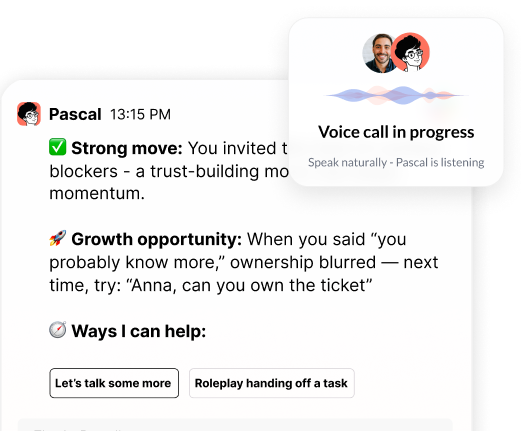
Pascal works inside Slack, Teams, and your meetings to deliver coaching at the moments that matter most. Visit heypinnacle.com to learn how purpose-built AI coaching scales manager effectiveness across your organization.

.png)
.webp)
“Thank you for setting the great foundation for my promotion; now I have a plan!"

Curious to see how AI Coaching can 10X the impact and scale of your development initiatives. Book a demo today for: