

A good AI coach demonstrates five measurable capabilities: coaching expertise built by professional coaches (not a repurposed chatbot), awareness of your people and workflows, proactive engagement that changes behavior, integration into existing tools, and guardrails for sensitive workplace topics. Generic AI tools lack the coaching foundation, organizational context, and safety mechanisms that determine whether managers use the system and improve.
Good AI coaching changes manager behavior, not just answers questions. Gallup's 2024 analysis of 100,000+ surveys found that 70% of team engagement variance comes from the manager—making manager effectiveness the highest-leverage investment an organization can make. A good AI coach improves how managers give feedback, delegate work, and navigate difficult conversations in ways their direct reports can observe and confirm.
The distinction matters. A good AI coach isn't measured by how human it sounds, but by whether managers trust it enough to use it repeatedly, whether it understands your organizational context, and whether direct reports report tangible improvement in their manager's effectiveness.
Behavioral outcomes trump conversational quality. 83% direct report improvement rates (from Pinnacle's customer data across 50+ enterprise deployments) matter more than natural language processing sophistication. Sustained engagement indicates real value—managers using the tool multiple times weekly signals utility, not novelty.
Context-awareness separates tools from solutions. Generic advice ("try active listening") fails where specific guidance ("based on your last three 1:1s with Sarah, here's how to address her concerns about project scope") succeeds. Integration determines adoption: tools requiring separate logins see 12% sustained usage; workflow-embedded solutions reach 60%+ (Gartner's 2024 Enterprise Software Adoption Report).
The AI coach must be purpose-built on coaching science, not a general-purpose language model with coaching prompts added. Pascal by Pinnacle is trained by ICF-certified coaches and grounded in established coaching frameworks (GROW model, situational leadership, emotional intelligence competencies)—a fundamental architectural difference from ChatGPT or generic AI assistants repurposed for workplace coaching.
Ask vendors: "Who built your coaching models?" If the answer is "our engineering team" rather than "professional coaches and organizational psychologists," you're evaluating a chatbot, not a coaching platform. The best AI coaches can explain which coaching methodologies inform their guidance.
Coaching credentials matter. Look for platforms developed with ICF-certified coaches or organizational psychology PhDs. Framework transparency is essential—vendors should explain which coaching methodologies inform their models. Boundary clarity separates good coaches from dangerous ones: effective coaches know when to escalate, and good AI coaches should too.
Red flags include vendors who can't articulate their coaching methodology or claim their AI "learns coaching naturally."
Context transforms generic advice into actionable guidance. An AI coach that knows your company's values, competency frameworks, career ladders, and current organizational priorities delivers fundamentally different value than one starting from zero with every conversation.
The most sophisticated AI coaches build knowledge graphs of your organization: who works with whom, what projects are active, what skills matter for advancement, and how your culture defines good leadership. (A knowledge graph is a database of relationships—think of it as a map showing how people, projects, and skills connect in your organization.) Pascal integrates performance data, real-time 360 feedback, career paths, and company context to provide guidance relevant to your managers specifically.
Integration depth matters. Calendar, email, Slack/Teams, meeting transcripts, HRIS data—each integration point adds contextual richness. Knowledge graph sophistication determines whether the AI understands relationships, projects, and organizational structure. Cultural alignment means the platform can incorporate your specific values and competency frameworks.
The privacy-performance balance is critical. Best platforms aggregate insights while protecting individual privacy. Pascal uses a knowledge graph of interactions, personalized to your values and competencies, while maintaining SOC2 Type II compliance and never training models on customer data.
Proactive AI coaching changes behavior by engaging managers before problems escalate, not just answering questions when asked. Reactive tools wait for managers to recognize they need help and formulate questions; proactive coaches observe work patterns, identify development opportunities, and initiate conversations that prevent issues.
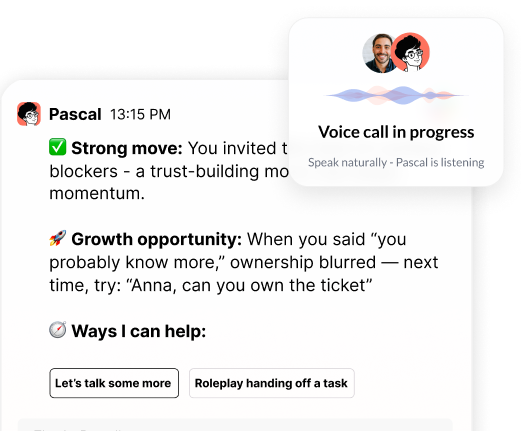
Pascal joins meetings (by accessing meeting transcripts through calendar integration), provides real-time feedback, and follows up in Slack or Teams on growth goals without waiting to be asked. This proactive engagement creates consistent habits rather than crisis-only support. After observing a manager dominating team meetings, a proactive coach might suggest: "I noticed you spoke for 18 of the 30 minutes in today's standup. Want to try a different facilitation approach tomorrow?"
Meeting observation enables in-the-moment feedback. Pattern recognition identifies recurring behaviors before they become problems. Habit formation through regular nudges creates sustained behavior change, not one-off improvements. Workflow integration delivers coaching in Slack/Teams where work happens, not separate platforms.
Effective AI coaching requires knowing when not to coach. Here's the scenario that should concern every CHRO: an employee confiding in an AI coach about feeling isolated and questioning whether she belongs. The AI offered supportive messages and coping strategies, but it never escalated to a human. Six weeks later, she resigned, citing lack of support.
Good AI coaches need moderation flags (automated detection systems that identify sensitive topics like mental health concerns, harassment, or discrimination) that route conversations to human experts, and clear boundaries about what the AI will and won't attempt to address.
Sensitive topic detection is non-negotiable. Platforms should identify mental health concerns, harassment, discrimination, and legal issues, then route them appropriately. Organization-specific controls allow you to define additional guardrails based on your culture and risk tolerance.
Anonymous aggregated insights protect individual privacy while providing organizational value. Pascal's approach includes moderation flags, sensitive topics escalation, organization-specific controls, and anonymous aggregated insights—all while maintaining SOC2 Type II compliance. Enterprise organizations should verify SOC 2 Type II certification, ISO 27001 compliance (international security standards), and GDPR readiness for European employee data.
Vendor demos showcase polished scenarios. Real evaluation requires testing edge cases that reveal whether you're buying vaporware or value. Prepare specific scenarios from your organization: a manager struggling with an underperforming team member, a first-time manager navigating delegation, a leader preparing for a difficult conversation about missed deadlines.
Watch how the AI responds to ambiguous situations. Does it ask clarifying questions or jump to generic advice? Test boundary recognition by introducing a scenario involving potential harassment. Does the system recognize when to escalate? Evaluate contextual memory by referencing earlier parts of the conversation—does the AI maintain coherence or treat each question as isolated?
Scenario testing reveals truth. Bring your actual organizational challenges, not hypothetical textbook cases. Test the AI's ability to incorporate your values and competency frameworks. Verify that the platform can explain its reasoning, not just provide answers.
Ask about the training data and coaching methodology. Request customer references who can speak to sustained adoption, not just initial enthusiasm. Verify security certifications and data handling practices. The best vendors welcome tough questions because they've built systems designed to handle real complexity.
Leading indicators predict long-term success better than lagging metrics. Track weekly active users and conversation depth (number of exchanges per session) to measure engagement. Monitor repeat usage rates—managers returning multiple times weekly signal genuine utility. Measure time-to-value: how quickly do new users find their first meaningful insight?
Behavioral outcomes matter most. Survey direct reports on whether their manager has improved in specific areas: feedback quality, delegation effectiveness, communication clarity. Track manager NPS and compare it to baseline. Monitor completion rates for performance reviews and 1:1 documentation.
Adoption metrics come first. Without sustained engagement, no behavior change occurs. Pascal customers report 83% direct report improvement rates (measured through quarterly pulse surveys of 5,000+ employees across 50+ enterprise customers), 150+ hours saved per manager annually, and 20% increases in manager NPS. These outcomes stem from high engagement: managers use Pascal multiple times weekly because it delivers value in their workflow.
Organizational metrics provide the business case. Track time-to-productivity for new managers, quality scores for performance reviews, and employee engagement survey results. The best platforms provide dashboards showing both individual adoption and organizational impact, with privacy-protected aggregated insights that reveal patterns without exposing individual data.
• Coaching expertise separates effective platforms from repurposed chatbots. Verify that ICF-certified coaches or organizational psychologists developed the coaching models, not just engineering teams.
• Contextual awareness determines whether advice is generic or actionable. The best AI coaches integrate deeply with your tools, understand your organizational structure, and personalize guidance to your values and competencies.
• Proactive engagement changes behavior. Reactive Q&A tools wait for managers to ask; proactive coaches observe patterns, provide real-time feedback, and initiate development conversations.
• Guardrails protect both employees and organizations. Sensitive topic detection, escalation protocols, and SOC2 Type II compliance are non-negotiable for enterprise deployment.
• Behavioral outcomes and sustained engagement predict success. Track direct report improvement rates, repeat usage, and time-to-value—not just conversational quality or feature lists.
The AI coaching market is crowded with vendors making bold promises. The platforms that deliver measurable value combine coaching science, organizational context, proactive engagement, workflow integration, and responsible guardrails. See how Pascal works inside Slack to deliver coaching that managers use and direct reports can observe.
Header photo by Vitaly Gariev on Unsplash

.png)
.webp)
“Thank you for setting the great foundation for my promotion; now I have a plan!"

Curious to see how AI Coaching can 10X the impact and scale of your development initiatives. Book a demo today for: