

Most AI coaching platforms are repurposed chatbots that offer generic advice. A good AI coach demonstrates five measurable qualities: coaching expertise built on professional frameworks, contextual awareness of your people and organization, proactive engagement in daily workflows, integration across your tech stack, and appropriate guardrails for sensitive workplace topics.
This creates a problem for CHROs: how do you separate legitimate coaching platforms from glorified chatbots? Here's what to look for.
The foundational difference between an effective AI coach and a chatbot is whether it was built on coaching science or trained to sound helpful. A chatbot generates encouraging words. A coach asks questions that create insight and provides specific, actionable guidance tied to observable behaviors.
According to SHRM's 2025 State of AI in HR Report, 70% of talent management executives expect managers to use AI in performance reviews, yet most platforms lack the structured coaching frameworks that drive behavior change.
Look for ICF-certified coaching methodology. Effective platforms are trained by credentialed coaches who understand developmental frameworks. The difference shows up immediately in the quality of questions asked and the specificity of feedback provided.
Test the quality of questions during demos. Good coaches ask questions that make you think differently about a situation. Chatbots ask generic questions: "How does that make you feel?" A purpose-built coach asks: "What would success look like if you approached this conversation differently?"
Evaluate the feedback structure. Purpose-built coaches provide guidance you can act on immediately: "In that meeting, you interrupted Sarah twice when she was explaining the technical constraints. Next time, try asking 'What else should I know?' before proposing solutions." Generic tools offer vague encouragement: "Great job in that meeting!"
Generic AI tools provide generic advice. A platform that doesn't understand your company values, individual employee goals, team dynamics, and actual work situations becomes a digital Magic 8-Ball.
Effective AI coaching requires four layers of contextual awareness. Organizational context means understanding your company values, leadership competencies, and cultural norms (the difference between coaching someone at a fast-moving startup versus a regulated financial institution). Individual context includes each person's role, development goals, strengths, and growth areas. Relational context covers team dynamics, reporting relationships, and interaction patterns. Situational context provides visibility into actual work situations, meetings, and communications.
Most platforms claim personalization but deliver surface-level customization. They might know your name and job title, but they don't know that you're working on delegation skills, that your team is distributed across three time zones, or that your company values direct feedback over diplomatic hedging.
The difference between generic and contextual coaching is the difference between "Try to communicate more clearly" and "In yesterday's standup, you used three acronyms that confused the new team members. Your goal is inclusive communication, so consider defining terms the first time you use them."
Ask vendors: How does your platform learn about our organization? What information does it use to personalize coaching? Can you show me examples of how coaching changes based on company culture, individual goals, and team dynamics?
The primary reason corporate learning tools fail is that people forget to use them. MIT research shows that 95% of AI projects fail to deliver expected results because they require managers to change their behavior rather than meeting them where they work.
Proactive engagement eliminates the adoption problem. Does the platform observe interactions and offer feedback without being asked? Or does it sit in a separate app waiting for you to remember to log in?
Workflow integration determines sustained use. Does it live in Slack, Teams, or Zoom where work happens? The best coaching happens at teachable moments: right after a difficult conversation, immediately following a meeting where you could have handled something differently, or when you're preparing for a high-stakes discussion.
Jeff Diana, former CHRO at Calendly, Atlassian, and SuccessFactors, puts it directly: "So much of the real learning and value comes from in-context coaching in the moment to drive performance and to solve problems in the moment."
Ask vendors: Does your platform integrate into our existing tools? Does it provide feedback proactively or only when users ask? Can you show me what a typical coaching interaction looks like in our daily workflow?
HR Executive recently highlighted a scenario where an employee confided in an AI coaching tool for six weeks about feeling isolated and questioning whether she belonged, but the AI never escalated to human support. The employee left the company. The AI kept offering coping strategies.
Moderation and flagging capabilities are non-negotiable. Does the platform identify when conversations involve harassment, discrimination, mental health concerns, or legal risks? Can it distinguish between "I'm frustrated with my manager's feedback style" and "My manager made a comment about my pregnancy that made me uncomfortable"?
Escalation protocols protect both employees and organizations. Does the system route sensitive topics to appropriate human expertise (HR, Employee Assistance Programs, or legal counsel)? Or does it keep offering AI-generated advice on topics that require human judgment?
Privacy protection and compliance matter. Is the platform SOC2 compliant? Does it train on your data? Can employees trust that their conversations remain confidential unless they involve genuine risk?
Organizational controls allow customization. Can you define what topics require human involvement based on your company's specific needs and risk tolerance?
Ask vendors: What topics does your platform flag as requiring human intervention? How does escalation work? What compliance certifications do you hold? Do you train on customer data?
According to SHRM research, 41% of talent management executives said ensuring AI tools deliver measurable value is their top concern. Usage metrics mean nothing if managers don't apply what they learn. 80% weekly active users sounds impressive until you realize none of them are changing their behavior.
Effective AI coaching platforms track three distinct measurement levels:
Data Breakdown:
• Metric Level: Adoption Leading Indicators | What It Measures: Sustained engagement patterns | Example Indicators: Weekly active usage, session depth, feature use, repeat engagement
• Metric Level: Behavioral Change Metrics | What It Measures: Applied skill development | Example Indicators: Direct report feedback scores, 360 improvement, competency assessments, observed behavior changes
• Metric Level: Business Outcomes | What It Measures: Organizational impact | Example Indicators: Manager NPS, retention rates, promotion readiness, team performance, engagement scores
Leading indicators predict sustained use. Look for metrics that show depth of engagement, not just surface-level logins. Are managers returning to the platform multiple times per week? Are they engaging with feedback after meetings? Are they using it to prepare for difficult conversations?
Behavioral metrics prove skill development. The gold standard is direct report feedback. Are team members noticing that their manager is asking better questions, providing clearer feedback, or creating more psychological safety? 360 assessments and competency evaluations provide quantitative evidence of improvement.
Business outcomes justify continued investment. Connect coaching to retention rates, promotion readiness, and team performance.
Ask vendors: What metrics do you track? Can you show me data on behavior change, not just usage? How do you measure impact on direct reports and team performance?
CHROs evaluating AI coaching need to understand how it stacks up against existing solutions: human coaching, learning management systems, and performance management tools.
Data Breakdown:
• Solution: Human Coaching | Cost per Manager: $3,000–15,000/year | Availability: Scheduled sessions | Personalization: High (with skilled coach) | Scalability: Limited by coach capacity | Context Awareness: Depends on what coachee shares
• Solution: LMS Platforms | Cost per Manager: $50–200/year | Availability: On-demand | Personalization: Low (generic content) | Scalability: Unlimited | Context Awareness: None
• Solution: Performance Tools | Cost per Manager: $100–500/year | Availability: Quarterly reviews | Personalization: Medium (role-based) | Scalability: Unlimited | Context Awareness: Historical data only
• Solution: AI Coaching | Cost per Manager: $30–300/year | Availability: 24/7 real-time | Personalization: Varies by platform | Scalability: Unlimited | Context Awareness: Varies by platform
Human coaching remains the gold standard for senior executives who need deep developmental work and accountability. But it's too expensive to scale across all managers. Learning management systems offer unlimited access to content but provide no personalization, no real-time feedback, and no accountability. Performance management tools capture historical data but offer no in-the-moment guidance.
Purpose-built AI coaching combines the personalization of human coaching with the scalability of digital tools and the real-time availability that neither traditional approach can match. The key is ensuring the platform delivers on all three dimensions.
• Purpose-built coaching expertise matters more than AI sophistication. Platforms trained by ICF-certified coaches on structured developmental frameworks outperform generic chatbots, regardless of underlying AI technology.
• Contextual awareness determines coaching quality. Without deep understanding of your organization, individuals, relationships, and situations, even sophisticated AI delivers generic advice that managers ignore.
• Proactive engagement in daily workflows drives sustained adoption. Platforms that integrate into Slack, Teams, and meetings eliminate the friction of remembering to use a separate tool.
• Appropriate guardrails protect both people and organizations. Moderation flags, escalation protocols, and privacy protections ensure sensitive topics receive human expertise while maintaining employee trust.
• Measure behavior change, not just usage. Track adoption leading indicators, behavioral change metrics, and business outcomes to prove ROI.
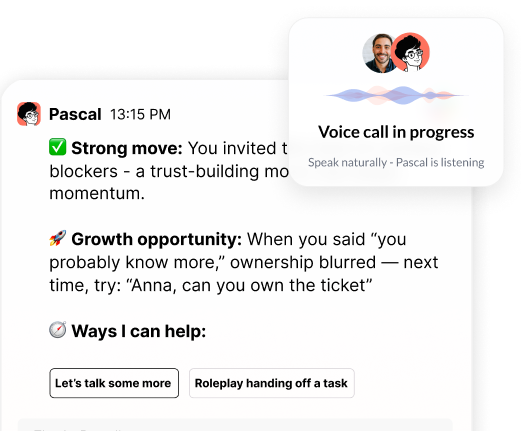
At Pinnacle, we built Pascal to meet these criteria: ICF-certified coaching methodology, deep contextual awareness through a proprietary knowledge graph, proactive engagement in Slack and Teams, sensitive topic escalation, and measurement of behavior change. Our customers report 83% of direct reports notice improvement in their managers' coaching skills within 90 days.
Ready to see how AI coaching works in practice? Explore how Pascal delivers real-time coaching inside your existing workflows.
Header photo by Vitaly Gariev on Unsplash

.png)
.webp)
“Thank you for setting the great foundation for my promotion; now I have a plan!"

Curious to see how AI Coaching can 10X the impact and scale of your development initiatives. Book a demo today for: