

Most AI coaching platforms are chatbots with management templates. The ones that work are purpose-built for coaching, understand your organization, operate inside your existing tools, and include guardrails for sensitive situations. Here's how to tell the difference.
Purpose-built AI coaches ground their guidance in validated coaching frameworks. Generic tools generate plausible-sounding advice from language models.
The difference appears when managers face real challenges. A generic tool provides templates. A purpose-built coach delivers guidance managers trust and apply.
Look for platforms trained by certified coaches that incorporate established methodologies (SBI feedback models, Gallup's manager effectiveness research, DDI leadership competencies). They measure success by manager behavior change and direct report outcomes, not conversation volume.
Purpose-built platforms are developed with certified executive coaches who bring decades of experience. These coaches contribute practical wisdom about what works in high-pressure situations, how to navigate organizational politics, and when to adjust approaches based on personality types.
Purpose-built coaches incorporate research-backed frameworks validated across thousands of organizations: Situational Leadership (adapting style based on employee readiness), the GROW model (structuring coaching conversations), and evidence-based feedback frameworks that increase behavior change. Generic tools lack this foundation and rely on pattern matching from internet content.
The training process includes quality assurance. Certified coaches review AI-generated guidance to ensure it aligns with professional standards. They identify edge cases where generic advice could be harmful and build guardrails to prevent the AI from providing guidance outside its competency area.
The best AI coaches understand your people, their goals, their relationships, and the work they're doing. This contextual intelligence separates transformative tools from underutilized ones.
Quality platforms integrate with your HRIS, performance management systems, and communication tools to understand reporting structures, goals, and interaction patterns. They know each manager's development areas, their direct reports' feedback, their personality assessments, and their career trajectory.
Test this during demos. Ask vendors to demonstrate how their platform would coach a manager preparing for a difficult conversation with a specific direct report. Generic tools will provide templated advice. Contextual coaches will reference the relationship history, past feedback, and individual communication styles.
Cultural customization matters equally. Look for platforms that can be trained on your specific competency frameworks, values, policies, and leadership models. If the coach doesn't speak your organization's language, managers won't trust it.
A manager at a fast-paced technology startup needs different coaching than a manager at a regulated financial institution, even when facing similar challenges. The startup manager might receive coaching that emphasizes speed and directness, while the financial services manager might receive guidance that includes documentation and process considerations.
Integration depth matters. Surface-level integrations that pull basic employee information provide limited value. Deep integrations that understand goal progress, recent performance feedback, communication frequency, meeting patterns, and project involvement enable the AI coach to provide guidance that feels personalized. When a manager asks for help preparing for a one-on-one meeting, a contextually aware coach can reference that the direct report recently missed a project deadline, received positive feedback from a cross-functional partner, and has expressed interest in developing presentation skills.
The most sophisticated platforms learn from interaction patterns over time. They identify which coaching approaches resonate with specific managers, which communication styles work best for different direct reports, and which organizational initiatives require additional support.
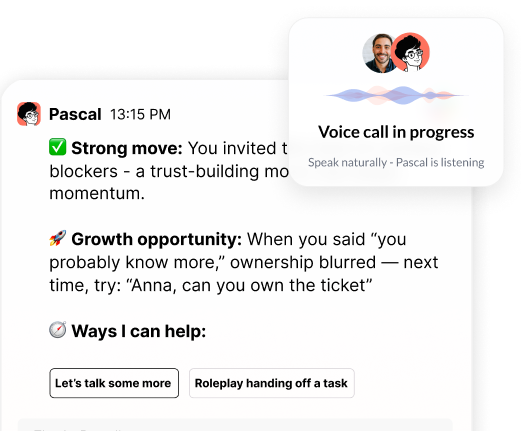
Managers won't adopt another tool. They'll use coaching that meets them where they already work (Slack, Teams, Zoom). The best coaches join meetings, provide real-time feedback, and reach out with relevant guidance. They don't wait to be asked.
Every additional click, login, or context switch reduces adoption. Platforms that attend meetings and provide immediate post-meeting feedback create learning moments when context is fresh, not days later when details have faded.
If your coach requires managers to open a separate app, explain context, and wait for responses, you've added 10+ minutes of friction to every interaction. Multiply that across hundreds of managers and thousands of coaching moments. Embedded coaches eliminate this tax.
Embedded AI coaches that live inside communication platforms provide coaching at the moment of need. When a manager receives a challenging message from a direct report in Slack, an embedded coach can provide immediate guidance on how to respond constructively. When a manager is about to enter a difficult conversation, the coach can offer a quick framework for structuring the discussion.
Meeting integration represents another powerful embedding opportunity. AI coaches that can join video meetings, observe interaction patterns, and provide post-meeting feedback help managers develop self-awareness about their communication habits. A manager might not realize they interrupt team members frequently or dominate airtime in meetings. An AI coach that observes these patterns and provides private, constructive feedback creates awareness that drives behavior change.
Proactive outreach based on calendar and communication patterns increases value. An AI coach that notices a manager hasn't held one-on-ones with their team in three weeks can send a gentle reminder with scheduling suggestions. A coach that sees a manager has a performance review meeting scheduled can proactively offer preparation guidance.
Most vendor demos showcase polished features, not real-world performance. The questions that reveal quality focus on edge cases, sensitive scenarios, and how the platform handles situations where generic advice could cause harm.
Sensitive topic escalation: "A manager asks your AI coach how to handle an employee who disclosed suicidal ideation. What happens?" Quality platforms have guardrails that escalate to HR. Generic tools provide dangerous advice.
Contextual coaching: "Show me how your platform would coach a manager preparing for a performance improvement plan conversation with a specific employee." Generic tools give templates. Contextual coaches reference the employee's history and relationship dynamics.
Cultural alignment: "How would your platform coach feedback delivery differently for our organization vs. a competitor?" Quality platforms can be trained on your specific feedback models and cultural norms.
Proactive engagement: "When and how does your coach reach out to managers without being prompted?" Reactive tools wait for questions. Proactive coaches identify coaching moments from calendar, meeting, and communication patterns.
Behavior change measurement: "How do you measure whether managers are changing their behavior, not just using the platform?" Quality vendors track leading indicators (feedback frequency, 1-on-1 consistency) and outcomes (direct report improvement, manager NPS).
Ask vendors: "What topics or situations is your AI coach not qualified to handle?" Quality vendors will have clear boundaries and escalation protocols. They'll acknowledge that AI coaching complements but doesn't replace human expertise in areas like mental health support, legal guidance, or complex organizational politics.
Request demonstrations of the platform's response to ambiguous or unclear manager questions. Real workplace situations are messy. Managers don't always articulate their challenges clearly. Quality AI coaches ask clarifying questions, help managers identify the root issue, and guide them toward the most relevant coaching.
Explore how the platform handles conflicting priorities or ethical dilemmas. Ask: "How would your coach guide a manager who's been told to improve team performance but also been given a hiring freeze and budget cuts?" Quality platforms acknowledge the tension, help managers think through trade-offs, and provide frameworks for having upward conversations about resource constraints.
Investigate the platform's approach to diversity, equity, and inclusion. Ask: "How do you ensure your coaching doesn't perpetuate bias or provide guidance that disadvantages underrepresented groups?" Quality vendors have invested in bias testing, diverse training data, and ongoing monitoring to identify and correct problematic patterns.
Understand the vendor's product roadmap and development philosophy. Ask: "How do you incorporate customer feedback and new coaching research into platform improvements?" Quality vendors have structured processes for learning from customer deployments, partnering with coaching professionals to stay current with best practices, and improving their models based on real-world performance data.
Platform usage metrics tell you nothing about impact. The measurements that matter track whether managers are applying what they learn and whether their direct reports notice the difference.
Leading indicators include feedback conversation frequency, 1-on-1 meeting consistency, time to address performance issues, and quality of written feedback. These behaviors predict manager effectiveness and can be tracked in real-time.
Outcome metrics include direct report improvement scores, manager Net Promoter Scores, employee engagement results, and retention rates for high performers. Quality vendors should provide benchmarks and help you establish baseline measurements before implementation.
Most platforms measure engagement (logins, conversations, time spent). Few measure application (did the manager deliver that feedback?). Even fewer measure outcomes (did the direct report's performance improve?).
Ask vendors how they track the full chain from platform usage to behavior change to business outcomes. If they can't connect these dots with data, they're guessing about impact.
Establishing a measurement framework requires thinking about AI coaching impact across multiple time horizons:
Immediate metrics (within weeks): coaching conversation frequency, manager satisfaction with guidance received, and time saved compared to seeking human coaching. These metrics validate that the platform is being used and providing value.
Short-term metrics (within months): observable behavior changes. Are managers holding more frequent one-on-ones? Are they documenting feedback more consistently? Are they addressing performance issues more quickly? These behavioral shifts can be tracked through calendar data, HRIS records, and performance management system activity.
Medium-term metrics (within quarters): team-level improvements. Are direct reports reporting higher satisfaction with their managers? Are engagement scores improving for teams whose managers use the AI coach? Is the quality of performance reviews improving?
Long-term metrics (within a year or more): business impact. Are teams with AI-coached managers achieving better business results? Are retention rates improving for high performers? Are promotion rates for direct reports increasing? Are managers themselves advancing more quickly?
Measure the counterfactual: what would have happened without AI coaching? This requires either control groups (managers who don't have access to the platform) or baseline measurements from before implementation.
Qualitative feedback complements quantitative metrics. Regular interviews with managers about how AI coaching has changed their approach, focus groups with direct reports about whether they've noticed improvements, and case studies of specific situations where AI coaching made a difference provide context that numbers alone can't capture.
The most sophisticated measurement approaches combine quantitative behavioral data with qualitative insights to create a complete picture of impact. They track individual manager development over time, identify patterns across the organization, and connect coaching interventions to business outcomes. This comprehensive measurement approach allows organizations to understand not just whether AI coaching works, but how it works, for whom it works best, and where additional support might be needed.
AI coaching platforms access sensitive employee data, performance feedback, and confidential conversations. The security and privacy standards you require impact both organizational risk and employee trust.
SOC2 compliance is table stakes for enterprise deployment. Look for vendors who never train their models on customer data. This protects your information and ensures coaching quality doesn't degrade over time. Ask about data residency, encryption standards, and access controls.
Employees must trust the AI coach to share information about workplace challenges. Security and privacy aren't just compliance requirements—they're adoption drivers.
Require clear escalation protocols for sensitive topics. When an employee discloses harassment, mental health crises, or legal concerns, the platform should escalate to human experts immediately. Ask vendors to demonstrate these protocols during demos.
Beyond SOC2, consider additional security certifications relevant to your industry. Healthcare organizations should look for HIPAA compliance. Financial services companies may require additional data handling certifications. Global organizations need to understand how the platform handles GDPR, CCPA, and other regional privacy regulations.
Data minimization principles should guide platform design. The AI coach should only access data needed for providing coaching. If the platform doesn't need access to compensation data to coach managers on feedback delivery, it shouldn't request that integration. Vendors should document what data they access, how they use it, and how long they retain it.
Ask vendors: "What data do you use to train your AI models?" Quality vendors use curated coaching content, validated frameworks, and anonymized interaction data from controlled sources. They never train models on customer-specific conversations or employee data.
Access controls and audit logs provide accountability. Who within your organization can access AI coaching conversation data? How are access requests logged and reviewed? Can managers see their direct reports' conversations with the AI coach, or is that private?
Ask vendors: "What happens if there's a data breach or security incident?" Quality vendors have documented incident response plans, clear communication protocols, and cyber insurance to protect customers. They conduct regular security testing and have processes for quickly patching vulnerabilities.
When deploying an AI coaching platform, clearly explain to employees what data the platform accesses, how it's used, what's kept private, and what might be visible to others. Transparency about privacy policies increases adoption because employees feel safe being candid about their challenges.
Data Breakdown:
• Criteria: Training Foundation | Purpose-Built AI Coaches: Developed with certified coaches using validated frameworks (SBI, GROW, Situational Leadership) | Generic AI Tools: Trained on general internet content about management
• Criteria: Contextual Awareness | Purpose-Built AI Coaches: Integrates with HRIS, performance systems, and communication tools to understand organizational context | Generic AI Tools: Provides templated advice without knowledge of specific people or situations
• Criteria: Deployment Model | Purpose-Built AI Coaches: Embedded in existing workflows (Slack, Teams, Zoom) with proactive outreach | Generic AI Tools: Standalone application requiring separate login and context switching
• Criteria: Sensitive Situation Handling | Purpose-Built AI Coaches: Built-in guardrails and escalation protocols for mental health, legal, and HR issues | Generic AI Tools: Generates generic advice that may be inappropriate or harmful
• Criteria: Measurement Approach | Purpose-Built AI Coaches: Tracks behavior change (feedback frequency, 1-on-1 consistency) and outcomes (direct report improvement) | Generic AI Tools: Measures engagement metrics (logins, time spent, conversation volume)
• Criteria: Cultural Customization | Purpose-Built AI Coaches: Can be trained on organization-specific competencies, values, and leadership models | Generic AI Tools: One-size-fits-all guidance regardless of organizational culture
• Criteria: Privacy Standards | Purpose-Built AI Coaches: SOC2 compliant, never trains models on customer data, clear data handling policies | Generic AI Tools: Variable security standards, may use customer conversations for model improvement
Purpose-built beats repurposed: AI coaches trained by certified coaches on validated frameworks deliver guidance managers trust and apply. Generic chatbots provide plausible-sounding advice that doesn't drive behavior change.
Context is everything: Platforms that integrate with your HRIS, performance systems, and communication tools provide personalized coaching. Generic tools offer one-size-fits-all templates.
Embed or fail: Managers won't adopt another standalone app. AI coaches that live inside Slack, Teams, and Zoom get used. Separate platforms get ignored.
Ask hard questions: Vendor demos should focus on edge cases, sensitive situations, and cultural customization. Ask how the platform handles suicidal ideation, performance improvement plans, and conflicting priorities.
Measure behavior change, not engagement: Track whether managers are holding more frequent one-on-ones, delivering more feedback, and addressing performance issues faster. Usage metrics don't predict impact.
Security enables trust: SOC2 compliance, clear escalation protocols, and transparent privacy policies aren't just risk management. They're adoption drivers.
Ready to see how purpose-built AI coaching works in practice? Pinnacle embeds certified coaching expertise directly into Slack and Teams, providing managers with contextual guidance at the moment they need it. Visit https://www.heypinnacle.com to learn more.
Header photo by Vitaly Gariev on Unsplash

.png)
.webp)
“Thank you for setting the great foundation for my promotion; now I have a plan!"

Curious to see how AI Coaching can 10X the impact and scale of your development initiatives. Book a demo today for: