

Scaling AI coaching responsibly means building governance before you scale, not after. Most organizations do this backward: they deploy AI tools to 78% of their workforce while only 1% have adequate governance frameworks (SHRM's State of AI in HR research). This creates legal exposure, erodes trust, and kills adoption.
The right sequence: establish data policies, define escalation protocols, pilot with a small group, measure trust and effectiveness, then scale. Organizations that follow this path see measurable manager improvement and avoid the governance crises that sink AI initiatives.
The trust equation is simple: employees who feel surveilled disengage. When managers discover their conversations are monitored without clear policies, they stop using the tool. You've spent budget on software nobody trusts.
Regulatory requirements compound this in financial services, healthcare, and life sciences. Data retention policies, privacy protections, and audit trails aren't optional. A single HIPAA violation or GDPR breach costs more than your entire coaching budget.
Cultural misalignment creates a different problem. Generic AI advice that contradicts your company values confuses managers and undermines leadership credibility. If your culture emphasizes radical candor but your AI coach suggests diplomatic hedging, you've created competing guidance systems.
Former Bloomberg and Pearson CHRO Melinda Wolfe describes the opportunity: "If we can finally democratize coaching—make it specific, timely, and integrated into real workflows—we solve one of the most chronic issues in the modern workplace."
The cost of poor execution is substantial. MIT research shows 95% of AI projects fail to deliver expected results, primarily due to adoption and governance failures. Speed without governance guarantees you'll join that 95%.
Four elements separate functional AI coaching from chatbots with management advice:
Organizational context. The AI must understand your company's values, competencies, and leadership principles. Generic advice from ChatGPT creates inconsistency. A tech company with 500 employees customized their AI coaching around a "radical candor" framework, resulting in a 20% manager NPS increase. The AI reinforced their culture instead of contradicting it.
Governance frameworks. Clear policies on data retention, privacy, and escalation protocols protect both employees and the organization. SOC2 compliance signals enterprise-grade security. Zero-day transcript retention addresses regulated industry requirements. Moderation systems flag sensitive topics (harassment, discrimination, mental health concerns) for human review.
Human oversight. Escalation paths route concerning conversations to HR business partners. ICF-certified coaches can train AI models to maintain quality standards. Regular audits verify the AI follows company standards and doesn't drift toward generic advice.
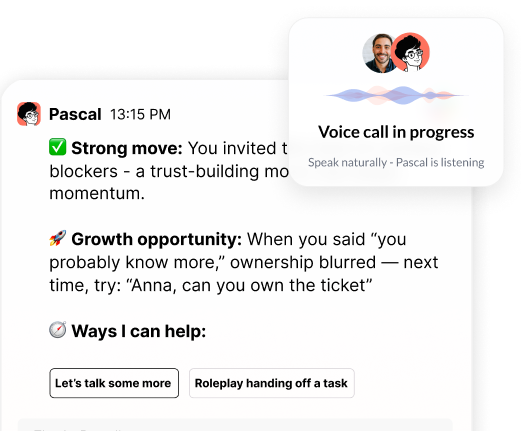
Workflow integration. Coaching must happen where managers already work (Slack, Teams, Zoom, Google Meet), not in a separate portal they need to remember to visit. Proactive suggestions during meetings drive adoption. 24/7 availability supports just-in-time guidance during critical moments.
AI coaching scales to every manager at 1% of traditional coaching costs, but requires different governance. Traditional executive coaching costs $200–$500 per hour and reaches only senior leaders. AI coaching provides 24/7 support to all managers with built-in escalation protocols for sensitive situations.
Data Breakdown:
• Dimension: Cost per manager | Traditional Coaching: $10,000–$25,000 annually | AI Coaching (Purpose-Built): $100–$250 annually
• Dimension: Availability | Traditional Coaching: Scheduled sessions (1–2x/month) | AI Coaching (Purpose-Built): 24/7, in-the-moment
• Dimension: Reach | Traditional Coaching: Senior leaders only | AI Coaching (Purpose-Built): All managers and ICs
• Dimension: Context | Traditional Coaching: Coach learns over time | AI Coaching (Purpose-Built): Instant access to performance data, meeting history, company values
• Dimension: Consistency | Traditional Coaching: Varies by coach quality | AI Coaching (Purpose-Built): Standardized around company frameworks
• Dimension: Privacy | Traditional Coaching: Confidential 1:1 | AI Coaching (Purpose-Built): Anonymized, aggregated insights
Traditional coaching maintains confidentiality through professional standards and coach-client privilege. AI coaching requires technical safeguards: zero-day transcript deletion for regulated industries, automatic flagging of harassment or discrimination concerns, transparent disclosure when AI observes interactions, opt-in models that respect employee autonomy, and regular audits to identify and correct algorithmic bias.
The coaching industry reached $6.25 billion in 2024 and is projected to hit $7.3 billion in 2025, driven by AI-enabled scalability (ADP's HR Trends Guide).
Marriott's VP of Learning Design Victor Arguelles states: "We only scale after employee satisfaction reaches defined thresholds." This approach prevents the governance-free scaling that creates legal exposure.
Phase 1: Define Success Criteria (Weeks 1–2). Identify specific behavioral competencies you want to develop. Set measurable outcomes (manager NPS, direct report engagement, time saved). Establish governance policies and escalation protocols before any deployment.
Phase 2: Pilot with a Small Group (Weeks 3–8). Start with 20–50 managers in a single function (engineering, sales, operations). Customize the AI around your company values and leadership principles. Integrate with existing tools. Collect weekly feedback and iterate.
Phase 3: Measure and Validate (Weeks 9–12). Track direct report feedback on manager improvement. Measure time saved. Assess manager confidence and satisfaction scores. Review escalation patterns to validate governance protocols. If satisfaction thresholds aren't met, don't scale.
Phase 4: Expand Strategically (Months 4–6). Roll out to additional functions based on pilot results. Maintain feedback loops. Build internal champions who advocate for the platform. Create case studies showcasing specific behavioral improvements.
Phase 5: Scale Organization-Wide (Months 7–12). Extend to all managers and high-potential individual contributors. Integrate with performance review cycles and goal-setting processes. Establish regular governance reviews. Monitor aggregated insights for organizational trends.
Phase 6: Optimize and Evolve (Ongoing). Refine coaching models based on employee feedback. Update organizational context as company values shift. Expand use cases beyond manager development. Use behavioral data for strategic workforce planning.
Transparency, voluntary participation, and clear data policies build trust. Employees need to understand when AI is observing, how their data is used, and what protections exist.
Communicate the "why" explicitly. Explain that AI coaching exists to support manager development, not to surveil or evaluate. Share specific examples: preparing for difficult conversations, improving 1:1 effectiveness, developing leadership skills. Make it clear that coaching conversations remain confidential unless they trigger escalation protocols for legal or ethical concerns.
Offer opt-in models. Voluntary participation signals respect for employee autonomy. Managers who choose to engage see higher value and become internal advocates. Forced adoption breeds resentment and minimal engagement.
Demonstrate data protection. Publish clear policies on data retention, privacy, and usage. For regulated industries, highlight zero-day transcript deletion capabilities. Show how aggregated insights protect individual anonymity while providing organizational value.
Create feedback channels. Regular pulse surveys capture employee sentiment. Anonymous feedback mechanisms allow honest input without fear of repercussions. Act on feedback to demonstrate responsiveness.
SHRM's research shows that HR leaders risk being sidelined if they don't take active leadership roles in AI adoption. Governance frameworks are a strategic imperative, not a compliance checkbox.
Data handling policies specify retention periods, access controls, and usage boundaries. Define who can access coaching data, under what circumstances, and for how long. Establish clear deletion schedules that align with legal requirements. Document how anonymized insights are generated and used.
Escalation protocols route sensitive conversations to appropriate human oversight. Define triggers for HR business partner involvement: harassment allegations, discrimination concerns, mental health crises, legal violations. Establish response time standards and escalation paths. Train HR teams on handling AI-flagged issues.
Bias monitoring catches algorithmic drift before it impacts employees. Regular audits examine coaching recommendations across demographic groups. Test for disparate impact in feedback patterns. Engage diverse employee groups in reviewing coaching quality. Update training data to address identified biases.
Regular governance reviews keep policies current as technology and regulations evolve. Quarterly reviews assess policy effectiveness, adoption patterns, and emerging risks. Annual comprehensive audits examine the entire AI coaching ecosystem. External reviews by legal and compliance teams validate governance adequacy.
Track manager effectiveness metrics, direct report engagement, time savings, and retention rates to quantify AI coaching impact.
Manager effectiveness shows up in direct report feedback. Track changes in 1:1 quality, feedback frequency, and development conversation depth. Monitor manager confidence scores and self-reported skill development.
Time savings translate to cost avoidance. Managers gain hours by accessing instant coaching instead of scheduling human coach sessions. HR teams reduce time spent on manager support questions. L&D teams scale impact without adding headcount.
Retention improvements demonstrate long-term value. Track manager retention rates before and after AI coaching deployment. Measure direct report retention, particularly among high performers. Calculate the cost of avoided turnover.
Behavioral competency development validates culture alignment. Assess progress against specific leadership competencies defined in your framework. Track adoption of company values in manager interactions. Measure improvement in critical skills (feedback delivery, conflict resolution, strategic thinking).
• Build governance before you scale. Only 1% of organizations have adequate AI governance despite 78% already using AI tools, creating legal exposure and trust risks that kill adoption.
• Responsible AI coaching requires organizational context, governance frameworks, human oversight, and workflow integration. Without these, you're deploying a chatbot with generic management advice.
• AI coaching scales to every manager at 1% of traditional coaching costs while maintaining ethical standards through escalation protocols, bias monitoring, and anonymized aggregated insights.
• Follow a six-phase framework: define success criteria, pilot with a small group, measure and validate, expand strategically, scale organization-wide, and optimize continuously based on employee satisfaction thresholds.
• Transparency, voluntary participation, and clear data policies build trust during rollout and determine whether managers actually use the tool.
Ready to scale AI coaching responsibly across your organization? See how Pascal works inside Slack, Teams, and your existing workflows to deliver contextual, culture-aligned coaching that managers trust and apply immediately.
Header photo by Vitaly Gariev on Unsplash

.png)
.webp)
“Thank you for setting the great foundation for my promotion; now I have a plan!"

Curious to see how AI Coaching can 10X the impact and scale of your development initiatives. Book a demo today for: