

Lead Summary: Scaling AI coaching requires privacy-first architecture, human oversight, and cultural alignment. Companies that embed ethical guardrails from day one build systems employees trust and use.
Sarah, a new engineering manager at a Series B startup, freezes during 1-on-1s when she needs to give critical feedback. She delays difficult conversations, watches team performance slip, and feels stuck. After three weeks with AI coaching, she's navigating these conversations confidently. The AI doesn't replace her judgment—it helps her structure feedback using her company's SBI framework and reminds her to ask clarifying questions before jumping to solutions.
This is AI coaching done right: specific, private, and aligned with how the company already develops leaders.
Most AI coaching implementations fail because companies prioritize speed over trust. They roll out surveillance-adjacent tools, skip cultural customization, and measure logins instead of behavior change. Employees opt out. Adoption collapses.
Here's how to scale AI coaching without breaking trust.
Data privacy determines success or failure. When employees believe conversations could be used against them, they stop using the system.
Zero-knowledge architecture means individual conversations remain confidential while aggregated insights inform strategy. Zoom's AI Companion, for example, processes meeting data locally and allows users to delete transcripts immediately. The system captures patterns (managers struggle with delegation, teams ask more questions about priorities in Q3) without exposing individual interactions.
For heavily regulated industries, this gets more complex. Healthcare and financial services companies often integrate with approved note-taking tools rather than recording meetings directly. Doximity, a network for physicians, built its AI coaching to work with existing HIPAA-compliant documentation workflows rather than creating new data collection points.
The technical implementation matters. End-to-end encryption protects data in transit. Local processing keeps sensitive content off central servers. Anonymized aggregation strips identifying information before generating organizational insights.
Without these safeguards, you're building a surveillance tool, not a coaching system.
Strong governance transforms AI coaching from surveillance into development. The difference is who has access to what data and whether the system supports employees or monitors them.
Establish an AI Ethics Committee with representatives from HR, Legal, IT, employee resource groups, and business leadership. At Atlassian, this committee reviews AI policies quarterly and has authority to pause deployments that violate ethical guidelines.
Create clear use policies. Explicitly prohibit using coaching data for performance reviews, promotion decisions, or disciplinary actions. Make this prohibition visible and enforceable.
Implement moderation flags for sensitive topics. When the AI detects burnout signals, harassment, or mental health concerns, it should escalate to human HR immediately. At Genentech, their coaching system routes these escalations to trained HR business partners within 2 hours during business days.
Conduct bias audits every six months. Review AI outputs across demographic groups to identify disparities in coaching quality. Microsoft's AI Red Team found their early coaching prototypes gave more assertive communication advice to women and more strategic thinking advice to men—patterns that reinforced stereotypes. They retrained the models before deployment.
As Melinda Wolfe, former CHRO at Bloomberg, Pearson, and GLG, notes: "If we have an innovation right now, it's incumbent upon us as HR leaders to show our companies an economic and effective way to help managers." Governance makes that innovation trustworthy.
Proactive coaching (AI joins meetings, observes communication patterns, offers real-time suggestions) drives higher adoption than on-demand-only systems. But this only works when employees control when it's active.
Design opt-in by default. Employees choose which meetings the AI joins, what types of guidance they receive, and when they want suggestions. Shopify's AI coaching pilot started with on-demand only. After managers saw value (average satisfaction score of 4.3/5.0 after 30 days), 73% opted into proactive features.
Build transparency dashboards that show exactly what data is collected and how it's used. Stripe's dashboard lets employees see every meeting the AI joined, every insight generated, and every aggregated data point their conversations contributed to. Employees can delete any session retroactively.
Create escalation protocols. When the AI detects sensitive topics, it should route to human support immediately without requiring the employee to take action. This matters for burnout, harassment, mental health concerns, and ethical violations.
Organizations that force adoption see usage rates below 40%. Those that earn trust through transparency see adoption above 75% (internal data from Pinnacle's pilot programs with 8 mid-market companies, 2023-2024).
Usage statistics tell you if people are logging in. They don't tell you if behavior is changing.
Track manager effectiveness improvements. At Asana, they measured 1-on-1 frequency, feedback quality (rated by direct reports in pulse surveys), and delegation patterns before and after AI coaching. After 6 months, managers who used AI coaching weekly held 1-on-1s 23% more consistently and received 18% higher feedback quality scores.
Measure skill development by tracking how frequently managers need support on specific challenges over time. If managers initially need frequent help with delegation but that decreases after 90 days, you're seeing skill acquisition.
Monitor team engagement through pulse surveys that ask specifically about manager effectiveness, psychological safety, and development opportunities. Compare these metrics before and after deployment to isolate impact.
Establish baselines before deployment. Without pre-implementation data, you can't prove impact.
Generic AI coaching fails because it doesn't understand your values, leadership frameworks, or communication norms.
Train AI on your specific leadership frameworks. If you use Radical Candor, SBI feedback models, or Situational Leadership, the AI should incorporate these into coaching. Dropbox trained their AI on their "Conscious Leadership" framework—specific language about ownership, curiosity, and feedback that reflects how they expect leaders to operate.
Train it on your policies, templates, and escalation pathways. When a manager asks about handling a performance issue, the AI should reference your actual performance improvement plan template and your HR escalation process.
This customization makes coaching immediately relevant. Recommendations align with how managers are already expected to lead. It also reinforces cultural behaviors at scale by consistently coaching to your standards across every interaction.
Organizations that skip customization see coaching that feels disconnected. Those that invest in alignment see coaching that feels like an extension of existing development programs.
Start with a pilot program. Include 20-50 managers across different departments (not just early adopters). Run for 90 days with clear success criteria: adoption rate above 60%, manager satisfaction score above 4.0/5.0, and measurable improvement in at least one behavioral metric.
Gather feedback weekly. What's working? What's confusing? What guidance feels most valuable? Notion's pilot revealed managers wanted more help with written communication (Slack messages, document feedback) than they expected. They adjusted the product roadmap based on this feedback before expanding.
After a successful pilot, expand in phases. Roll out to one division at a time rather than the entire organization. This lets you maintain quality, address issues quickly, and build momentum through success stories.
Assign an executive sponsor who can remove roadblocks, secure resources, and champion the program at leadership level. Without executive support, AI coaching initiatives stall in procurement or get deprioritized when budgets tighten.
AI coaching doesn't work everywhere. Recognize when to pause or stop.
Don't scale if employees don't trust leadership. AI coaching requires baseline psychological safety. If your organization has recent layoffs, leadership turnover, or low engagement scores, fix the trust problem first. Adding AI coaching to a low-trust environment accelerates distrust.
Don't scale if you can't commit to governance. If you don't have resources for an AI Ethics Committee, regular bias audits, and human oversight, you're not ready. Half-implemented governance is worse than no governance.
Don't scale if you're measuring the wrong things. If leadership wants to use AI coaching data for performance reviews or stack rankings, stop the project. This violates the trust required for adoption.
Don't scale if customization isn't possible. If the AI can't be trained on your leadership frameworks and cultural norms, it will feel generic and disconnected. Employees will stop using it.
• Privacy is non-negotiable: Implement end-to-end encryption, local processing, and anonymized aggregation before scaling
• Governance prevents surveillance: Establish AI Ethics Committees, conduct bias audits every 6 months, and explicitly prohibit using coaching data for performance decisions
• Cultural customization drives adoption: Train AI on your leadership frameworks (Radical Candor, SBI, Situational Leadership) and company-specific policies
• Opt-in by default: Demonstrate value through on-demand coaching before requesting access to proactive features
• Measure behavior change: Track manager effectiveness, team engagement, and skill development (not logins)
• Pilot with 20-50 managers for 90 days: Test across departments, gather weekly feedback, and establish clear success criteria before expanding
• Recognize failure modes: Don't scale in low-trust environments, without governance resources, or when leadership wants surveillance
Responsible AI coaching isn't about deploying technology faster. It's about building systems employees trust, that align with your culture, and that deliver measurable improvements in how managers lead.
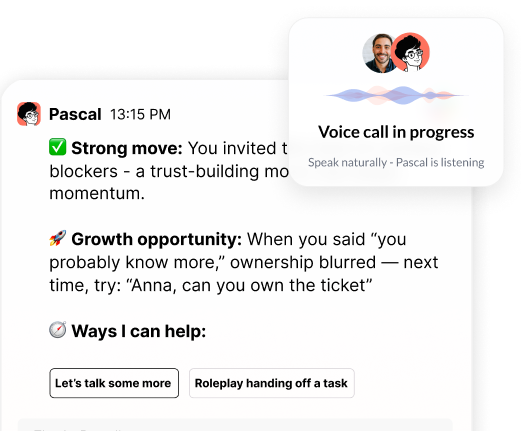
Pascal works inside Slack, Teams, and your meetings to deliver AI coaching with privacy-first architecture and cultural customization. We help CHROs scale coaching without breaking trust. Visit heypinnacle.com to see how we implement these principles.
Header photo by Vitaly Gariev on Unsplash

.png)
.webp)
“Thank you for setting the great foundation for my promotion; now I have a plan!"

Curious to see how AI Coaching can 10X the impact and scale of your development initiatives. Book a demo today for: