

Meeting-integrated AI coaching tools embed directly into platforms like Zoom and Teams, delivering feedback during conversations rather than requiring managers to seek guidance separately. Early adopters report measurable improvements in manager effectiveness, though the approach isn't suitable for all organizations or team cultures.
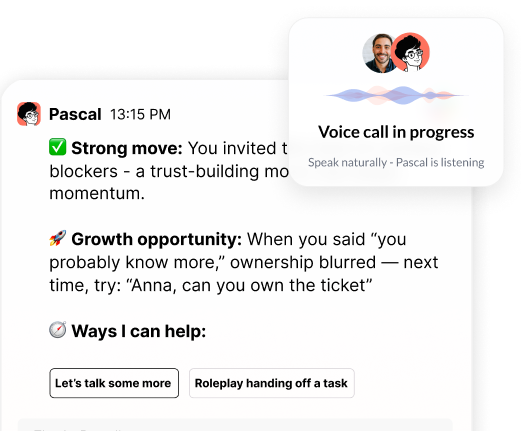
The AI joins meetings with participant consent, observes team dynamics, and identifies coaching moments as they happen. Within minutes of a meeting ending, managers receive feedback on specific behaviors—what went well and where to improve.
Managers don't need to open another app or schedule coaching sessions. Guidance arrives automatically where work already happens. Research from The Edge of Work (a workplace trends newsletter) shows that embedding AI into existing workflows drives higher adoption than standalone tools.
This approach works best for managers who already record meetings and want developmental feedback. It fails when teams view observation as surveillance or when organizational culture doesn't support transparent feedback.
Standalone tools require managers to leave their workflow, manually explain context, and remember to use another platform. Managers already juggle 15+ tools daily. Adding one more creates immediate friction.
Generic AI coaches require managers to re-explain situations, team dynamics, and history every time they seek guidance. This context gap makes the coaching feel disconnected from reality.
On-demand tools wait for managers to realize they need help and take action. Most managers don't recognize coaching moments until after they've passed. Without proactive touchpoints, usage drops within 30 days of launch.
Meeting-integrated tools solve this by eliminating context-switching. The AI already knows team relationships, individual communication styles, and ongoing challenges because it observed previous meetings.
Start by establishing clear governance, securing stakeholder buy-in, and running a focused pilot with 20–30 managers who will become internal champions.
Develop clear policies on meeting recording, data usage, and participant consent. Make it opt-in and transparent. Identify 3–5 specific manager challenges AI coaching will address: delegation, feedback quality, psychological safety, or meeting efficiency.
Confirm your meeting platforms support AI integration and that your security team approves the vendor's SOC2 compliance. Choose managers who are open to experimentation, represent diverse teams, and can articulate what's working or not.
Define leading indicators like adoption rate and coaching interactions per week, plus lagging indicators like Manager Net Promoter Score (a metric measuring how likely direct reports are to recommend their manager), direct report feedback, and performance review quality.
Prepare talking points for managers about how AI coaching supports their development, not surveillance. Organizations that invest in change management upfront see higher AI adoption rates than those that treat implementation as purely technical.
Integration follows a clear sequence: select the right platform, configure organizational context, pilot with early adopters, scale based on data, and refine based on manager feedback.
Select a vendor whose AI coach joins meetings and provides feedback, not just a chatbot that requires manual input. Verify the platform integrates natively with your meeting tools. Confirm SOC2 compliance and data protection standards.
Ensure the AI includes guardrails that escalate sensitive topics (harassment, mental health, legal issues) to human experts. Check whether the AI was trained by professional coaches or just generic language models.
Multiple vendors now offer meeting observation with coaching layers, including Pinnacle's Pascal, Grain, Fellow, and others. Each takes a different approach to feedback timing, privacy controls, and coaching methodology.
Provide the AI coach with your company's leadership competencies, values, performance frameworks, and cultural priorities so guidance aligns with how you define great management.
Upload your leadership competency model and performance review criteria. Define your organization's communication norms and cultural values. Specify priority coaching areas: delegation for new managers or strategic thinking for senior leaders. Set guardrails for topics that require human HR involvement.
Start with managers who are development-focused, represent diverse teams, and can provide detailed feedback on what's working.
Conduct kickoff sessions explaining how AI coaching works and addressing privacy concerns. Encourage managers to use the AI coach for meeting prep, post-meeting reflection, and difficult conversation planning.
Collect weekly feedback on coaching quality, relevance, and adoption barriers. Track leading indicators: coaching interactions per manager, meeting attendance rate, manager satisfaction scores.
Use pilot insights to adjust coaching prompts, refine integration settings, and identify which manager populations benefit most.
Analyze which coaching scenarios drove the highest engagement and impact. Identify patterns in manager feedback about what felt helpful versus generic. Adjust the AI's coaching style based on your culture—more direct for high-accountability environments, more exploratory for innovation-focused teams.
Expand to additional cohorts in waves, using early adopters as champions.
Track both adoption metrics and business outcomes to prove ROI and guide refinement.
Monitor weekly active users, average coaching interactions per manager, and manager satisfaction scores. Measure Manager Net Promoter Score changes, direct report engagement scores, and performance review quality improvements.
Collect qualitative feedback through manager interviews and focus groups. Refine coaching models quarterly based on what's driving measurable behavior change.
Privacy concerns are the number one barrier to adoption. Address them head-on with transparent policies, opt-in consent, and clear data governance.
Make AI meeting attendance opt-in for both managers and participants. Provide clear notifications when the AI coach is present in a meeting. Explain exactly what data is captured, how it's used, and who has access.
Emphasize that the AI coach is there to support development, not surveillance. Individual coaching conversations remain private, and aggregated insights are anonymized.
Ensure your vendor is SOC2 compliant and never trains AI models on customer data. Build trust by starting with volunteers, sharing success stories, and demonstrating that the AI coach provides value without compromising privacy.
Research from Lattice on AI in meetings shows that organizations prioritizing transparency and consent see higher adoption rates than those that mandate AI attendance without clear communication.
Leading indicators show adoption and engagement, while lagging indicators prove business impact. Track both to demonstrate ROI and guide continuous improvement.
Leading indicators:
• Weekly active users (target: 80%+ of enrolled managers)
• Average coaching interactions per manager per week (target: 3–5)
• Meeting attendance rate (percentage of meetings where AI coach is present)
• Manager satisfaction scores (target: 8+ out of 10)
Lagging indicators:
• Manager Net Promoter Score (target: 20%+ lift)
• Direct report engagement scores (target: 10–15% improvement)
• Performance review quality ratings (measured through calibration sessions, where HR reviews a sample of reviews for consistency and quality)
• Time to manager proficiency (reduction in ramp time for new managers)
• 360 feedback improvements on specific competencies
Early adopters report measurable improvements in these areas, though results vary based on implementation quality, organizational culture, and manager engagement.
Meeting-integrated AI coaching delivers continuous, contextual guidance in the flow of work. Traditional training provides one-time knowledge transfer that managers struggle to apply in real situations.
Traditional training happens in workshops or self-paced modules, weeks or months before managers face the actual challenges. By the time they need the skill, they've forgotten the framework. Training also assumes everyone needs the same content at the same time, ignoring individual context and development needs.
AI coaching embedded in meetings provides guidance at the exact moment managers need it—during a difficult delegation conversation, after a tense team discussion, or before a performance review. The AI understands the specific team dynamics, communication patterns, and organizational context, making the coaching immediately applicable.
Organizations are finding that AI coaching complements traditional training by providing the sustainment and practice that makes learning stick. Training introduces concepts; AI coaching ensures managers apply them consistently in real work situations.
Purpose-built AI coaching platforms include guardrails that recognize sensitive topics and escalate them to appropriate human experts rather than attempting to provide guidance beyond their scope.
When a manager discusses potential harassment, discrimination, mental health concerns, or legal issues, the AI coach flags the conversation and directs the manager to HR, legal, or employee assistance resources. The moderation system identifies these situations and ensures managers get the right kind of support—human expertise for complex, sensitive topics.
This escalation process protects both the organization and the individual. It prevents AI from providing inappropriate guidance on issues that require human judgment, legal expertise, or clinical training. It also ensures that serious workplace issues are documented and handled through proper channels, reducing organizational risk.
Organizations should define clear escalation protocols during implementation, specifying which topics require human involvement and how quickly HR or legal teams will respond. This builds trust that the AI coach operates within appropriate boundaries and connects managers to the right resources when situations exceed its scope.
• AI coaching integration succeeds when embedded directly into meeting platforms, providing feedback without requiring managers to leave their workflow or remember to seek guidance.
• Successful implementation requires transparent privacy policies, opt-in consent, clear governance, and a focused 60-day pilot with 20–30 managers before scaling enterprise-wide.
• Meeting-integrated AI coaching complements traditional training by providing continuous, contextual guidance that ensures managers apply learned skills in real work situations.
• Multiple vendors now offer meeting-integrated coaching tools, each with different approaches to privacy, feedback timing, and coaching methodology.
• This approach works best for organizations with existing meeting recording practices and cultures that support transparent developmental feedback.
Ready to see how meeting-integrated AI coaching works in practice? Discover how Pinnacle's Pascal delivers coaching inside Slack, Teams, and Zoom to help your managers develop faster and lead more effectively.
Header photo by Vitaly Gariev on Unsplash

.png)
.webp)
“Thank you for setting the great foundation for my promotion; now I have a plan!"

Curious to see how AI Coaching can 10X the impact and scale of your development initiatives. Book a demo today for: