

AI coaching platforms handle privacy through user-level data isolation, encryption, and compliance frameworks that prevent cross-account leakage. Secure platforms combine technical safeguards (encryption, access controls) with operational controls (retention policies, audit trails) and ethical oversight (escalation protocols for sensitive topics).
Privacy means employees can trust their conversations won't leak to colleagues, managers, or HR systems. This requires architectural isolation: each user's data exists in a separate, encrypted environment that the AI cannot cross-reference with other users' information.
Individual data isolation forms the foundation. Each employee gets their own coaching instance that doesn't share information with others. Unlike general AI tools where context bleeds across users, enterprise coaching platforms create hard boundaries between individual accounts.
No training on customer data separates purpose-built solutions from repurposed AI tools. Your conversations never improve models for other customers. This architectural decision determines whether the platform can be trusted with sensitive workplace discussions.
Transparent controls give employees agency. They see which meetings the AI joins and can remove it at any time. When managers understand they control their data, adoption increases.
The critical difference lies in whether privacy is a feature added later or a foundational architecture decision. Generic AI tools repurposed for coaching aggregate data across users to improve performance. Purpose-built coaching platforms isolate data by design.
Comparison Table: Privacy Architecture
Data Breakdown:
• Approach: Generic AI (ChatGPT, Claude) | Data Isolation: Shared context across organization | Training on Customer Data: Yes, unless enterprise tier | Retention Controls: Limited
• Approach: Repurposed productivity AI | Data Isolation: Department-level silos | Training on Customer Data: Often yes | Retention Controls: Basic
• Approach: Purpose-built coaching | Data Isolation: User-level isolation | Training on Customer Data: Never | Retention Controls: Custom windows, zero-day options
• Approach: Traditional human coaching | Data Isolation: Complete confidentiality | Training on Customer Data: N/A | Retention Controls: Coach notes only
User-level isolation means each employee's coaching data lives in a separate database partition with its own encryption keys. The AI cannot access another user's conversations, observations, or behavioral patterns. Department-level silos, by contrast, allow the AI to see patterns across a team—useful for productivity tools, problematic for confidential coaching.
Zero-day retention deletes transcripts immediately while capturing behavioral insights. A platform can note "manager struggled with delegation in three conversations this month" without storing the actual conversation text. This matters for regulated industries where data retention creates compliance risk.
Integration strategy affects security review cycles. Platforms that integrate with already-approved tools like Zoom or Teams recording leverage existing governance frameworks rather than introducing new recording layers.
Data residency gives global organizations control over where information lives geographically. Enterprise platforms offer regional data centers to meet GDPR requirements in Europe or data localization laws in China and India.
CHROs should prioritize three layers: technical security, operational governance, and ethical safeguards.
Technical security forms the baseline. Encryption in transit (data moving between your browser and the server) and at rest (data stored in databases) protects against interception and breach. Single sign-on integration, role-based permissions, and multi-factor authentication control who accesses what data.
Operational governance determines how data flows through the organization. Audit trails log every access event: who viewed what data, when, and from where. Custom retention windows let organizations configure how long different data types persist. A company might delete meeting transcripts after 24 hours but retain aggregated behavioral insights for 90 days.
Ethical safeguards prevent AI coaching from becoming surveillance. When the AI detects discussions about mental health, harassment, or legal issues, it routes the conversation to human resources through escalation protocols. Moderation flags alert administrators without exposing individual conversations.
Anonymous aggregation provides organizational insights without compromising individual privacy. When platforms surface patterns across manager conversations (for example, "40% of managers struggle with delegation"), data must be aggregated with sufficient sample sizes to prevent individual identification. Most platforms require at least 10 people in a cohort before showing aggregate insights.
Traditional human coaching offers complete confidentiality but limited scalability and no organizational insights. AI coaching can provide both individual privacy and aggregated organizational intelligence, but poor implementation creates surveillance risks that human coaching never posed.
Human coaching advantages include complete confidentiality, no data retention concerns, and established ethical frameworks. When you talk to a human coach, the conversation stays between you. Notes remain private. There's no digital trail to breach or subpoena.
Human coaching limitations constrain organizational impact. No organizational visibility means HR can't identify systemic issues. Costs of $3,000-$15,000 per person annually (based on typical executive coaching rates from the International Coaching Federation) limit access to senior leaders. Limited availability creates scheduling friction.
AI coaching advantages democratize access. Every employee gets confidential support at lower cost. 24/7 availability eliminates scheduling barriers. Organizational insights surface patterns without individual exposure.
AI coaching risks emerge from poor implementation: surveillance if poorly designed, data breach exposure if security is weak, compliance complexity across jurisdictions, and employee trust barriers when transparency is lacking.
The key differentiator: purpose-built AI coaching platforms can deliver both individual confidentiality and organizational intelligence by separating the data layers. Personal coaching conversations remain private while behavioral patterns surface anonymously.
Heavily regulated industries (healthcare, life sciences, financial services) face heightened scrutiny around AI tools that record meetings and retain data. These organizations need zero-day retention capabilities, data residency controls, and the ability to blacklist specific teams or meetings from AI observation.
HIPAA considerations dominate healthcare. Platforms must avoid protected health information (PHI) or sign Business Associate Agreements (BAAs). A BAA is a legal contract required under HIPAA that defines how a vendor will handle PHI, what safeguards they'll implement, and their liability if a breach occurs. Without a signed BAA, healthcare organizations cannot use a platform that might access patient data.
Financial services demand the highest security standards. Banking and hedge funds require on-premise deployment options or private cloud instances. They're cautious about AI tools that record meeting information, even with zero-day retention policies, because of SEC and FINRA requirements around communication surveillance.
Life sciences need audit trails proving no clinical trial data entered AI systems. Pharma companies face FDA scrutiny on data handling. The ability to blacklist specific sensitive meetings becomes essential.
Pilot strategies reduce risk during initial deployment. Start with teams that don't access sensitive information (HR, marketing, sales) before expanding to regulated functions. This builds organizational confidence while limiting exposure.
Employee trust requires transparency, control, and demonstrated value. Organizations that succeed communicate clearly about what data the AI accesses, give employees opt-out mechanisms, and show how coaching improves their work without exposing them to management scrutiny.
Transparency starts at deployment. Platforms should send a notification at the beginning of calls explaining how users can opt out. Employees see which meetings the AI joins. This visibility builds confidence that the system respects boundaries.
Control mechanisms give employees agency. They can remove the AI from specific meetings at any time. They decide which conversations to share with their coach. This autonomy transforms AI coaching from a monitoring tool into a trusted resource.
Demonstrated value overcomes initial skepticism. When managers see the AI help them prepare for difficult conversations, draft performance reviews, and navigate delegation challenges, trust builds through utility.
Clear boundaries between individual coaching and organizational insights matter. Company-level insights must be anonymized and aggregated. If employees feel monitored, they'll turn it off.
Communication strategy shapes adoption. Organizations should communicate that AI coaching exists to support managers, not evaluate them. Emphasize that no individual-level data flows to HR without explicit consent.
AI coaching platforms should meet SOC2 Type II, GDPR, and industry-specific compliance requirements while providing custom data retention policies and data residency controls.
SOC2 Type II demonstrates operational security over time. This audit verifies that security controls work consistently across months, not just at a point in time. The report examines five trust principles: security, availability, processing integrity, confidentiality, and privacy.
GDPR compliance protects European employee data. This includes right to erasure (employees can request deletion of their data), data portability (employees can export their data), and consent management (explicit opt-in for data processing). Global organizations need platforms that handle multi-jurisdictional requirements.
Industry-specific standards vary by sector: HIPAA for healthcare, FINRA for financial services, FedRAMP for government contractors. Platforms should have clear roadmaps for these certifications.
Custom data retention policies adapt to organizational risk tolerance. Some companies want zero-day transcript deletion. Others need 90-day windows for quality assurance. The platform should accommodate both.
Data residency controls let organizations choose where information lives. EU data stays in EU data centers. US data stays in US data centers. This geographic control satisfies both legal requirements and organizational preferences.
• Privacy architecture matters more than privacy policies. User-level data isolation prevents cross-account leakage and ensures no training on customer data. This is foundational, not a feature added later.
• Regulated industries need zero-day retention and blacklist capabilities. Healthcare, financial services, and life sciences require the ability to delete transcripts immediately while still capturing behavioral insights and blocking AI from sensitive meetings.
• Employee trust requires transparency and control. Successful deployments communicate clearly about data access, provide opt-out mechanisms, and demonstrate coaching value without exposing employees to management scrutiny.
• Security standards are table stakes, not differentiators. SOC2 Type II, GDPR compliance, and custom data retention policies should be baseline requirements, with industry-specific certifications on clear roadmaps.
• The right balance separates individual coaching from organizational intelligence. Purpose-built platforms provide both confidential personal support and anonymized aggregate insights by separating data layers.
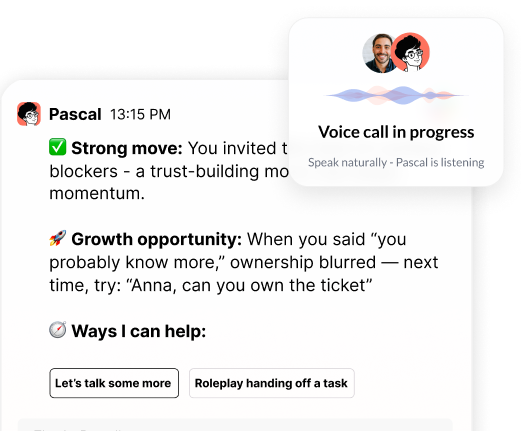
Pascal delivers AI coaching directly in Slack, Teams, Zoom, and one-on-ones. With user-level data isolation, SOC2 compliance, and zero-day retention capabilities, your team gets personalized guidance without privacy concerns.
Explore how Pascal protects employee privacy while scaling manager effectiveness.
Header photo by Vitaly Gariev on Unsplash

.png)
.webp)
“Thank you for setting the great foundation for my promotion; now I have a plan!"

Curious to see how AI Coaching can 10X the impact and scale of your development initiatives. Book a demo today for: