

AI coaching platforms protect employee data through SOC 2 compliance, encryption, user-level data isolation, and policies against training on customer information. Purpose-built platforms combine personalized guidance with architectures that prevent data leakage between employees while maintaining regulatory compliance.
Enterprise-grade AI coaching requires SOC 2 Type II compliance, end-to-end encryption, and GDPR/CCPA adherence. These form the foundation that determines whether your platform becomes a trusted resource or a liability.
Jackson Lewis's 2024 privacy outlook notes that AI governance is now judged by documented processes and accountability, not aspirational principles. Organizations using AI for performance management face increasing scrutiny from regulators and employees.
Critical security standards include:
• SOC 2 Type II certification: Validates that security controls operate effectively over time through regular audits, not just at a single point.
• Encryption standards: Data encrypted in transit (TLS 1.3) and at rest (AES-256). The National Institutes of Health emphasizes that robust encryption must be implemented for all collected data, with specialized parsing systems that prevent unauthorized access during breaches.
• Regional compliance: GDPR for European employees, CCPA for California residents, with data residency controls that let organizations specify where employee data is stored and processed.
• Access controls: SSO integration, role-based permissions, and audit logging for all data access events.
Pascal by Pinnacle maintains SOC 2 compliance and offers full data residency controls. This matters for life sciences and financial services companies navigating complex regulatory requirements where temporary data storage creates compliance risk.
User-level data isolation (each employee's coaching conversations stored separately from every other employee's data) prevents the most common privacy failure in AI systems: cross-contamination where one person's sensitive information appears in another's coaching session.
Architectural safeguards include:
• Separate data instances: Each employee gets an isolated coaching environment with no shared memory between accounts.
• Zero cross-account access: The AI coach for Employee A has no visibility into conversations with Employee B, even on the same team.
• Meeting-based permissions: The platform only accesses meetings where the specific employee is present—no backdoor access to team discussions they didn't attend.
• Anonymized aggregation: Organizational insights require minimum thresholds (10+ employees) to prevent individual identification.
This isolation model differs from traditional coaching, where human coaches might inadvertently reference patterns observed across clients. It also contrasts with LMS platforms that aggregate learning data at the team level, potentially exposing individual progress to managers.
Pascal maintains strict data separation where your version of the platform only accesses interactions it witnessed with you present. It doesn't share data from private conversations between other people.
AI coaching platforms should offer configurable retention policies ranging from zero-day deletion (processing without storage) to rolling retention windows based on your organization's risk tolerance. The key question: can we prove data is deleted when we say it is?
Retention options include:
• Zero-day retention: Transcripts processed for behavioral insights but never stored—critical for pharmaceuticals and financial services where temporary data storage creates compliance exposure.
• Rolling retention windows: Organizations set 30-day, 90-day, or custom retention periods for different data types (chat logs, meeting transcripts, performance insights).
• Deletion verification: Platforms provide audit trails confirming when data was permanently removed from all systems, including backups.
• Employee-initiated deletion: Individuals delete their own coaching history without IT intervention, giving them control over their personal development data.
• Post-termination protocols: Clear policies for what happens to coaching data when employees leave, including whether departing employees can access their coaching history.
Pascal offers customizable retention policies including zero-day options for conservative security environments. This addresses concerns from industries where data retention itself creates regulatory risk, regardless of how well that data is protected.
The vendor demo is where privacy promises meet reality. These questions separate platforms with genuine security architecture from those with compliance theater.
Cloverleaf's privacy framework notes that organizations should verify that systems minimize stored personal information and limit data use to stated purposes. Here are the critical questions:
Architecture and data flow:
• "Can you show me the data flow diagram from employee interaction to storage to deletion?"
• "What happens if I want zero-day retention—can you still provide coaching value?"
• "How do you prevent data from Employee A appearing in Employee B's coaching session?"
Compliance and certification:
• "When was your last SOC 2 audit, and can I see the report?"
• "How do you handle GDPR right-to-deletion requests within 30 days?"
• "What data residency options do you offer for our European employees?"
Training and model updates:
• "Do you train your AI models on customer data? If so, can we opt out?"
• "How do model updates work—do they require reprocessing our historical data?"
• "What happens to our data if we terminate the contract?"
Sensitive content handling:
• "How does your platform detect and escalate sensitive topics like harassment or mental health concerns?"
• "Who has access to flagged conversations, and what's the escalation protocol?"
• "Can we customize what topics trigger human review based on our policies?"
Pascal includes moderation flags, sensitive topics escalation to human resources, organization-specific controls, and anonymous aggregated insights that protect individual privacy while providing organizational value.
The tension between effective coaching and privacy protection isn't binary—it's about finding the right equilibrium for your organization's risk tolerance and culture. Platforms that collect too little data deliver generic advice that managers ignore. Platforms that collect too much create surveillance concerns that destroy trust.
The minimum viable context includes:
• Role and career information: Job title, function, tenure, career aspirations—enough to tailor advice without exposing sensitive performance data.
• Team dynamics: Who reports to whom, team structure, collaboration patterns—but not the content of private conversations.
• Company culture: Values, competencies, leadership principles—the framework that makes coaching feel aligned with organizational expectations.
• Performance context: Goals, development areas, recent feedback themes—but stored at the individual level with no manager access to raw coaching conversations.
Organizations should implement what Cloverleaf calls "privacy by design": systems that minimize personal information stored, limit data use to stated purposes, define retention clearly, and maintain transparency about what data is collected and why.
Pascal provides hyper-personalized coaching based on your role, goals, and company culture while maintaining strict data separation. Your manager never sees your coaching conversations—only anonymized, aggregated insights when there are enough participants to protect individual privacy.
Certain vendor responses should immediately escalate your security review process. These red flags indicate inadequate security architecture or lack of transparency about data practices.
Critical warning signs:
• Vague answers about data training: If a vendor can't clearly explain whether they train models on customer data, assume they do. Purpose-built platforms should have explicit "no training on customer data" policies.
• No SOC 2 certification: If they're "working toward" compliance but don't have it, they're not ready for enterprise deployment.
• Shared data architecture: If the vendor describes "aggregate learning" or "cross-customer insights," your data is being pooled with other organizations.
• Unclear retention policies: If they can't specify how long data is stored and provide deletion verification, they lack basic data governance.
• No sensitive content escalation: If there's no protocol for flagging harassment, discrimination, or mental health concerns, the platform creates legal exposure.
• Generic privacy policies: If the privacy policy reads like it was copied from a consumer app, the vendor hasn't thought through enterprise requirements.
Large enterprises in heavily regulated industries like pharma, banking, and hedge funds are cautious about data privacy. They're often reluctant to adopt tools that record meeting information, even with zero-day retention policies. This caution is justified—the cost of a privacy breach far exceeds the value of any coaching platform.
• SOC 2 Type II compliance, end-to-end encryption, and GDPR/CCPA adherence are baseline requirements, not premium features—platforms without these certifications aren't ready for enterprise deployment.
• User-level data isolation prevents cross-contamination where one employee's sensitive information appears in another's coaching session.
• Zero-day retention options allow organizations to extract coaching value without storing transcripts, addressing concerns from heavily regulated industries where data retention itself creates compliance risk.
• The right balance between personalization and privacy includes role, team dynamics, company culture, and performance context while maintaining strict separation between individual coaching conversations and organizational insights.
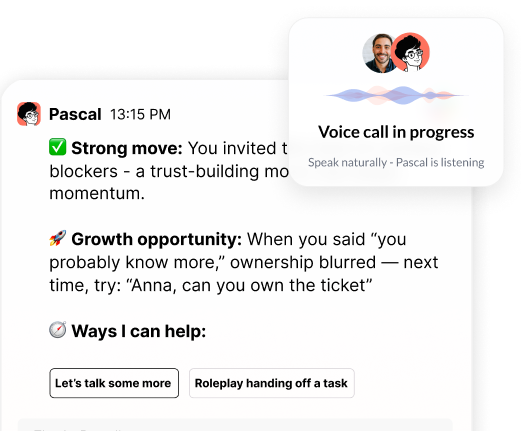
Pascal combines personalized AI coaching with enterprise-grade security: SOC 2 compliance, user-level data isolation, zero training on customer data, and configurable retention policies including zero-day options. See how Pascal works inside Slack to deliver coaching that's both effective and protected.
Header photo by Christina @ wocintechchat.com M on Unsplash

.png)
.webp)
“Thank you for setting the great foundation for my promotion; now I have a plan!"

Curious to see how AI Coaching can 10X the impact and scale of your development initiatives. Book a demo today for: