

AI coaching delivers guidance before difficult conversations (preparation and role-play), during the interaction (real-time observation), and after (structured reflection). This continuous loop turns isolated training events into ongoing skill development.
Traditional feedback training happens in workshops, often weeks before managers face actual difficult conversations. A manager absorbs the Situation-Behavior-Impact framework in a conference room, then faces a performance conversation three months later with no reinforcement.
Generic frameworks don't account for individual employee personalities. A manager might remember the model but have no idea how to adapt it when the employee becomes defensive.
According to a 2023 LinkedIn Learning report, managers cite "lack of practice opportunities" and "no real-time support" as the top barriers to effective feedback conversations. Traditional training platforms show 12-18% utilization rates despite high costs, while 1:1 executive coaching remains accessible only to senior leaders.
Effective learning requires three elements: psychological safety to experiment, immediate feedback on performance, and structured reflection that connects actions to outcomes.
AI coaching creates psychological safety by offering a judgment-free space to practice. When a manager rehearses firing an underperformer, they can stumble through the first attempt, use the wrong tone, and forget to explain next steps. The AI identifies what worked (clear opening statement) and what didn't (rushed through the hard part).
Immediate feedback matters more than perfect advice. Traditional coaching happens days after the conversation, when memory has faded. AI coaching provides feedback within minutes, while the conversation is still fresh.
Pattern recognition emerges over time. After 12 conversations, a manager might discover they interrupt employees who process information verbally. They hadn't noticed this pattern in real-time, but the AI flagged it consistently. They start counting to three before responding—a small change that employees mention in the next 360 review.
AI coaching requires access to sensitive conversations. What data does it collect? Who can see it? What happens when it misreads a situation?
Pascal operates under three privacy principles. First, conversations remain confidential between the manager and the AI. HR doesn't see transcripts unless the manager shares them. Second, the AI flags certain topics (discrimination, harassment, threats) for human review, but these flags go to the manager first with guidance on when to escalate. Third, the system is SOC2 Type II certified and processes data according to enterprise security standards.
The AI learns from communication research and coaching frameworks—not from other managers' private discussions. When a manager role-plays a performance conversation, the system draws on established models and aggregated behavioral patterns, not individual conversation data.
What happens when the AI gives bad advice? Managers can flag suggestions that didn't work, and these flags inform future guidance. The AI doesn't make decisions—it offers observations and options. Managers still choose their own words and approach.
The biggest risk isn't bad advice—it's over-reliance. Managers who use AI coaching as a crutch instead of a development tool stop building their own judgment. Pascal addresses this by reducing support as managers demonstrate competence. After a manager successfully navigates 15 difficult conversations, the AI shifts from prescriptive guidance to open-ended questions.
Sarah, a first-time engineering manager at a Series B startup, had to tell her top performer he wasn't getting promoted. She'd taken the company's feedback training six months earlier but couldn't remember the frameworks. At 9 PM the night before the conversation, she opened Pascal in Slack.
She role-played the conversation with the AI coach. The AI asked her to explain the promotion decision, then responded as her employee might: "So you're saying I'm not good enough?" Sarah's first attempt was defensive. The AI flagged it: "You started with 'It's not that simple'—this phrase often escalates tension. Try acknowledging his feeling first."
Sarah tried again: "I hear that this is disappointing. Let me explain the specific skills the senior role requires." The AI confirmed this approach, then helped her prepare for three likely objections based on what Sarah had told it about the employee's communication style (direct, results-focused, impatient with process).
The next day, the conversation went better than expected. The employee was disappointed but understood the gap. Sarah received feedback within 10 minutes: the AI identified the exact moment where her tone shifted from defensive to collaborative, and flagged one instance where she interrupted him mid-sentence.
Over the next six months, Sarah had 14 more difficult conversations. The AI tracked patterns: she tended to hedge accountability with phrases like "I'm not sure if this is a big deal, but..." She practiced removing these qualifiers. By month six, her 360 review scores improved by 23 points in "delivers clear feedback" and 18 points in "creates accountability." Her team's engagement scores increased from 6.2 to 7.8 (out of 10). The employee she'd denied promotion hit the required skills in four months and was promoted in the next cycle.
AI coaching doesn't replace human coaches—it handles repetitive skill-building so human coaches can focus on strategic development.
Human coaches excel at deep relationship-building, nuanced emotional intelligence, and career guidance. They can't be present in every meeting or available at 2 AM when a manager is drafting a difficult email. AI coaches respond instantly when managers need help, embed in Slack and Teams (platforms managers already use dozens of times per day), and cost $50-$100 per manager per year compared to $200-$600 per hour for traditional executive coaching.
This economic reality means most organizations limit human coaching to senior leaders, leaving first-time and mid-level managers without support. According to a 2024 Harvard Business Review study, only 8% of first-time managers receive any coaching in their first year, despite facing the steepest learning curve.
The most effective approach combines both. At a 400-person technology company, managers use Pascal for routine feedback conversations and skill-building. When a manager faces a complex situation (restructuring a team, managing out a long-tenured employee, navigating a discrimination complaint), they work with a human coach. In the first year, 89% of difficult conversations were handled with AI coaching alone, while 11% required human coach escalation. The AI handles volume; humans handle complexity.
Data Breakdown:
• Feature: Cost | AI Coaching: $50-$100 per manager/year | Traditional Training: $500-$2,000 per manager/year | Human Coaching: $200-$600 per hour
• Feature: Availability | AI Coaching: 24/7, instant response | Traditional Training: Scheduled workshops (quarterly/annual) | Human Coaching: Scheduled sessions (weekly/monthly)
• Feature: Feedback Timing | AI Coaching: Immediate (within minutes) | Traditional Training: Weeks/months after training | Human Coaching: Days after conversation
• Feature: Scalability | AI Coaching: Unlimited managers | Traditional Training: Limited by instructor availability | Human Coaching: Limited to senior leaders
• Feature: Best For | AI Coaching: Skill-building, practice, real-time support | Traditional Training: Foundational knowledge | Human Coaching: Complex situations, strategic development
Five capabilities separate purpose-built coaching systems from generic chatbots.
Proactive engagement. The platform initiates support before critical moments. When a manager schedules a 1:1 with an employee who received critical feedback last week, the AI surfaces guidance without waiting to be asked.
Contextual awareness. The AI needs access to communication patterns and team dynamics to provide relevant guidance. When Sarah prepared for her promotion conversation, the AI used information she'd provided about her employee's communication style to tailor its role-play responses.
Personalization. The platform adapts to individual manager styles and company values. A manager with 15 years of experience receives different guidance than a first-time manager does. The AI reinforces company-specific competencies (at Sarah's startup: "default to transparency" and "disagree and commit").
Enterprise-grade privacy. Look for SOC2 Type II compliance, clear data policies, and organization-specific controls. Conversations should remain confidential, with moderation flags for sensitive topics that escalate to human HR support.
Continuous learning loops. After each difficult conversation, the platform provides observations that build on previous feedback. Sarah tracked her progress over six months: she reduced hedging language by 60%, increased her use of specific examples by 40%, and improved her ability to stay calm when employees became defensive.
• Traditional feedback training fails because it happens weeks before managers need it, offers generic frameworks, and provides no practice or reflection on actual conversations
• AI coaching transforms difficult conversations into learning moments by providing preparation support, immediate feedback, and structured reflection—creating the psychological safety and feedback required for skill development
• Privacy concerns (data access, confidentiality, bad advice) are addressed through SOC2 certification, manager-controlled sharing, and feedback loops that flag unsuccessful guidance
• The most effective approach combines AI coaching for routine support (available 24/7, embedded in existing tools, $50-$100 per manager per year) with human coaches for complex situations requiring nuanced judgment ($200-$600 per hour)
• Look for five capabilities: proactive engagement, contextual awareness, personalization to company values, enterprise-grade privacy, and continuous learning loops that track manager progress over time
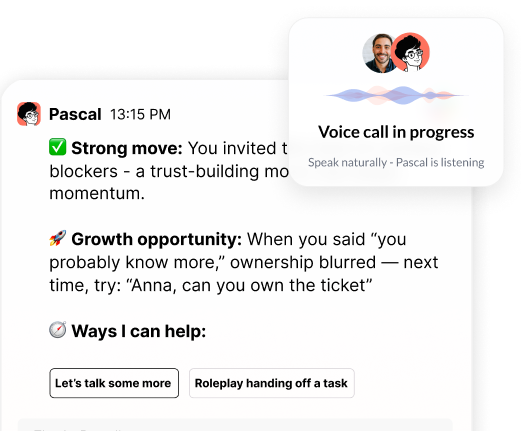
Pascal by Pinnacle delivers AI coaching when managers need it—before difficult conversations, during real-time interactions, and after critical moments. Built by ICF-certified coaches, Pascal turns every feedback conversation into a learning opportunity.
Explore how Pascal transforms manager effectiveness
Header photo by Vitaly Gariev on Unsplash

.png)
.webp)
“Thank you for setting the great foundation for my promotion; now I have a plan!"

Curious to see how AI Coaching can 10X the impact and scale of your development initiatives. Book a demo today for: