

AI coaching provides real-time guidance during difficult conversations, helping managers think clearly when emotions run high. Instead of relying on training from weeks ago, managers get specific support in the moment they need it.
Most managers receive training in workshops, then face actual conversations alone and anxious. The gap between learning a framework and applying it under pressure causes three problems: managers avoid difficult conversations until problems fester, they calibrate wrong (too harsh or too vague), and they don't follow through afterward.
Qualtrics research found that feedback frequency predicts manager effectiveness better than any other factor. Yet most managers skip these conversations because they lack confidence.
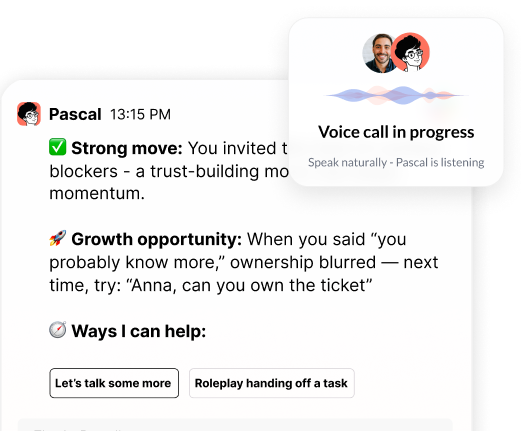
AI coaching closes the timing gap. Pascal by Pinnacle appears in Slack when a manager is preparing for a tough conversation, providing talking points based on the specific employee's communication style. The technology handles cognitive load (remembering frameworks, adapting to personalities) so managers can focus on the human connection.
Managers avoid feedback conversations for three reasons. They fear damaging relationships, especially in remote environments where repair is harder. They feel unprepared to navigate the discussion without clear talking points. And they lack confidence managing their own emotions and responding to employee reactions.
The consequences compound. Problems that could be addressed in brief conversations grow into performance issues requiring formal documentation. Team dynamics suffer as other employees notice poor performance goes unaddressed. Managers experience increased stress from the growing backlog of unresolved issues.
AI coaching addresses each barrier. Structure reduces preparation anxiety. Real-time support helps managers regulate emotions during tense moments. Better outcomes build confidence that makes future conversations less intimidating.
Pascal creates a private space where managers rehearse difficult conversations without judgment. The AI roleplays as the specific employee using past meeting data, letting managers test approaches and build confidence through repetition.
A manager preparing to address missed deadlines can practice the conversation five times, adjusting based on feedback. The AI simulates realistic responses, so when the actual conversation happens, the manager has already worked through their anxiety.
The practice environment offers privacy (no peers watching), repetition (unlimited attempts), and immediate feedback on tone and word choice. The simulation adapts to different personality types. For an analytical employee who prefers data-driven discussions, the AI roleplay reflects that preference. For a relationship-oriented employee, the simulation emphasizes connection and context before diving into performance issues.
Traditional training offers one or two roleplay opportunities with peers. AI coaching enables unlimited practice. A manager can run through a difficult conversation ten times in thirty minutes, testing different approaches and building muscle memory.
"Managers rarely need help in a workshop—they need it when preparing for a tough 1:1 or in the middle of a team conflict." — Melinda Wolfe, Former CHRO at Bloomberg, Pearson, and GLG
Pascal joins Zoom and Google Meet sessions, providing live prompts in Slack without disrupting conversation flow. When a manager becomes defensive, the AI flags it. When a conversation stalls, it suggests reframing techniques.
The AI monitors conversation patterns, tone indicators, and content themes simultaneously. When it detects warning signs (a manager talking too much without pausing for employee input, language becoming accusatory, or the conversation drifting from its intended purpose), it delivers targeted prompts.
These prompts are brief and actionable. Rather than lengthy explanations, the AI might suggest: "Pause and ask what they think" or "Reframe this around future goals." The brevity ensures managers can quickly absorb and apply the guidance without losing conversation momentum.
Employees in the conversation don't see the AI prompts. The manager receives guidance through a separate Slack channel, maintaining the human connection while benefiting from technological support.
Real-time guidance also helps managers recognize and capitalize on positive moments. When an employee shows openness to feedback or takes accountability for a mistake, the AI prompts the manager to reinforce that behavior.
The technology learns from each interaction, becoming more attuned to individual manager styles and team dynamics. Over time, the AI recognizes patterns specific to each manager's communication approach and tailors suggestions accordingly. This personalization means the guidance becomes increasingly relevant and actionable as the system gathers more data.
AI coaching systems analyze multiple data streams to provide contextual guidance. They process conversation transcripts in real-time, identifying key phrases and emotional indicators. They reference historical performance data, previous feedback conversations, and employee development plans to ensure suggestions align with ongoing growth trajectories.
The technology also considers organizational context. Company values, leadership competencies, and cultural norms inform the guidance provided. A startup with a direct communication culture receives different prompting than a traditional enterprise where diplomatic language is valued.
Natural language processing enables the AI to understand not just what is said, but how it's said. Tone analysis detects frustration, defensiveness, or disengagement. Sentiment tracking monitors whether conversations are trending positive or negative. Pattern recognition identifies when discussions are becoming circular or unproductive.
Machine learning algorithms improve over time. As managers use the system, it learns which prompts lead to successful outcomes and which fall flat. This continuous improvement means the coaching becomes more effective with each interaction.
The data privacy considerations are significant. AI coaching systems must handle sensitive performance information, personal development goals, and confidential business discussions. Leading platforms use encryption, role-based access controls, and data minimization principles to protect information while still providing valuable guidance.
Table: Traditional Coaching vs. AI-Enabled Coaching
Data Breakdown:
• Aspect: Timing | Traditional Coaching: Post-conversation analysis | AI-Enabled Coaching: Real-time guidance during conversation
• Aspect: Availability | Traditional Coaching: Scheduled sessions only | AI-Enabled Coaching: On-demand, 24/7 access
• Aspect: Practice Opportunities | Traditional Coaching: Limited roleplay in workshops | AI-Enabled Coaching: Unlimited simulation practice
• Aspect: Personalization | Traditional Coaching: Generic frameworks | AI-Enabled Coaching: Adapted to specific employee and situation
• Aspect: Follow-through | Traditional Coaching: Manual tracking by manager | AI-Enabled Coaching: Automated reminders and progress tracking
The difference between demotivating criticism and useful feedback is framing. AI coaching helps managers structure conversations around future potential rather than past failures.
Instead of "you did this wrong," the AI guides managers toward "here's how to grow in this area." Pascal provides specific language patterns that reduce defensiveness and connects performance gaps to development resources.
Traditional approach: "You've been missing deadlines."
AI coaching approach: "I've noticed the last three project deadlines were missed. Let's talk about what's getting in the way and how I can better support you."
The second approach opens dialogue instead of triggering defensiveness.
When people receive criticism framed as judgment of their character or abilities, their brains activate threat responses. Blood flow shifts from the prefrontal cortex (responsible for reasoning and learning) to the amygdala (responsible for fight-or-flight responses). In this state, learning is neurologically impossible.
Feedback framed as development data keeps the prefrontal cortex engaged. The employee can process information, consider alternatives, and commit to behavior change.
AI coaching helps managers master this reframing through pattern recognition and suggestion. When a manager types or says something that sounds judgmental, the AI offers alternative phrasings. Over time, managers internalize these patterns and begin reframing naturally, even without AI prompts.
The connection to career goals is powerful. When feedback is explicitly linked to what an employee wants to achieve (a promotion, skill development, or project leadership), it transforms from criticism into a roadmap. The AI helps managers make these connections by accessing employee development plans and suggesting relevant links during conversations.
Managers avoid difficult conversations because they fear saying the wrong thing or damaging relationships. AI coaching removes this barrier by providing a safety net.
When managers know they have real-time support available, they initiate conversations rather than avoiding them. Pascal provides specific talking points, helps managers prepare thoroughly, and offers support during the conversation itself.
The confidence gap shows up in conversation frequency. Managers with AI support have more feedback conversations because the anxiety barrier is lower. More conversations create more learning opportunities for both managers and employees.
Each successful conversation makes the next one easier. Managers who complete one difficult conversation with AI support gain evidence that they can handle these situations. This evidence-based confidence is more durable than confidence built on theory alone.
This increased frequency creates a virtuous cycle. More conversations mean more practice, which builds more confidence, which leads to even more conversations. The feedback culture shifts from episodic and anxiety-inducing to continuous and normalized.
The psychological safety created by AI support extends beyond individual managers. When teams see their managers handling difficult conversations with greater skill and composure, trust increases. Employees become more receptive to feedback because they experience it as constructive rather than punitive.
Manager Confidence Metrics: Before and After AI Coaching Implementation
Data Breakdown:
• Metric: Feedback conversations per month | Before AI Coaching: 1.8 | After 6 Months: 4.7 | Improvement: +161%
• Metric: Manager confidence rating (self-reported, 1-10 scale) | Before AI Coaching: 5.2 | After 6 Months: 7.9 | Improvement: +52%
• Metric: Employee perception of manager effectiveness | Before AI Coaching: 6.1 | After 6 Months: 8.3 | Improvement: +36%
• Metric: Time spent preparing for difficult conversations | Before AI Coaching: 47 minutes | After 6 Months: 18 minutes | Improvement: -62%
• Metric: Conversations avoided due to anxiety | Before AI Coaching: 43% | After 6 Months: 12% | Improvement: -72%
Most development efforts fail in the gap between feedback and behavior change. Employees agree to change, then return to old patterns because there's no structured support for new behavior.
AI coaching closes this gap through accountability loops. Pascal tracks development goals across conversations, reminds managers to follow up on commitments, and surfaces patterns that indicate whether behavior is changing.
This transforms feedback from a one-time event into an ongoing development process. The technology is persistent without being intrusive, surfacing reminders before 1:1s, after project milestones, and when patterns suggest a check-in would be valuable.
Studies show that without structured follow-up, 70% of development commitments made during feedback conversations are never fully implemented. The reasons are predictable: competing priorities, lack of clarity on next steps, absence of accountability mechanisms, and forgetfulness.
AI coaching addresses each failure point. Competing priorities are managed through intelligent reminder timing. The AI learns when managers and employees are most likely to engage with development activities and schedules prompts accordingly. Lack of clarity is resolved through specific, actionable next steps generated during the initial feedback conversation and reinforced in follow-ups.
When a manager and employee agree on a development goal, the AI creates a tracking structure. Before subsequent 1:1 meetings, both parties receive prompts to reflect on progress. During meetings, the AI surfaces the development goal and suggests discussion points.
The pattern recognition capabilities enable adaptive support. If an employee is making progress on a development goal, the AI suggests ways to accelerate or expand the growth. If progress has stalled, it prompts the manager to explore obstacles and adjust the approach.
When an employee commits to improving presentation skills, the AI can suggest relevant courses, articles, or internal experts. This transforms the development conversation from abstract commitment to concrete action plan with clear resources.
• AI coaching provides just-in-time guidance when managers need it, eliminating the gap between training and application
• Practice environments let managers build confidence before high-stakes conversations, similar to flight simulators for pilots
• Real-time guidance during conversations prevents mistakes as they unfold, not after damage is done
• Reframing feedback as growth data requires specific language patterns that reduce defensiveness and connect gaps to next steps
• Structured follow-through ensures conversations lead to behavior change through progress tracking and ongoing nudges
• Manager confidence increases measurably with AI support, leading to more frequent and more effective feedback conversations
Ready to transform how your managers handle difficult conversations? See how Pascal works inside Slack at www.heypinnacle.com to provide real-time coaching when it matters most.
Header photo by Priscilla Du Preez 🇨🇦 on Unsplash

.png)
.webp)
“Thank you for setting the great foundation for my promotion; now I have a plan!"

Curious to see how AI Coaching can 10X the impact and scale of your development initiatives. Book a demo today for: