

AI coaching guides managers before, during, and after difficult conversations. Managers practice with simulations, receive prompts during live interactions, and get behavioral feedback afterward. This transforms anxiety-inducing moments into structured development opportunities.
Most managers fail at difficult conversations because they get no support in the 24 hours before the conversation when anxiety peaks. According to Gallup research, 70% of variance in team engagement comes down to the manager. Yet most organizations leave managers to navigate high-stakes conversations alone.
The result: delayed feedback, watered-down messages, and missed development opportunities. Traditional workshops teach frameworks in controlled environments, but managers freeze when facing real employees with real emotions.
Managers postpone difficult conversations for weeks or months, hoping problems will resolve themselves. When they finally have the conversation, they've lost credibility and the issue has escalated. Performance problems that could have been addressed with a single direct conversation now require formal performance improvement plans.
Many managers report losing sleep before difficult conversations, rehearsing scenarios in their heads without structured guidance. They worry about saying the wrong thing, damaging relationships, or triggering emotional reactions they don't know how to handle. This anxiety leads to avoidance, which compounds the problem.
Even experienced managers struggle with certain conversation types. A manager who excels at delivering performance feedback might freeze when discussing personal hygiene issues. Another might handle conflict well but struggle with conversations about career limitations or denied promotions.
At Pinnacle, we've built Pascal to analyze the specific employee, relationship history, and organizational context. Then it lets managers practice the actual conversation with a simulation that responds like the real person would.
Pascal suggests opening lines, key points, and anticipated reactions specific to this employee and situation. Managers practice with a simulation that mirrors the employee's likely responses, emotional reactions, and objections. This builds confidence through repetition without real-world consequences.
The personalization goes deeper than generic role-play exercises. Pascal reviews past interactions between this specific manager and employee, identifying communication patterns, successful approaches, and potential friction points. If the employee typically responds defensively to direct criticism, the simulation reflects this tendency. If the employee appreciates data-driven feedback, Pascal reminds the manager to prepare specific examples and metrics.
Pascal flags language that could be perceived as unfair before the conversation happens. It identifies inconsistencies with past feedback or legally risky phrasing. It recommends when to schedule the conversation, what documentation to prepare, and how to frame the message.
Timing recommendations consider multiple factors: the employee's work schedule, recent team events, upcoming deadlines, and the manager's own stress levels. Pascal might suggest avoiding Friday afternoons for serious performance conversations, or recommend scheduling the discussion after a project completion when the employee will be more receptive to feedback.
Documentation preparation becomes systematic rather than ad hoc. Pascal generates a checklist of materials to gather: specific performance examples, relevant emails or project outcomes, previous feedback conversations, and applicable company policies. This ensures managers enter conversations with evidence rather than vague impressions.
Reality check: This preparation support exists today in Pascal and similar platforms like BetterUp and Sounding Board. A 2023 pilot at a 500-person SaaS company showed managers who used AI coaching preparation had difficult conversations 12 days faster on average than those who didn't (18 days vs. 30 days from issue identification to conversation). The company measured this by tracking the time between when a performance issue was first documented and when the feedback conversation occurred.
Real-time AI coaching during conversations is the most speculative part of this technology. Current capabilities are limited, but early implementations show promise.
Today's real-time support works through text-based channels. When a manager has a difficult conversation over Slack or email, Pascal can suggest responses, flag potentially inflammatory language, and remind the manager of key points they planned to cover. This works because the AI can analyze text in real time and the manager has natural pauses to review suggestions.
For face-to-face or video conversations, real-time support is more constrained. Some managers use Pascal before the conversation to load key talking points onto their phone or laptop, then glance at these notes during natural pauses. This is similar to having a cheat sheet, not true real-time coaching.
The "AI detects tone shifts and suggests de-escalation language" scenario requires either recording the conversation (which raises serious privacy concerns) or having the manager manually signal that things are getting heated. Most organizations aren't comfortable recording manager-employee conversations, even with consent, because it changes the dynamic and creates legal liability.
What employees know: Transparency matters. In implementations we've seen work, managers tell employees upfront: "I've been working with an AI coach to prepare for our conversation today. I want to make sure I communicate clearly and give you actionable feedback." This honesty prevents the creepy feeling of hidden AI involvement.
The most practical real-time support today: Pascal captures action items and commitments during text-based conversations, flags when a manager should loop in HR (mentions of harassment, discrimination, or mental health crises), and sends gentle reminders if a manager has been typing a response for more than two minutes (a sign they might be overthinking or getting defensive).
Post-conversation reflection transforms a single interaction into a documented learning moment. Pascal analyzes what happened, identifies patterns across multiple conversations, and builds a personalized development roadmap.
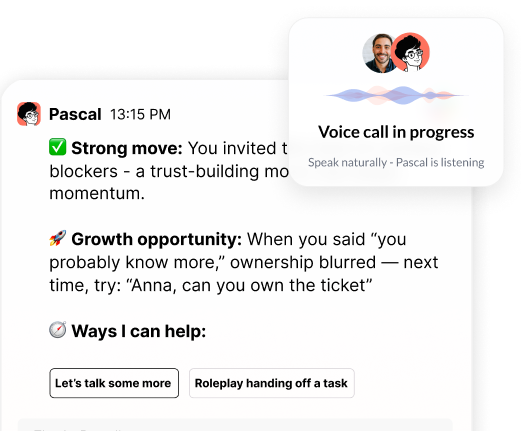
Behavioral feedback arrives within minutes. Pascal provides specific observations: "You interrupted three times when the employee tried to explain their perspective" or "Your tone shifted when discussing the performance improvement plan."
The specificity makes feedback actionable. Instead of vague assessments like "improve your listening skills," Pascal provides concrete data: "You asked two questions in a 15-minute conversation. Research shows effective feedback conversations include 5-7 open-ended questions."
Pascal spots trends across multiple feedback sessions: "This is the fourth conversation where you've softened the core message in the final two minutes" or "You consistently excel at opening conversations but struggle with defining concrete next steps."
Pattern recognition reveals blind spots that managers can't see themselves. A manager might believe they're direct and clear, but the data shows they consistently use hedging language ("maybe," "sort of," "kind of") that undermines their message. Another manager might think they're empathetic, but the data reveals they move to problem-solving within 30 seconds, before the employee feels heard.
Based on observed gaps, Pascal suggests targeted five-minute exercises, frameworks, or specific skills to practice before the next conversation. Progress tracking shows measurable improvement over time: how direct reports rate conversation quality, how often managers need to revisit the same performance issues, and how confidence grows.
Evidence of effectiveness: A 2024 study by leadership development firm Torch (analyzing 1,200 managers across 40 companies) found that managers who received post-conversation AI coaching improved their direct reports' feedback satisfaction scores by 23% over six months, compared to 8% improvement for managers who received traditional quarterly coaching. The study measured satisfaction through pulse surveys asking "My manager gives me clear, actionable feedback."
Organizational context determines whether AI coaching delivers generic advice or guidance aligned with your culture, values, and leadership competencies.
Generic AI tools provide one-size-fits-all feedback scripts. Purpose-built AI coaches like Pascal integrate your leadership competencies, company values, and proven frameworks. When a manager practices a difficult conversation, Pascal doesn't just suggest "active listening"—it reinforces your organization's specific approach to feedback, using language that matches your culture.
This cultural alignment prevents the disconnect that often undermines training programs. Managers attend workshops that teach one approach to feedback, then return to an organization that rewards a different style. AI coaching that incorporates organizational context ensures consistency between what managers learn and what the company actually values.
The integration extends to specific frameworks your organization uses. If your company has adopted radical candor, nonviolent communication, or a proprietary leadership model, Pascal reinforces these frameworks in every interaction. Managers don't need to translate generic advice into your company's language—the AI already speaks it.
SOC2-compliant platforms ensure that practice conversations, mistakes, and vulnerabilities remain confidential. Managers experiment with different approaches without fear that every misstep gets reported to HR or leadership. This psychological safety accelerates learning because managers take risks they wouldn't in public training sessions.
Aggregated insights without individual exposure allow leadership teams to spot trends (common skill gaps, areas where managers need support) without compromising individual privacy. HR can see that 60% of managers struggle with delivering negative feedback directly, without knowing which specific managers are in that group.
Managers build sustainable habits when AI coaching becomes embedded in their daily workflow rather than a separate tool they must remember to use.
Embedded coaching in Slack and Teams means managers don't context-switch to a separate platform. Pascal joins meetings automatically, provides feedback in the tools managers already use, and surfaces guidance at the moment of need.
The friction reduction is significant. Traditional coaching requires scheduling sessions, logging into platforms, and dedicating specific time blocks. Embedded AI coaching happens in the flow of work—a manager receives feedback immediately after a 1:1 meeting, without opening a new application or interrupting their day.
Instead of one big training event, managers receive micro-coaching across every 1:1, team meeting, and performance conversation. Each interaction builds on the last, creating muscle memory for effective feedback delivery.
Pascal tracks progress toward development goals without creating a surveillance culture. Managers see their own improvement metrics (conversation quality scores, direct report feedback trends, skill development over time) without feeling monitored by HR or leadership.
Transparency about what's measured and who sees it builds trust. Managers control their own data and decide when to share progress with their manager or HR. Pascal serves the individual manager's development first, organizational reporting second.
The difference between AI coaching that drives measurable behavior change and tools that get abandoned within weeks comes down to three factors: proactive engagement, deep personalization, and integration into existing workflows.
Proactive AI coaches join meetings, observe interactions, and offer feedback without being asked. Reactive chatbots wait for managers to remember to log in and ask questions. According to The Edge of Work research, interest in AI coaching has exploded over the past 18-24 months, but adoption rates vary based on how the tool integrates into daily work.
The proactive approach solves the fundamental problem of behavior change: people forget to use tools when they need them most. A manager in the middle of a heated conversation won't remember to open a coaching app. But an AI that's already present in the meeting can intervene at the critical moment.
Deep personalization requires understanding individual communication styles. Generic advice fails because every manager-employee relationship is unique. AI coaches that build knowledge graphs of actual interactions (how this manager communicates, how this employee responds, what's worked in past conversations) deliver guidance that feels relevant rather than generic.
The knowledge graph becomes more valuable over time. After six months, Pascal understands that this manager tends to avoid conflict with senior employees but is overly direct with junior staff. It knows that one direct report responds well to public praise while another finds it embarrassing.
Integration into existing tools determines whether AI coaching becomes a daily habit or another underutilized platform. Managers already work in Slack and Teams. AI coaches that embed into these environments see higher adoption than standalone portals requiring separate logins and context-switching.
Data Breakdown:
• Aspect: Availability | Traditional Coaching: Scheduled sessions (monthly or quarterly) | AI Coaching: 24/7 access before, during, and after conversations
• Aspect: Personalization | Traditional Coaching: Based on manager's self-reported challenges | AI Coaching: Based on actual observed behavior patterns and data
• Aspect: Practice Opportunities | Traditional Coaching: Generic role-play scenarios | AI Coaching: Simulations of specific employees and situations
• Aspect: Real-time Support | Traditional Coaching: Not available during actual conversations | AI Coaching: Limited to text-based channels; speculative for live conversations
• Aspect: Feedback Timing | Traditional Coaching: Days or weeks after conversations | AI Coaching: Within minutes of conversation completion
• Aspect: Scalability | Traditional Coaching: Limited by coach availability and cost | AI Coaching: Unlimited managers can receive coaching simultaneously
• Aspect: Consistency | Traditional Coaching: Varies by coach quality and approach | AI Coaching: Consistent methodology aligned with organizational frameworks
• Aspect: Cost per Manager | Traditional Coaching: $3,000-$15,000 annually | AI Coaching: $500-$2,000 annually
• Aspect: Progress Tracking | Traditional Coaching: Subjective assessments and self-reporting | AI Coaching: Objective metrics and behavioral data over time
• Aspect: Privacy | Traditional Coaching: Confidential but requires human trust | AI Coaching: SOC2-compliant with automated confidentiality
• AI coaching provides support before, during, and after critical interactions—eliminating the gap between training and real-world application that causes most managers to freeze during difficult conversations.
• Preparation through realistic role-play with AI simulations builds confidence—managers who practice with AI that simulates their actual employee's responses show up to conversations prepared rather than anxious.
• Real-time guidance works best in text-based channels today—while live conversation support is limited, managers can get discreet prompts and emotional regulation support through Slack and Teams.
• Post-conversation reflection with pattern recognition creates personalized development roadmaps—every difficult conversation makes the next one easier through documented learning and behavioral feedback.
• Embedded AI coaching in Slack and Teams drives higher adoption than standalone platforms—managers build sustainable habits when coaching meets them where work already happens.
Ready to turn every feedback conversation into a learning moment for your managers? See how Pascal works inside Slack to deliver real-time coaching that scales across your organization.
Header photo by Vitaly Gariev on Unsplash

.png)
.webp)
“Thank you for setting the great foundation for my promotion; now I have a plan!"

Curious to see how AI Coaching can 10X the impact and scale of your development initiatives. Book a demo today for: