

AI coaching converts feedback conversations into learning opportunities through role-play preparation, real-time guidance, and post-conversation reflection. Pascal integrates into Slack and Teams, offering managers support before, during, and after challenging dialogues.
Feedback conversations fail because managers lack preparation, struggle with emotional regulation, and receive no support during critical moments. AI coaching addresses these through pre-conversation role-play, in-meeting guidance, and post-conversation reflection.
The preparation gap creates the first failure point. A manager needs to address a team member who missed a deadline but hasn't practiced the delivery or anticipated reactions. Pascal enables role-play with context about the specific employee, recent interactions, and team dynamics. The manager describes the situation: "I need to address Sarah's missed deadline and defensive attitude in team meetings." Pascal asks clarifying questions about context and relationship history, then steps into Sarah's role using knowledge of past discussions.
The emotional intelligence deficit compounds the problem. According to DDI's Global Leadership Forecast, 57% of employees report their manager struggles with difficult conversations. During actual conversations, Pascal provides emotional regulation support and suggests reframing techniques when emotions escalate.
Traditional training ends when the workshop does. Pascal continues after the conversation, asking managers to reflect on what worked and scheduling follow-up check-ins to ensure accountability. This sustained engagement drives behavior change: in Pascal's internal data, users report 83% direct report improvement rates and save 150+ hours annually on manager development.
AI coaching fills the gap between learning and doing by meeting managers in real time with personalized guidance.
Comparison: Traditional Approaches vs. Pascal
Data Breakdown:
• Capability: Availability | Traditional Training: Quarterly workshops | Human Coaching: Scheduled sessions | LMS Platforms: Self-paced modules | Pascal: 24/7, in workflow
• Capability: Personalization | Traditional Training: Generic scenarios | Human Coaching: Highly personalized | LMS Platforms: One-size-fits-all | Pascal: Context-aware
• Capability: Cost per manager | Traditional Training: $500–2,000/year | Human Coaching: $15,000+/year | LMS Platforms: $50–200/year | Pascal: ~$150/year
• Capability: Practice opportunities | Traditional Training: Role-play in class | Human Coaching: Limited to sessions | LMS Platforms: None | Pascal: Unlimited
• Capability: Real-time support | Traditional Training: None | Human Coaching: None | LMS Platforms: None | Pascal: During conversations
• Capability: Behavior reinforcement | Traditional Training: One-time event | Human Coaching: Periodic check-ins | LMS Platforms: Self-directed | Pascal: Continuous
Pascal doesn't replace human coaches—it scales what they do best while handling routine guidance. As Melinda Wolfe, former CHRO at Bloomberg, Pearson, and GLG, notes: "If we can democratize coaching, make it specific, timely, and integrated into real workflows, we solve one of the most chronic issues in the modern workplace."
The cost differential matters for scale. Human coaching at $15,000 per manager annually serves only executives. Pascal at $150 per manager makes personalized development accessible across the organization.
Pascal transforms difficult conversations through three phases: preparation (role-play and script development), real-time support (in-meeting guidance), and reflection (post-conversation learning).
Phase 1: Preparation (24–48 hours before)
The manager describes the situation: "I need to address Sarah's missed deadline and defensive attitude in team meetings." Pascal asks clarifying questions about context, relationship history, and desired outcomes. Role-play begins with Pascal stepping into Sarah's role using knowledge of past interactions and team dynamics.
If the manager communicates too aggressively, Pascal corrects in real time and suggests better approaches. The practice feels authentic because Pascal knows the relationship dynamics. Pascal then generates talking points and a conversation framework aligned with company values.
Phase 2: Real-Time Support (during the conversation)
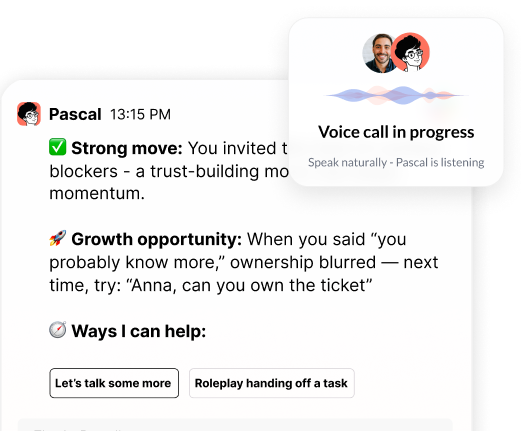
With consent from both parties, Pascal can join the meeting through Slack or Teams to observe dynamics. It provides guidance on pacing, tone, and question framing through a private channel visible only to the manager. When the conversation veers off track, Pascal flags those moments for the manager to notice and adjust.
Phase 3: Reflection (immediately after)
Pascal asks: "How did the conversation go compared to our role-play?" It identifies specific moments where the manager handled things well or could improve. Pascal schedules follow-up check-ins to ensure accountability, tracking progress on the manager's delegation and feedback skills over time.
This approach addresses what Jeff Diana, former CHRO at Calendly, Atlassian, and SuccessFactors, identifies as the core need: "Real learning and value come from in-context coaching—solving problems in the moment, not in a classroom."
Proactive AI coaching drives higher usage because it eliminates the barrier of remembering to seek help—meeting managers where they already work rather than waiting for them to open another app. In Pascal's internal data, proactive engagement achieves 75%+ regular usage compared to 51% for on-demand models.
The activation energy problem creates the barrier. Managers need coaching most when they're overwhelmed—precisely when they're least likely to remember to ask for help. Proactive triggers solve this by joining scheduled 1:1s automatically (with consent), sending pre-meeting preparation prompts, and following up after difficult conversations without requiring the manager to initiate.
Contextual awareness amplifies the impact. Because Pascal integrates with Slack, Teams, and meeting platforms, it knows when a manager is about to have a performance review or just received critical feedback from their team. This knowledge enables timely, relevant interventions.
Behavioral reinforcement creates habit formation. Proactive nudges train managers to expect and rely on coaching moments rather than treating them as optional. Over time, managers internalize the coaching patterns and begin applying them independently.
CHROs should prioritize five capabilities: coaching expertise (not just LLM sophistication), contextual awareness (knowledge of actual team dynamics), proactive engagement (not passive chatbots), cultural alignment (customization to company values), and privacy protection (SOC2 compliance, no training on customer data).
Coaching expertise separates effective platforms from chatbots. Look for platforms trained by ICF-certified coaches (International Coaching Federation, the industry's leading credentialing body), not just engineers optimizing language models. Ask vendors: "Who designed your coaching methodology?"
Contextual awareness determines relevance. Platforms that integrate with Slack, Teams, and meeting tools can reference past conversations, understand team relationships, and provide personalized feedback based on real interactions. Generic platforms that lack this context deliver advice disconnected from actual work situations.
Proactive engagement drives adoption. Platforms that wait for managers to initiate conversations achieve lower adoption. Platforms that join meetings, send timely prompts, and follow up automatically achieve higher regular usage. The difference compounds over time as proactive systems build habits.
Cultural alignment ensures coaching reinforces company values. Platforms should allow customization to specific competencies, leadership principles, and organizational processes. Generic advice that contradicts company culture creates confusion and undermines trust.
Privacy protection addresses the most common CHRO concern. Ensure the platform is SOC2 compliant (a security framework that audits how companies handle customer data) and contractually commits to never training models on customer data. Ask: "Where does our conversation data go, and who can access it?" Platforms that can't answer clearly should be disqualified immediately.
HR leaders can measure AI coaching ROI through four metrics: manager engagement rates (usage frequency), behavior change indicators (360 feedback improvements), time savings (hours redirected from reactive support), and business impact (retention, promotion readiness, team performance). Establish baseline measurements before implementation.
Manager engagement rates provide the leading indicator. Track weekly active users, average sessions per manager, and retention over 90 days. High regular usage demonstrates the tool meets real needs and integrates into workflow effectively.
Behavior change indicators measure actual development. Collect 360 feedback before and after implementation, focusing on specific behaviors like "gives clear, actionable feedback" and "handles difficult conversations constructively." In Pascal's internal data, users report 83% direct report improvement rates on targeted behaviors within six months.
Time savings quantify efficiency gains. Calculate hours HR business partners and L&D teams spend on routine coaching requests, manager escalations, and reactive support. AI coaching platforms can save 150+ hours annually per HRBP by handling common scenarios and providing self-service guidance.
Business impact connects coaching to outcomes. Track manager retention rates, promotion readiness scores, and team performance metrics. While attribution is complex, correlations between coaching engagement and business outcomes validate investment decisions and guide program expansion.
• Feedback conversations fail due to lack of preparation, emotional regulation challenges, and no real-time support—AI coaching addresses all three through role-play, in-meeting guidance, and post-conversation reflection
• Proactive AI coaching achieves higher regular usage because it eliminates the barrier of remembering to seek help and meets managers where they work
• The three-phase AI coaching process (preparation, real-time support, reflection) creates a complete learning loop that traditional training cannot match
• When evaluating platforms, prioritize coaching expertise, contextual awareness, proactive engagement, cultural alignment, and privacy protection over generic AI capabilities
• Measure ROI through engagement rates, 360 feedback improvements, time savings, and business impact metrics—not just training completion rates
Pascal transforms difficult conversations from anxiety-inducing confrontations into structured learning moments. Our AI coach integrates with Slack, Teams, and your meeting platforms to provide real-time guidance when it matters most.
See how Pascal works or schedule a demo to experience the difference between AI coaching and traditional training.
Header photo by Vitaly Gariev on Unsplash

.png)
.webp)
“Thank you for setting the great foundation for my promotion; now I have a plan!"

Curious to see how AI Coaching can 10X the impact and scale of your development initiatives. Book a demo today for: