

AI coaching converts feedback and difficult conversations into learning opportunities by providing real-time guidance, structured frameworks, and safe practice environments when managers need them—turning moments of tension into moments of growth. Unlike traditional training that happens weeks before or after critical conversations, AI coaching meets managers in the moment with personalized support that helps them navigate complexity while building skills.
Difficult conversations fail to become learning experiences because they happen in isolation, without preparation, real-time support, or structured follow-up. Managers receive generic training months before they need it, then face high-stakes conversations alone—with no coach present to help them recognize what's working, what's not, or how to adjust their approach. According to Gallup research, 70% of the variance in team engagement comes down to the manager, yet most receive minimal support for the conversations that matter most.
The traditional approach creates three gaps. First, the timing gap: training happens in workshops while conversations happen in real work contexts weeks or months later. Second, the practice gap: managers learn concepts but never rehearse applying them to their specific situations. Third, the feedback gap: no one observes the actual conversation to provide coaching on what happened.
This is where AI coaching changes the equation. As Melinda Wolfe, former CHRO at Bloomberg, Pearson, and GLG, notes: "Managers rarely need help in a workshop—they need it when preparing for a tough 1:1 or in the middle of a team conflict."
The most effective learning happens through deliberate practice with immediate feedback—what AI coaching provides at scale.
AI coaching transforms feedback conversations into learning moments through three mechanisms: pre-conversation preparation with role-play simulations, real-time guidance during the actual discussion, and structured post-conversation reflection that solidifies new skills. This creates a complete learning loop that traditional training and human coaching cannot replicate at scale.
Before the conversation: AI coaching platforms allow managers to rehearse difficult conversations in a private, judgment-free environment. The AI can simulate the specific employee based on past interaction data, helping managers practice different approaches and receive immediate feedback on their communication style, word choice, and emotional tone. According to TalentLMS research on AI coaching platforms, this "self-led practice area becomes a private gym for communication and decision-making skills" where employees can rehearse repeatedly without fear of real-world consequences.
Here's what this looks like in practice. A manager opens Slack and types: "I need to address missed deadlines with Sarah." Pascal asks clarifying questions about the situation, then offers to role-play the conversation. The manager types what they plan to say. Pascal responds as Sarah might, based on past meeting transcripts and communication patterns. After the practice session, Pascal highlights specific phrases that worked ("You focused on the project impact, not personal criticism") and suggests adjustments ("Consider asking about obstacles before discussing consequences").
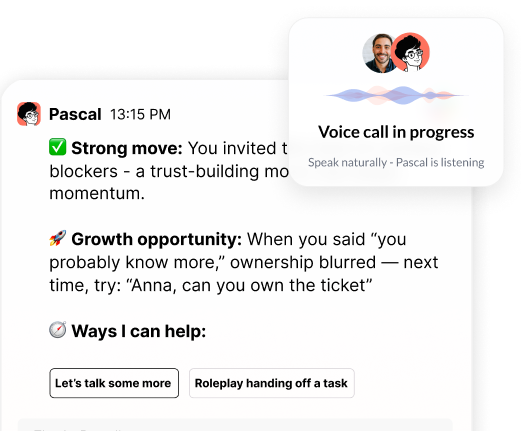
During the conversation: AI coaching can join meetings (with appropriate permissions) and provide real-time observations. Pascal joins scheduled 1:1s and team meetings, observing communication patterns, power dynamics, and missed opportunities for feedback or recognition. After the meeting, it sends a private message: "You gave positive feedback on the Q2 launch, but you didn't acknowledge Maria's specific contribution to the database redesign. Consider following up."
After the conversation: The AI synthesizes what happened, highlights specific moments where the manager demonstrated growth or missed opportunities, and suggests concrete next steps. This immediate feedback loop—not a quarterly review or annual training—transforms isolated conversations into cumulative skill development.
One engineering manager at a Pascal customer company described the shift: "I used to avoid performance conversations until they became crises. Now I practice them with Pascal first, get feedback on my approach, and go into the actual conversation with confidence. The first time I addressed a deadline issue early—before it became a pattern—my team member thanked me for the clarity. That never happened before."
The transformation happens because the manager practiced the conversation three times with Pascal, received feedback on their tone, adjusted their approach, and entered the real conversation with a clear framework. The practice created confidence. The confidence created better execution. The better execution created a learning moment for both manager and employee.
Managers avoid difficult conversations because they fear saying the wrong thing, damaging relationships, or triggering defensive reactions—and they lack confidence in their ability to navigate the emotional complexity. Research from Coachello confirms that "the most effective solutions combine human coaching principles with AI's ability to provide instant feedback and allow leaders to practice key skills more often."
The avoidance creates a vicious cycle: managers delay accountability conversations, performance issues compound, and when they finally address the problem, the conversation is more difficult than it needed to be. AI coaching addresses this directly through three mechanisms.
Providing specific talking points: Instead of generic advice like "be direct but empathetic," Pascal offers actual phrases tailored to the situation: "Based on the project delays we discussed last month, I'd like to understand what's blocking your progress on the Q2 deliverables."
Role-playing the specific employee: Pascal simulates how your actual team member might respond based on past meeting data, personality patterns, and communication style. This isn't generic practice—it's rehearsing the exact conversation you need to have. The simulation quality depends on how much interaction data exists. For a team member you've had 10 meetings with, the simulation reflects their actual communication patterns. For a new hire, Pascal acknowledges the limitation and offers general coaching instead.
Coaching on the accountability dial: Managers need to calibrate their approach between too soft (avoiding the issue) and too hard (damaging the relationship). Pascal helps managers find the right level of directness for each situation and person. The accountability dial is a framework for adjusting your approach based on the severity of the issue and the employee's track record. Pascal asks questions like "Is this the first time or a pattern?" and "What's at stake if this continues?" to help managers calibrate.
AI coaching platforms are purpose-built systems trained on leadership frameworks and organizational culture, with persistent memory of your specific context—while generic AI tools like ChatGPT provide one-off responses without understanding your team dynamics, company values, or past conversations. The difference determines whether you get generic advice or coaching that actually changes behavior.
Generic AI tools have three limitations. First, no persistent memory: ChatGPT doesn't remember your previous conversations, your team members' names, or the context of ongoing situations. Second, no coaching methodology: these tools weren't trained on ICF (International Coaching Federation) principles, leadership frameworks, or the specific competencies your organization values. Third, no integration with work: they exist as separate applications you must remember to use, rather than meeting you where work happens.
AI coaching platforms like Pascal are different by design. They maintain a knowledge graph (a structured database of your working relationships, communication patterns, and development goals that connects related information and tracks changes over time). They're trained by ICF-certified coaches on proven coaching methodologies. They integrate directly into Slack, Teams, Zoom, and Google Meet—providing guidance in the flow of work rather than requiring you to context-switch.
Traditional executive coaching costs $15,000+ per person annually and serves only senior leaders. Pascal delivers coaching at a fraction of that cost, making it accessible to every manager in the organization.
You measure AI coaching effectiveness through three layers: behavioral change in managers, team outcomes, and organizational impact—not just usage metrics or satisfaction scores. The most meaningful indicators are changes in how often managers have difficult conversations, how quickly they address issues, and whether their teams report feeling more supported.
Behavioral indicators: Track whether managers are having more frequent 1:1s, addressing performance issues earlier, and seeking feedback from their teams. In a 2024 internal survey of Pascal customers, 83% of direct reports reported improvement in their managers' effectiveness after implementation. (This data comes from Pascal customer surveys, not independent research.)
Team outcomes: Measure engagement scores, retention rates, and performance metrics for teams whose managers use AI coaching. One Pascal customer (a 500-person technology company) saw a 20% increase in manager NPS (Net Promoter Score, a metric measuring how likely employees are to recommend their manager) within six months of implementing Pascal. The company's baseline manager NPS was 32; after six months it reached 38.
Organizational efficiency: Calculate time saved by HR business partners who no longer field basic management questions, and measure whether managers are escalating the right issues at the right time. Organizations using Pascal report saving 150+ hours of HR time per quarter by handling routine coaching through AI. (This estimate comes from Pascal customer interviews tracking HR ticket volume before and after implementation.)
The key is measuring behavior change, not just tool adoption. A manager who practices one difficult conversation per month and receives feedback is building skills that compound over time—even if they're not using the tool daily.
Human coaches should focus on the complex, emotionally charged situations that require human judgment, empathy, and accountability—while AI coaching handles the routine guidance, practice sessions, and just-in-time support that make up the majority of coaching needs. This complementary model makes coaching accessible to everyone while preserving what only humans can deliver.
AI coaching excels at scalable, consistent support: practicing difficult conversations, providing frameworks for common situations, and offering immediate feedback on communication patterns. Human coaches excel at holding emotional space, navigating ambiguity, and creating accountability for senior leaders facing high-stakes decisions.
The hybrid model works best when AI coaching serves as the first layer of support, available 24/7 for every manager. Human coaches then focus on senior leaders, complex organizational dynamics, and situations requiring deep empathy. As noted by The Edge of Work, organizations experimenting with AI coaching are finding it complements rather than replaces human expertise.
AI coaching should recognize when a situation requires human intervention—such as legal issues, mental health concerns, or complex organizational politics—and provide clear guidance on when to involve HR or a human coach. Pascal flags situations involving potential harassment, discrimination, mental health crises, or legal risk and recommends immediate escalation to HR.
One CHRO at a Pascal customer company described the shift: "We used to have three executive coaches serving 20 senior leaders. Now we have AI coaching for all 200 managers, and our human coaches focus on C-suite and VP-level challenges. We're getting better outcomes at lower cost."
You build trust in AI coaching through transparency about data use, clear escalation paths for complex situations, and demonstrable results that show the AI provides valuable guidance without judgment. Managers need to see that the AI protects their privacy, understands their context, and helps them succeed rather than monitoring them for HR.
Privacy protection is foundational. Pascal is SOC2 compliant (a security standard requiring regular audits of data handling practices) and never uses customer data to train models. Conversations with the AI coach are private to the manager unless they choose to share insights. Anonymous aggregated data helps organizations understand trends without exposing individual conversations.
Here's how consent works in practice: Before Pascal joins any meeting, both participants receive a notification asking for permission. Either person can decline. If a manager wants to practice a conversation with an AI simulation of their employee, Pascal uses only data the manager has access to (meeting transcripts, Slack messages, shared documents). The employee being simulated is not notified, but the simulation is used only for the manager's private practice—never shared or stored beyond that session.
Results build trust over time. When managers see their teams responding better to feedback, when difficult conversations go more smoothly, and when they feel more confident addressing issues early, trust in the AI coaching grows organically.
Start with opt-in pilots where managers volunteer to try AI coaching for specific challenges. Let early adopters share their experiences. Build momentum through demonstrated value rather than mandated adoption.
• AI coaching transforms difficult conversations by providing preparation, real-time guidance, and post-conversation reflection—creating a complete learning loop that traditional training cannot match.
• The most effective AI coaching is proactive, not on-demand—joining meetings and providing feedback in the moment rather than waiting to be asked.
• Purpose-built AI coaching platforms differ from generic AI tools through persistent memory, coaching methodology, and integration into daily workflows.
• Measure success through behavioral change and team outcomes, not just usage metrics—focus on whether managers are having more effective conversations and whether teams feel more supported.
• Human coaches should focus on complex, high-stakes situations while AI coaching handles routine guidance and practice at scale, creating a complementary model that serves everyone.
Pascal by Pinnacle delivers AI coaching directly in Slack, Teams, and meetings—helping managers prepare for difficult conversations, practice with realistic simulations, and receive immediate feedback on their approach. See how Pascal works inside Slack to turn every challenging conversation into a learning moment.
Header photo by Vitaly Gariev on Unsplash

.png)
.webp)
“Thank you for setting the great foundation for my promotion; now I have a plan!"

Curious to see how AI Coaching can 10X the impact and scale of your development initiatives. Book a demo today for: