

AI coaching systems learn safely by isolating each user's data, escalating sensitive topics to humans, and never training on customer conversations. The system improves through expert-designed frameworks, not by pooling employee data across accounts.
Safe learning means the platform personalizes guidance without creating privacy risks or exposing sensitive employee data. Each employee's information stays separate. The system flags inappropriate content and routes topics like harassment or mental health to human resources.
Pascal by Pinnacle isolates each employee's data in SOC2-compliant architecture. Your coaching interactions, meeting transcripts, and performance context never influence another employee's experience. The coaching models improve through frameworks from ICF-certified coaches, not by ingesting employee conversations.
The system routes sensitive discussions (discrimination, mental health crises, legal concerns) to qualified human support automatically. CHROs define what topics are appropriate, what data the coach can access, and how insights are aggregated for leadership visibility.
The platform learns your communication style and leadership challenges by observing meetings you invite it to. This understanding never crosses into another employee's coaching experience.
Pascal knows you struggle with delegation, but it doesn't share that insight with your manager or HR unless you choose to. The coach joins meetings with your consent, providing feedback on actual conversations rather than requiring manual input. The system accesses only necessary data: role, goals, team structure, company values. Not full biographical profiles or performance ratings.
You can view what Pascal knows about you, remove the coach from meetings, and delete conversation history at any time. CHROs see organizational trends (common skill gaps, coaching topic frequency) through anonymized reporting while individual conversations remain confidential.
A tech company with 500 employees using Pascal reported that 83% of direct reports noticed improvement in their managers' effectiveness. The coaching felt personalized to real situations, not generic advice from a training module. (Source: Pinnacle customer case study, Q3 2024)
Technical safeguards include encryption, role-based access controls, audit logging, and architectural isolation that prevents one employee's information from influencing another's coaching.
Pascal's SOC2 Type II compliance demonstrates third-party validation of these controls. AES-256 encryption protects stored data. TLS 1.3 secures data in transit. Conversations cannot be intercepted or accessed by unauthorized parties.
Zero-day retention options let highly regulated environments extract behavioral insights without storing conversation transcripts. The system processes conversations in real-time, extracts metadata (topic frequency, sentiment patterns, skill gaps), then deletes the transcript. This maintains compliance while enabling coaching.
Moderation filters flag inappropriate content, bias indicators, or policy violations to trigger human review. Audit trails log all data access, coaching interactions, and system changes to enable compliance reporting and incident investigation. Regular penetration testing and third-party audits validate ongoing security.
Forrester research found that 68% of employees won't use workplace AI tools if they don't trust how their data is handled. (Source: Forrester, "The State of AI in the Workplace," 2023) Technical safeguards drive adoption.
Traditional HR tech (learning management systems, performance platforms, engagement surveys) collects data periodically and provides static content. AI coaching systems learn continuously from real interactions, providing guidance that evolves as employees grow.
The difference: a quarterly engagement survey shows you had a problem three months ago. Real-time coaching helps you navigate a difficult conversation happening right now.
Data Breakdown:
• Dimension: Learning model | Traditional HR Tech: Static content libraries, annual updates | AI Coaching Systems: Continuous improvement through individual interactions
• Dimension: Personalization | Traditional HR Tech: Role-based content recommendations | AI Coaching Systems: Individual communication style, team dynamics, real challenges
• Dimension: Timing | Traditional HR Tech: Scheduled training events, quarterly reviews | AI Coaching Systems: Just-in-time guidance in the flow of work
• Dimension: Data collection | Traditional HR Tech: Periodic surveys, manual input | AI Coaching Systems: Passive observation of meetings with consent
• Dimension: Privacy model | Traditional HR Tech: Centralized databases, manager visibility | AI Coaching Systems: User-level isolation, confidential coaching
Traditional approaches assume everyone needs the same information at the same time. AI coaching recognizes that a new manager navigating their first performance review needs different support than a senior leader managing organizational change.
Governance frameworks require clear policies on data access, escalation protocols, usage boundaries, and regular audits. CHROs must define what "safe learning" means for their specific culture and compliance requirements before deployment.
Data access policies specify what information the AI coach can access (meeting transcripts, organizational structure) and what remains off-limits. Escalation protocols define when the system routes conversations to human resources, legal, or employee assistance programs. Usage boundaries clarify what topics are appropriate for AI coaching versus human intervention, preventing the system from providing therapy, legal advice, or medical guidance.
Regular audits review coaching interactions for bias, policy violations, or unintended consequences. Transparent communication ensures employees understand how the system works, what data it accesses, and how to opt out.
AI coaching platforms handle sensitive topics through automated detection, immediate escalation to qualified humans, and clear boundaries. Pascal uses moderation flags to identify discussions about harassment, discrimination, mental health crises, or legal concerns, then routes those conversations to appropriate resources (HR, employee assistance programs, legal counsel) rather than attempting to coach through them.
The system states its limitations: "I'm not qualified to provide mental health counseling. Let me connect you with someone who can help." This transparency protects both employees and organizations while ensuring people get appropriate support.
Automated detection uses natural language processing to identify keywords, sentiment patterns, and context clues that indicate sensitive topics. Human-in-the-loop review ensures edge cases receive appropriate attention. Clear disclaimers remind users that AI coaching complements but doesn't replace human judgment, legal advice, or clinical support.
Metrics include adoption rates, coaching interaction frequency, escalation accuracy, privacy incident rates, and behavior change outcomes. Track both leading indicators (engagement, trust) and lagging indicators (performance improvement, retention).
Adoption rates above 60% within 90 days indicate employees trust the system. Coaching interaction frequency of 3-5 sessions per week per user suggests the guidance is relevant and timely. Escalation accuracy measures whether sensitive topics are correctly identified and routed to appropriate humans (target: 95%+ accuracy with minimal false positives).
Privacy incident rates should remain at zero, with regular audits confirming no cross-account data leakage or unauthorized access. Behavior change outcomes track whether managers demonstrate improved skills (better feedback conversations, stronger delegation, improved team dynamics) validated through 360-degree feedback and direct report surveys.
Pascal customers report that 83% of direct reports notice improvement in their managers' effectiveness, 150+ hours saved per manager annually, and 20% increases in manager NPS scores. (Source: Pinnacle customer aggregate data, 2024)
• Safe learning requires user-level data isolation, zero customer-data training policies, and transparent escalation protocols that protect employee privacy while enabling personalized guidance.
• Purpose-built AI coaching platforms achieve personalization through contextual awareness of individual communication styles without pooling data across users or exposing sensitive information.
• Technical safeguards including SOC2 compliance, encryption, audit trails, and moderation flags are foundational requirements for enterprise AI coaching deployment.
• Governance frameworks must define data access policies, usage boundaries, and escalation protocols before deployment to ensure AI coaching reinforces organizational values.
• Effective metrics track both adoption and outcomes (coaching interaction frequency, escalation accuracy, privacy incident rates, measurable behavior change) to validate safe learning.
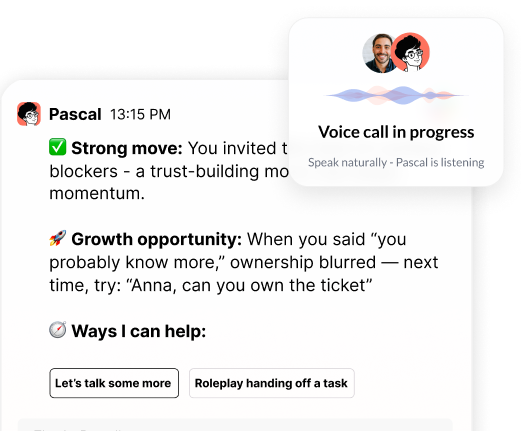
Pascal by Pinnacle provides AI coaching that learns from real interactions while maintaining enterprise-grade privacy and security. Our SOC2-compliant platform isolates user data, escalates sensitive topics to qualified humans, and never trains on customer conversations. See how Pascal works inside Slack to deliver coaching that managers trust and CHROs can confidently deploy.
Header photo by Zulfugar Karimov on Unsplash

.png)
.webp)
“Thank you for setting the great foundation for my promotion; now I have a plan!"

Curious to see how AI Coaching can 10X the impact and scale of your development initiatives. Book a demo today for: