

Disclosure: This guide examines AI coaching approaches with specific examples from Pascal by Pinnacle, where I work. The evaluation framework applies to any vendor.
AI coaching systems that learn from real employee interactions personalize better than static models, but only with three safeguards: user-level data isolation (your conversations never train models for other employees), transparent opt-in controls (you choose what the AI observes), and organizational anonymization (company insights are aggregated and stripped of individual identifiers). Without these protections, learning becomes surveillance.
Safe learning means the AI improves based on real workplace interactions while protecting employee privacy. Three requirements:
User-level data isolation: Your coaching conversations stay yours. They don't improve the coaching your colleague receives.
Transparent user control: You choose what the AI observes. You can opt out anytime.
Organizational anonymization: Company-level insights are aggregated. No individual identifiers reach HR.
Systems missing any of these protections create surveillance risk. When employees feel monitored, they disengage. BCG found that employees who trust AI tools become regular users. Those who don't, opt out.
The distinction matters because unsafe approaches (where individual coaching data feeds shared models or HR sees personal conversations) transform a development tool into a monitoring system.
Safe learning architecture includes:
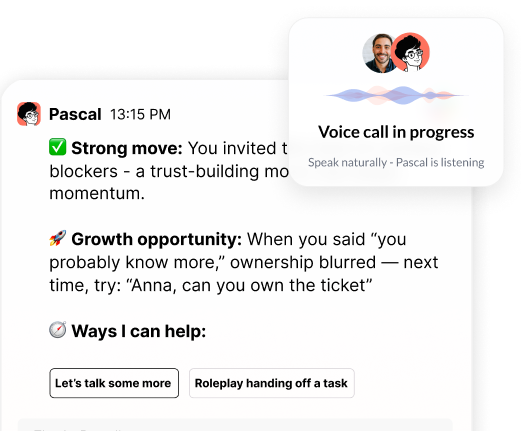
Explicit consent mechanisms: Clear notifications before AI joins meetings. Simple opt-out controls. Pascal sends notifications at the beginning of calls explaining how to opt out.
Coaching-to-insights firewall: Individual coaching remains confidential. Organizational patterns (skill gaps, cultural trends) surface only in anonymized, aggregated form.
SOC2 compliance and encryption: Enterprise-grade security that protects data in transit and at rest. Pinnacle achieved SOC2 compliance to meet CHRO security requirements.
Retention controls: Configurable policies including zero-day transcript retention for regulated industries. You can extract behavioral insights without storing conversation transcripts.
Static pre-trained models deliver generic advice. Managers ignore them within weeks because they lack organizational context.
Synthetic data training uses simulated scenarios. The coaching feels artificial and misses cultural nuances.
Real interaction learning (when safeguarded) understands your company's actual communication patterns, values application, and manager challenges.
Data Breakdown:
• Learning Approach: Static Pre-trained Models | Personalization: Generic advice | Privacy Risk: Minimal | Coaching Relevance: No company context
• Learning Approach: Synthetic Data Training | Personalization: Simulated scenarios | Privacy Risk: Low | Coaching Relevance: Artificial patterns
• Learning Approach: Real Interaction Learning (unsafe) | Personalization: Actual patterns | Privacy Risk: CRITICAL | Coaching Relevance: High (but trust destroyed)
• Learning Approach: Real Interaction Learning (safe) | Personalization: Actual patterns | Privacy Risk: Managed | Coaching Relevance: Contextual and trusted
Static models require no employee data but deliver coaching so generic that managers revert to old habits. Unsafe real interaction learning captures rich context but creates privacy violations.
Safe real interaction learning captures context while maintaining trust through:
• Meeting observation with explicit consent and opt-out controls
• Architecture that learns team dynamics without exposing raw conversation data
• Training on your company's values and leadership principles
• Feedback grounded in actual observed interactions
Jeff Diana, former CHRO at Calendly and Atlassian, describes the value: "So much of the real learning comes from in-context coaching in the moment to drive performance and solve problems in the moment." That requires learning from real work, not simulated exercises.
AI coaches need four context layers: role and career data (title, tenure, development goals), team dynamics (communication patterns, meeting effectiveness), company culture (values, competencies, leadership principles), and temporal context (performance cycles, goal-setting seasons).
They should never access compensation data, performance ratings, HR case files, or personal communications outside work channels. These create compliance risk without improving coaching quality.
The "minimum viable context" principle guides implementation. Too little context produces generic advice. Too much creates privacy concerns that destroy trust.
Data AI coaches should access (with consent):
• Calendar and meeting metadata (who, when, duration—not content unless you opt in)
• Work communication patterns in Slack or Teams (frequency, response times, collaboration networks)
• Meeting transcripts where you explicitly invite the AI coach
• Self-reported goals, challenges, and development priorities
• Company-provided competency frameworks, values statements, and leadership principles
• Anonymized organizational benchmarks (how your meeting load compares to role peers)
Data AI coaches should never access:
• Compensation, equity, or financial information
• Performance ratings or review documents (unless you share them)
• HR case files, disciplinary records, or legal matters
• Personal email, texts, or communications outside work platforms
• Individual-level data from engagement surveys or 360 reviews
• Medical information, accommodation requests, or protected class data
Pascal's architecture learns team relationships and communication dynamics without storing raw transcripts in most deployment modes. For regulated industries, the platform offers zero-day retention on transcripts while extracting behavioral insights.
Effective consent mechanisms provide clear notification before AI observation begins, explain what data the AI will access and how it will be used, offer simple opt-out controls that work immediately, and respect opt-out decisions without penalty.
Systems that bury consent in lengthy terms of service or make opt-out difficult destroy trust.
Pascal sends notifications at the beginning of calls. You decide when and which conversations you want the AI to join. The system learns about you and your work over time, but only from interactions you approve.
This differs from surveillance tools that monitor all employee activity by default. When employees feel monitored, they turn off the AI.
The opt-in versus opt-out debate reveals organizational values. Opt-in systems (where employees must actively choose the AI coach) create friction but maximize trust. Opt-out systems (where the AI is present by default but employees can disable it) drive higher adoption but risk feeling invasive.
Organizations with strong existing trust often succeed with opt-out approaches that clearly explain the value. Organizations rebuilding trust or operating in regulated industries start with opt-in approaches that let early adopters demonstrate value.
HR teams can access anonymized, aggregated insights that reveal skill gaps across the organization, cultural patterns and values alignment, communication effectiveness trends, and manager development needs. But only when enough participants exist to protect individual privacy.
Individual coaching conversations remain confidential.
Pascal provides administrators with engagement metrics, conversational trends, and organizational patterns only in anonymized, aggregated form. The platform requires sufficient participation levels before surfacing any organizational insights.
Safe organizational insights:
• Skill deficiency patterns across teams (e.g., "40% of new managers struggle with delegation")
• Cultural alignment metrics (how often company values appear in actual conversations)
• Communication effectiveness trends (meeting length, decision clarity, follow-through rates)
• Manager development needs (which competencies show the widest gaps)
Unsafe organizational insights that violate privacy:
• Individual performance rankings or comparisons
• Manager-specific effectiveness scores (even if anonymized, can be reverse-engineered in small teams)
• Real-time monitoring dashboards showing who's using the coach and when
• Conversation content or quotes (even if anonymized, risk individual identification)
The line between useful insight and invasive monitoring determines whether your AI coaching investment builds or destroys organizational trust.
Demand technical specifics, not marketing promises:
"Walk me through what happens to my coaching conversation data—where is it stored, who can access it, and how long is it retained?" Vague answers about "secure storage" or "industry-standard practices" indicate inadequate protections.
"Show me the notification employees receive before the AI joins a meeting. How do they opt out, and what happens to data if they opt out mid-conversation?" Systems that make opt-out difficult prioritize data collection over employee trust.
"What organizational insights do administrators see, and how do you ensure individual privacy?" Request screenshots of actual admin dashboards. Look for aggregation thresholds and anonymization controls.
"Can you deploy within our firewall for the most conservative security environments?" This capability signals serious enterprise commitment.
"What happens if an employee discusses a sensitive topic like harassment or mental health?" Effective systems include escalation protocols and moderation flags that route sensitive content appropriately.
"What does your SOC2 report cover?" SOC2 Type II certification verifies that a vendor's security controls work over time. It covers data encryption, access controls, and incident response. Not all vendors have it.
• Safe learning requires user-level data isolation, transparent opt-in controls, and strict separation between individual coaching and organizational insights
• Real interaction learning personalizes better than static models, but only when safeguarded—unsafe learning destroys trust
• AI coaches need role data, team dynamics, company culture, and temporal context but should never access compensation, performance ratings, HR case files, or personal communications
• Effective consent mechanisms provide clear notification, explain data usage, offer simple opt-out controls, and respect opt-out decisions
• HR teams can extract anonymized, aggregated insights about skill gaps and cultural patterns, but individual coaching conversations must remain confidential
AI coaching that learns from real interactions transforms manager development from scheduled events into continuous, contextual experiences. The winners will be organizations that design systems employees trust enough to use every day.
See how Pascal delivers contextual AI coaching that learns from real work while protecting employee privacy.
Header photo by Christina @ wocintechchat.com M on Unsplash

.png)
.webp)
“Thank you for setting the great foundation for my promotion; now I have a plan!"

Curious to see how AI Coaching can 10X the impact and scale of your development initiatives. Book a demo today for: