

AI coaching integrates with foundational AI models by giving them context about people, including behavioral and relationship insights. The AI a manager uses for daily work, such as writing emails or planning projects, can then understand communication styles, team dynamics and individual strengths, which makes its output more human and contextually appropriate. With Pascal, Pinnacle's AI coach, each person connects their own Pascal data to the AI assistant they already use through MCP.
Managers already use general AI assistants for much of their writing and planning. They ask for help with emails, project plans, meeting agendas and feedback drafts, and those assistants produce clear, competent text on request.
General assistants work from the text in front of them, and knowledge of the people involved makes that text fit its reader. With it, a draft email to a direct report can match whether that person prefers directness or needs more context first, and a project plan can reflect how each team member works best.
Coaching data holds that kind of knowledge about how people communicate. A coach that works with a manager over time builds an understanding of how that manager communicates, how the team responds and where each person does their best work.
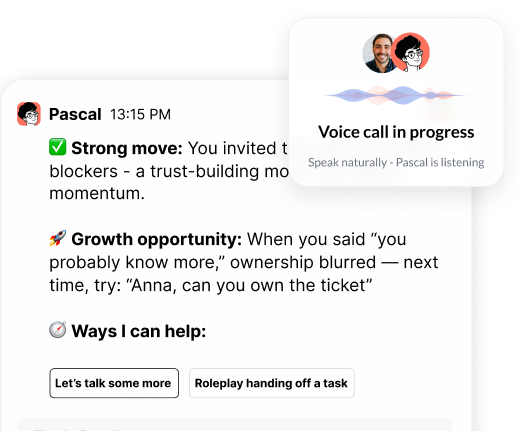
Pascal is an AI coach for every manager: a leadership companion who accompanies them in their meetings and work, and coaches from what actually happened. He primarily draws on live meeting data through calendar integrations and meeting transcripts. His memory tracks goals, communication patterns, relationships and context across meetings over time, so his coaching becomes more personalized with every conversation.
Company context adds a second layer to that picture of how people work. Pascal integrates natively with Slack, Outlook, Zoom and Teams, and Pinnacle's HR and Workday connectors give him role, level, performance review and goal data. Companies can also add their competencies, training materials, policies and culture documentation, which keeps his coaching tied to how the organization leads.
MCP, short for Model Context Protocol, is an open standard that lets an AI assistant connect to an outside source of data. Pascal's coaching data is available through MCP for each person's own account, so each person connects their own Pascal data to Claude, Microsoft Copilot or another AI assistant of their choice. That assistant can then use the behavioral and relational intelligence Pascal collects from the person's own meetings and coaching.
An email to a colleague shows how this works in practice. When the assistant knows how that colleague tends to communicate, it can suggest a firmer or softer opening, flag a phrase that may land poorly with that person, or recommend that a sensitive message become a live conversation. The manager still decides what to send, and the draft starts from a more accurate picture of the person reading it.
Each person's coaching conversations with Pascal stay private. HR and executives see aggregated, anonymized insights, and only for groups large enough to protect anonymity. Pinnacle does not train its models on customer data. The MCP connection runs through each person's own account, so every person chooses the AI assistant that works with their own coaching data.
Buying teams can judge coaching tools on how well their insights reach the AI assistants managers already use. These questions keep the evaluation focused on data quality and trust.
For HR and L&D leaders, the near-term task is checking where a coach's people insights come from and how each person controls them before connecting the coach to any other AI tool. A coach that answers both questions clearly gives managers better everyday AI output and keeps each person in charge of their own data.



“Thank you for setting the great foundation for my promotion; now I have a plan!"

Curious to see how AI Coaching can 10X the impact and scale of your development initiatives. Book a demo today for: