

AI coaching delivers identical frameworks, feedback quality, and leadership guidance to every manager regardless of location. The technology eliminates the geographic lottery where headquarters managers get executive coaches and in-person training while regional managers get sporadic webinars or nothing.
Management quality fragments because traditional development can't scale consistently. Headquarters managers access executive coaches, attend in-person training, and benefit from proximity to senior leadership. Regional managers receive sporadic webinars, outdated LMS content, or nothing.
DDI's Global Leadership Forecast shows only 11% of organizations have high-quality leadership at all levels (https://www.ddiworld.com/research/global-leadership-forecast). The gap widens when comparing central versus distributed locations.
The access inequality is structural. Executive coaching costs $200-600 per hour, making it financially impossible to provide to all managers. In-person workshops reach headquarters teams but become diluted "train-the-trainer" cascades in remote locations. Best practices shared in Boston don't reach managers in Austin, London, or Singapore. Time zones exclude entire regions from live training.
Gallup research shows managers account for 70% of variance in team engagement (https://www.gallup.com/workplace/231593/why-great-managers-rare.aspx). Inconsistent manager quality translates directly to inconsistent business performance across locations.
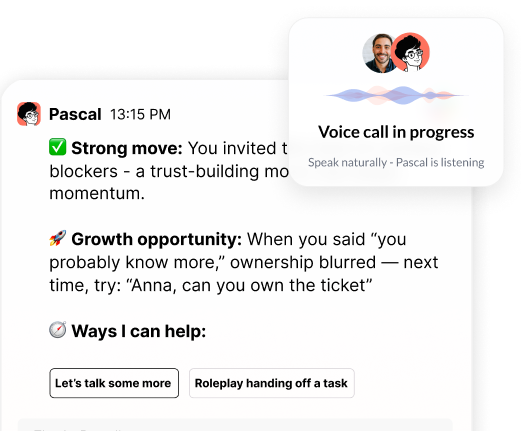
Pascal by Pinnacle addresses this by delivering International Coaching Federation (ICF) certified coaching frameworks identically to every manager, 24/7, regardless of geography.
AI coaching platforms standardize management development by encoding leadership frameworks into software that delivers identical guidance to every manager. When a manager in Denver and a manager in Dublin both face a difficult performance conversation, they receive the same evidence-based coaching approach, adapted to their context but grounded in consistent methodology.
The standardization happens through five mechanisms:
Uniform coaching logic ensures every manager receives guidance based on the same leadership competencies, communication frameworks, and behavioral science principles. For example, when addressing underperformance, every manager learns the same feedback structure: specific behavior observation, impact explanation, collaborative solution development.
Centralized knowledge base means company values, leadership expectations, and cultural norms are programmed once and distributed everywhere simultaneously. Your competency model, performance review templates, and internal frameworks become the foundation for all coaching interactions.
Consistent feedback quality eliminates the "off days" problem. Human coaches deliver different advice based on mood, experience level, or personal biases. AI coaches provide the same quality guidance every time.
Simultaneous updates mean when your organization refines a management framework, every manager globally receives the updated guidance instantly. No six-month re-training cascade required.
Standardized escalation protocols ensure sensitive situations (legal concerns, mental health, harassment) trigger the same escalation process regardless of location.
Comparison: Traditional vs. AI coaching consistency
Data Breakdown:
• Dimension: Geographic reach | Traditional Coaching/Training: Limited to HQ or major hubs | AI Coaching: Every location simultaneously
• Dimension: Cost per manager | Traditional Coaching/Training: $5,000-15,000 annually | AI Coaching: $50-150 annually
• Dimension: Framework consistency | Traditional Coaching/Training: Varies by trainer/coach | AI Coaching: Identical across all users
• Dimension: Update speed | Traditional Coaching/Training: Months (re-training required) | AI Coaching: Instant (software update)
• Dimension: Availability | Traditional Coaching/Training: Scheduled sessions only | AI Coaching: 24/7, in-the-moment
• Dimension: Quality variance | Traditional Coaching/Training: High (depends on coach skill) | AI Coaching: Minimal (same AI model)
Pascal integrates your competency models, performance frameworks, and cultural documentation, ensuring managers in every office are coached using your organization's exact standards.
Evaluate AI coaching platforms on three capabilities: contextual customization (can it learn your frameworks?), proactive engagement (does it meet managers where they work?), and appropriate guardrails (does it escalate sensitive issues to humans?).
Contextual customization depth determines whether the platform can ingest your leadership competencies, performance review templates, company values, and internal training materials. Generic coaching advice won't create consistency with your culture. The platform must understand what "good management" means at your organization. Ask vendors: How do you incorporate our specific frameworks? Can you show examples of customization for similar organizations?
Integration with daily tools matters because managers won't consistently use a separate platform. Does it work inside Slack, Teams, Zoom, or Google Meet? Managers need coaching in the moment, not when they remember to log into another system.
Proactive vs. reactive design drives higher engagement. Does the AI coach reach out with relevant guidance, or does it wait for managers to ask questions? Proactive systems join meetings, provide real-time feedback, and remind managers to apply learned frameworks. Reactive systems become glorified search engines.
Privacy and compliance architecture determines whether managers in regulated industries will trust the system. Is it SOC2 certified (a security standard for handling sensitive data)? Does it train on your data? Organizations handling sensitive information need enterprise-grade security guarantees. Ask vendors: Where is our data stored? Who has access? Do you use our conversations to train your models?
Escalation intelligence ensures the AI recognizes when a situation requires human HR intervention—legal issues, mental health concerns, harassment allegations. The system should flag these conversations and route them to appropriate personnel immediately.
Pascal meets all five criteria: trained on ICF-certified coaching frameworks, integrates with existing tools, proactively joins meetings to provide real-time feedback, maintains SOC2 compliance without training on customer data, and includes moderation flags and escalation protocols for sensitive topics.
AI coaching outperforms traditional approaches (LMS platforms, train-the-trainer cascades, coaching marketplaces) on the dimensions that matter for multi-location consistency: simultaneous reach, cost scalability, and quality standardization.
AI doesn't replace human coaches for C-suite executives navigating complex situations. It makes coaching-level support accessible to frontline and mid-level managers who never received personalized development.
Learning Management Systems achieve average completion rates of 20-30%. Content becomes outdated quickly. There's no personalization to individual manager challenges and no real-time application support. Managers in satellite offices complete the same generic modules as headquarters staff but receive no contextual guidance for applying concepts to their situations.
Train-the-trainer cascades degrade quality with each layer. The process takes 6-12 months to reach all locations. Inconsistent interpretation of frameworks means the message delivered in Singapore differs from the message delivered in Chicago. High facilitator turnover disrupts continuity.
Coaching marketplaces cost $150-400 per session, limiting scale. Quality varies by individual coach expertise. Scheduling across time zones creates friction. Managers in smaller offices often get assigned less experienced coaches.
AI coaching platforms deliver the same quality coaching to every manager simultaneously at a fraction of traditional costs. The coaching industry reached $6.25 billion in 2024 and is projected to hit $7.3 billion in 2025 (https://www.talentlms.com/blog/top-ai-coaching-platforms), but traditional models can't achieve the consistency required for global operations.
Organizations measure AI coaching consistency through four categories: adoption metrics (usage across locations), quality metrics (manager effectiveness improvements), business metrics (performance outcomes), and equity metrics (access distribution). The most telling indicator is whether managers in satellite offices achieve the same development outcomes as headquarters managers.
Adoption metrics reveal whether the platform works equally well across geographies. Track daily active users by location, engagement rates (messages per manager per week), and feature utilization patterns. If headquarters shows 80% adoption but regional offices show 30%, the platform isn't solving the consistency problem.
Quality metrics measure manager effectiveness improvements. Direct report satisfaction scores, 360 feedback trends, and manager Net Promoter Score should improve at similar rates across all locations.
Business metrics connect coaching to outcomes. Compare performance review quality, time-to-productivity for new managers, voluntary turnover rates, and promotion readiness across locations. If regional managers take six months longer to reach effectiveness than headquarters managers, consistency remains elusive.
Equity metrics track whether all managers receive equal development opportunities. Measure coaching interactions per manager by location, response time to manager questions, and escalation rates to human support. True consistency means a first-time manager in a satellite office receives the same quality guidance as a first-time manager at headquarters.
Create "consistency scorecards" that track these metrics quarterly, identifying locations where AI coaching adoption or effectiveness lags behind the organizational average. This data-driven approach ensures the platform delivers standardized quality.
• AI coaching eliminates geographic inequality in manager development by delivering identical frameworks, feedback quality, and leadership guidance to every location simultaneously
• Prioritize contextual customization, proactive engagement, and appropriate guardrails when evaluating AI coaching platforms—generic chatbots won't create consistency with your culture
• Traditional approaches (LMS, train-the-trainer, coaching marketplaces) can't achieve the simultaneous reach, cost scalability, and quality standardization required for multi-location consistency
• Measure success through adoption metrics, quality metrics, business metrics, and equity metrics—true consistency means satellite office managers achieve the same development outcomes as headquarters managers
• AI coaching makes coaching-level support accessible to frontline and mid-level managers who previously had no access to personalized development
See how Pascal works inside Slack, Teams, and your existing tools. Visit heypinnacle.com to learn how organizations are standardizing management quality across every location.
Header photo by Vitaly Gariev on Unsplash

.png)
.webp)
“Thank you for setting the great foundation for my promotion; now I have a plan!"

Curious to see how AI Coaching can 10X the impact and scale of your development initiatives. Book a demo today for: