

Management quality varies by location because traditional development is inconsistent. A manager at headquarters has direct access to senior leaders, executive coaches, and weekly workshops. A manager in a satellite office gets quarterly webinars and an overextended HRBP covering three states.
AI coaching delivers the same frameworks and feedback to every manager, regardless of location. This eliminates the variance that comes from uneven access to training and support.
Gallup research shows only one in 10 people possess the talent to manage, yet organizations promote 82% of managers based on individual contributor performance rather than leadership capability. Teams with managers in the bottom quartile of engagement scores show 32% higher turnover than those with top-quartile managers. DDI's Global Leadership Forecast found that only 11% of organizations have a strong leadership bench. Replacing a manager costs 100-150% of their annual salary.
The problem compounds across locations. Managers at headquarters build informal networks, observe senior leaders, and get immediate feedback when situations go wrong. Remote managers navigate the same challenges alone, with delayed support and no model to follow.
Traditional approaches concentrate resources at headquarters:
• In-person training workshops happen at headquarters; remote offices get recorded sessions
• Executive coaching ($15,000–$50,000 per person annually) is reserved for senior leaders
• Regional HR business partners have widely varying spans of control
• Competency frameworks get interpreted differently by local leadership
• Peer learning groups form naturally at larger offices; isolated managers are excluded
AI coaching platforms deliver the same coaching logic and frameworks to every manager, regardless of location or time zone. The standardization works through three mechanisms:
Unified competency frameworks. AI coaches encode your organization's leadership competencies, values, and behavioral expectations, then apply them consistently. A manager preparing for a difficult conversation in Singapore gets the same framework-based guidance as one in Seattle.
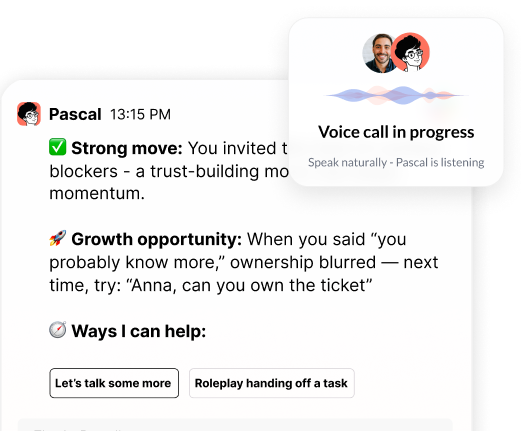
Real-time feedback. Instead of waiting for quarterly reviews or annual training, AI coaching surfaces guidance during a difficult conversation, before a performance review, or after a tense team meeting. This prevents bad habits from forming and reinforces effective behaviors when they matter.
24/7 availability. Managers in Singapore and Seattle get the same support at the times they need it. As Melinda Wolfe, former CHRO at Bloomberg, Pearson, and GLG, notes: "If we have an innovation right now, it's incumbent upon us as HR leaders to show our companies an economic and effective way to help managers."
AI coaching outperforms traditional approaches on three dimensions:
Scalability. Traditional human coaching costs $15,000–$50,000 per person annually and serves fewer than 5% of managers. AI coaching reaches 100% of managers at a fraction of the cost.
Consistency. Human coaches vary in quality, methodology, and availability. Regional HRBPs interpret competency frameworks differently. AI coaching applies the same frameworks to every interaction.
Real-time application. Traditional training happens in scheduled sessions, weeks or months before managers face the situations where they need support. AI coaching surfaces guidance at the moment of decision, when learning sticks and behavior change occurs.
The hybrid model works best. Reserve human coaching for senior leaders, complex interpersonal situations, and high-stakes transitions. Deploy AI coaching for the majority of managers who need consistent, accessible support for daily leadership challenges.
Organizations implementing AI coaching see three outcomes: reduced variance in management quality between headquarters and satellite offices, faster time-to-competency for new managers, and increased manager confidence in handling difficult situations without escalating to overburdened HRBPs.
Reduced quality variance. When every manager receives the same frameworks and real-time feedback, the performance gap between headquarters and remote locations narrows. The Edge of Work research shows that AI coaching interest in enterprise environments has accelerated over the past 18-24 months, with learning and talent leaders recognizing the potential to scale development in ways traditional approaches never could.
Faster manager development. New managers in satellite offices traditionally take longer to reach competency than those at headquarters. AI coaching compresses this timeline by providing immediate, context-specific guidance for every situation they encounter.
Decreased HRBP burden. Regional HRBPs spend the majority of their time answering basic manager questions and coaching through routine situations. AI coaching handles these interactions, allowing HRBPs to focus on complex cases and strategic initiatives.
Start with high-impact populations. Deploy AI coaching first to new managers, distributed teams, and roles with frequent high-stakes decisions. These populations see ROI fastest, building organizational momentum for broader adoption.
• Management quality varies across locations because traditional development (in-person training, regional HR support, human coaching) is inconsistent in delivery and availability, creating gaps in engagement, performance, and retention.
• AI coaching standardizes leadership development by delivering the same frameworks, real-time feedback, and guidance to every manager globally, regardless of location or time zone.
• The hybrid model works best: reserve human coaching for senior leaders and complex situations, deploy AI coaching for managers who need consistent, accessible support for daily leadership challenges.
• Organizations implementing AI coaching see reduced variance in management quality between headquarters and satellite offices, faster time-to-competency for new managers, and decreased burden on regional HRBPs.
Header photo by Zulfugar Karimov on Unsplash

.png)
.webp)
“Thank you for setting the great foundation for my promotion; now I have a plan!"

Curious to see how AI Coaching can 10X the impact and scale of your development initiatives. Book a demo today for: