

AI coaching handles routine coaching moments 24/7, freeing human experts to focus on complex situations where human judgment is irreplacable. This approach democratizes coaching access while preserving the value of human expertise.
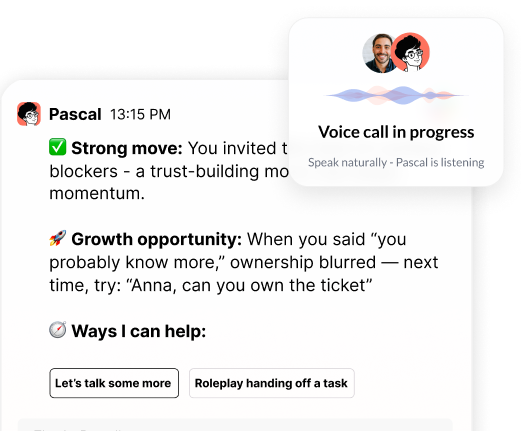
AI coaching is software that delivers real-time guidance to managers during work moments—in meetings, before difficult conversations, and when making decisions. These platforms integrate into daily workflows (Slack, Teams, Zoom), observe team interactions with permission, and provide just-in-time support.
The shift: AI coaching transforms development from a scheduled event into a continuous experience. Traditional training happens in classrooms or on-demand modules. Human coaching happens in monthly sessions. AI coaching happens in the moment—when a manager is preparing for a difficult conversation, navigating a team conflict, or making a decision that affects morale.
The complementary model: Human coaches handle complex situations requiring empathy and accountability. AI handles routine coaching moments with consistency and scale. A mid-sized tech company with 500 employees might use AI coaching to support 80 managers daily, while reserving human coaching for 15 senior leaders navigating succession planning and organizational transformation. The AI coach attends meetings, provides feedback preparation prompts, and reinforces leadership principles between human coaching sessions.
The integration approach: AI coaching sits between traditional L&D content (workshops, LMS) and human coaching, reinforcing learning at the moment of application. Melinda Wolfe, former CHRO at Bloomberg, Pearson, and GLG, notes: "If we can democratize coaching—make it specific, timely, and integrated into real workflows—we solve one of the most chronic issues in the modern workplace."
AI coaching excels at scalability, consistency, and real-time availability. Human coaches remain superior for building deep accountability, holding emotional space, and navigating sensitive or politically complex situations. Organizations deploy both: AI coaching for routine coaching moments (feedback preparation, decision frameworks, communication planning), and human coaches for situations requiring nuanced judgment, cultural navigation, or executive presence development.
Data Breakdown:
• Capability: Availability | AI Coaching: 24/7, in-the-moment | Human Coaching: Scheduled sessions (weekly/monthly) | Traditional L&D (LMS, Workshops): Scheduled events, self-paced modules
• Capability: Cost per manager | AI Coaching: Lower annual cost | Human Coaching: Higher annual investment | Traditional L&D (LMS, Workshops): Mid-range annual cost
• Capability: Scalability | AI Coaching: Unlimited managers simultaneously | Human Coaching: 1:1 or small groups | Traditional L&D (LMS, Workshops): Scales via recorded content
• Capability: Context awareness | AI Coaching: Observes meetings, interactions, goals | Human Coaching: Relies on manager self-reporting | Traditional L&D (LMS, Workshops): Generic, role-based content
• Capability: Response time | AI Coaching: Instant, proactive | Human Coaching: Days between sessions | Traditional L&D (LMS, Workshops): Weeks to find relevant module
• Capability: Emotional intelligence | AI Coaching: Pattern recognition, empathy frameworks | Human Coaching: Deep human empathy, accountability | Traditional L&D (LMS, Workshops): None (content delivery only)
• Capability: Best use cases | AI Coaching: Routine feedback, decision prep, communication | Human Coaching: Executive presence, career pivots, sensitive conflicts | Traditional L&D (LMS, Workshops): Foundational knowledge, compliance
The data advantage: AI coaches attend meetings (with permission), building a knowledge graph of interactions that human coaches can't observe. When a manager asks for help preparing for a 1:1, the AI recalls previous conversations with that direct report, recent team dynamics, and organizational priorities.
The accountability gap: Human coaches create accountability through relationship and presence. AI coaches create accountability through consistency and follow-through reminders. A human coach might say, "I'm holding you accountable to have that conversation by next week." An AI coach sends a reminder the morning of the conversation, provides a framework, and follows up afterward to reinforce learning.
The expertise question: AI coaching platforms can be trained by certified coaches, ensuring coaching quality at scale, but they lack the lived experience human coaches bring to complex leadership transitions.
Combining AI and human coaching creates a "coaching continuum" where AI handles high-frequency, lower-complexity moments (preparing for 1:1s, navigating team conflicts, communication planning) while human coaches focus on high-stakes work (executive presence, career transitions, organizational politics).
Democratized access: Every manager gets coaching-level support, not just executives. AI platforms can provide 24/7 guidance to all managers at an organization, while senior leaders also work with human executive coaches. New managers get immediate support for their first difficult conversation instead of waiting weeks for their next coaching session.
Reinforcement at scale: AI coaching reinforces human coaching sessions by providing daily reminders, practice scenarios, and accountability between monthly human coach meetings. A manager working with a human coach on delegation skills receives AI prompts before team meetings: "You mentioned wanting to delegate more. Here's a framework for this conversation."
Data-informed human coaching: AI platforms generate anonymized insights showing where managers struggle most, helping human coaches and L&D teams prioritize topics and interventions. Instead of guessing what managers need, L&D teams see aggregated data showing that managers struggle with feedback conversations, informing workshop design and human coaching focus areas.
Continuous learning: Jeff Diana, former CHRO at Calendly and Atlassian, notes: "Real learning and value come from in-context coaching—solving problems in the moment, not in a classroom." AI coaching bridges the knowing-doing gap by meeting managers at the point of application.
Start by mapping your current coaching and L&D ecosystem. Identify the highest-volume, lowest-complexity coaching needs (new manager transitions, feedback conversations, communication skills), and deploy AI coaching to handle these moments while preserving human coaching budget for senior leaders and complex situations. The most successful implementations follow a "crawl-walk-run" approach: pilot with 20-30 managers for 90 days, measure engagement and manager NPS improvement, then scale based on demonstrated ROI.
Phase 1: Audit your current state (2-4 weeks). Document where coaching and development dollars go: human coaching programs, LMS platforms, workshop facilitators, manager training. Identify utilization rates and satisfaction scores. Most organizations discover they're spending on underutilized platforms while managers report feeling unsupported in daily moments.
Phase 2: Define use cases (1-2 weeks). Map the highest-volume coaching moments: new manager onboarding, feedback preparation, 1:1 planning, communication challenges, decision-making frameworks. These routine moments represent the majority of coaching needs but consume disproportionate human coach time. AI coaching handles these at scale while human coaches focus on situations requiring deep expertise.
Phase 3: Pilot with measurement (90 days). Select 20-30 managers across different functions and experience levels. Integrate AI coaching into existing workflows (Slack, Teams, meeting tools). Measure weekly engagement rates, manager NPS changes, and direct report feedback. Track behavior change within 60 days.
Phase 4: Scale strategically (6-12 months). Expand to broader manager populations while maintaining human coaching for senior leaders and high-stakes situations. Build organizational hooks: integrate AI coaching into performance review cycles, goal-setting rituals, and leadership development programs.
Integration with human coaches: Human coaches become more effective when paired with AI coaching. They receive anonymized insights about common challenges, spend sessions on complex issues rather than routine guidance, and extend their impact between meetings through AI reinforcement. One executive coach reports: "AI handles the 'what' and 'how' between our sessions. I focus on the 'why' and the deeper identity work."
The primary challenges are cultural resistance to AI observation, unclear boundaries between AI and human coaching domains, and integration complexity with existing HR tech stacks. Organizations that succeed address these through transparent communication, clear escalation protocols, and phased rollouts that build trust before scaling.
Privacy and trust concerns: Managers worry about AI observing their meetings and conversations. Address this by establishing clear data governance. Look for platforms that are SOC2 compliant, never train models on customer data, and provide organization-specific controls. Transparency builds adoption—explain what AI observes, how insights are used, and who has access.
Defining the boundary: When should AI escalate to human expertise? Platforms should include moderation flags for sensitive topics (mental health, harassment, legal issues) and escalation protocols. AI should identify situations requiring human judgment and route them appropriately.
Change management: Managers accustomed to scheduled training resist always-on coaching. Frame AI coaching as a performance enabler, not surveillance. Pilot programs that demonstrate value overcome resistance faster than top-down mandates. When managers see peers getting better results with AI coaching support, adoption accelerates.
Integration complexity: AI coaching platforms must connect with existing tools (Slack, Teams, Zoom, HRIS systems) without creating workflow friction. Evaluate vendors on integration capabilities and implementation support. The best platforms embed into daily tools managers already use rather than requiring new logins or workflows.
• AI coaching and human coaching serve complementary roles: AI handles routine, high-frequency coaching moments at scale, while human coaches focus on complex situations requiring deep expertise
• The hybrid model increases coaching touchpoints from monthly to daily while reducing per-manager costs compared to human coaching alone
• Successful integration follows a crawl-walk-run approach: audit current state, define high-volume use cases, pilot with 20-30 managers for 90 days, then scale based on demonstrated engagement and behavior change
• Privacy, clear escalation protocols, and transparent communication are essential for building trust—platforms must be SOC2 compliant with organization-specific controls and never train models on customer data
• AI coaching democratizes access to coaching-level support for every manager, not just executives, while preserving human coaching budget for senior leaders
Ready to see how AI coaching complements your existing L&D programs? Explore how Pinnacle works inside Slack, Teams, and your daily workflows to deliver real-time coaching at scale while preserving what only human coaches can provide.
Header photo by Resume Genius on Unsplash

.png)
.webp)
“Thank you for setting the great foundation for my promotion; now I have a plan!"

Curious to see how AI Coaching can 10X the impact and scale of your development initiatives. Book a demo today for: