
Sarah, a marketing director, gets different content recommendations from ChatGPT and Claude. She doesn't know which to trust, so she ignores both and writes the email herself. Two hours wasted.
Tom, an engineering manager, delegates a code review to an AI agent. The agent misses a critical security flaw. Tom doesn't catch it because he assumed the AI was thorough. Three days of rework.
These aren't edge cases. They're the daily reality for managers learning to work with AI agents. The problem isn't access to tools—it's knowing when to use them, how to evaluate their output, and when to override their recommendations.
AI fluency means five specific capabilities:
1. AI task delegation — Knowing which tasks to give to AI vs. humans, understanding where AI fails, and sequencing work between agents and team members.
2. Multi-agent coordination — Managing conflicting recommendations from different AI tools, synthesizing AI outputs with human judgment, and deciding when to override AI consensus.
3. AI output evaluation — Spotting hallucinations, biases, and logical errors in AI-generated work, and knowing when to request human review.
4. Ethical AI decisions — Navigating privacy and compliance considerations, balancing efficiency with human impact, and maintaining transparency about AI usage.
5. Team AI adoption coaching — Supporting team members at different comfort levels, creating safety for experimentation, and addressing AI anxiety.
Salesforce CEO Marc Benioff said at Davos 2024 that today's executives are "the last generation of CEOs to manage all-human workforces." Leadership skills once reserved for senior managers—decision-making, prioritization, coordination—are now essential for everyone managing AI agents.
AI coaching delivers guidance when managers face actual decisions requiring AI judgment. Not in scheduled training sessions. In the moment—when Sarah gets conflicting recommendations, when Tom delegates to an AI agent, when a manager prepares for a 1:1 about AI adoption concerns.
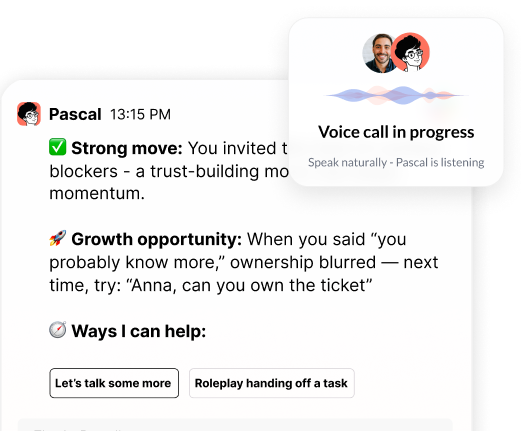
This happens inside Slack, Teams, and Zoom. The AI coach observes meetings and communications, then provides feedback on specific situations. "You delegated that task to the AI agent without specifying output format—here's how to write clearer prompts." "Your team member expressed AI anxiety in that message—here's how to address it."
The difference from traditional training: context. Generic webinars teach AI concepts in isolation. AI coaching responds to your actual work. The more workplace context the system accesses (meetings, communications, team dynamics), the more relevant the guidance.
According to Melinda Wolfe, former CHRO at Bloomberg, Pearson, and GLG: "Managers rarely need help in a workshop—they need it when preparing for a tough 1:1 or in the middle of a team conflict." This applies to AI fluency. Managers need guidance when deciding whether to use AI for a specific task, not during a generic webinar.
Purpose-built platforms can be trained on your organization's competencies, leadership frameworks, and values. The AI coach learns how your company works, then provides guidance that fits your culture.
Three common approaches to building AI fluency: traditional training (workshops and eLearning), human coaching, and AI coaching platforms. Each has different costs, scalability, and effectiveness.
Traditional training costs $200–$800 per employee per year. Workshops and eLearning modules deliver scheduled sessions disconnected from actual work. Employees forget 70% of content within 30 days without reinforcement. Retention rate after six months: 10–20%. Time to competency: 6–12 months. LinkedIn Learning and similar platforms see engagement rates below 15% in most organizations.
Human coaching costs $3,000–$15,000 per employee per year. Highly personalized, with 60–80% retention when sessions continue. Time to competency: 3–6 months. The constraint: scalability. Only senior executives get access due to cost.
AI coaching platforms cost $30–$150 per employee per year (1% of human coaching cost). Available 24/7 in daily workflows. Adapts to individual context and company culture. Retention rate: 70–85% with continuous reinforcement. Time to competency: 1–3 months with daily practice. Scales to entire workforce.
The key difference: behavior observation. Traditional training relies on self-reported surveys. Human coaches observe limited sessions. AI coaching platforms observe real-time interactions in meetings and communications, providing concrete data on behavior change.
Pascal by Pinnacle observes behavior in actual meetings and Slack conversations, then provides coaching to reinforce skills. This gives L&D leaders data on behavior change that surveys can't capture.
Managers attempting to build AI fluency through ChatGPT experimentation or online courses face three barriers:
Blind spots — They don't know what they don't know. Without external observation, they can't identify ineffective AI usage patterns or missed opportunities.
No feedback — They can't assess whether they're using AI effectively. Is that prompt good enough? Should I have delegated that task? Did I evaluate the output correctly?
Random exploration — They lack structured progression. Self-paced learning has 5–10% completion rates in corporate settings.
MIT research shows that 95% of AI projects fail to deliver expected results, primarily due to the "last mile" problem—the gap between having tools and knowing how to use them effectively. AI coaching bridges this gap by meeting managers where work happens.
AI coaching creates accountability. Managers, their leaders, and HR partners can see engagement and progress. The platform provides a judgment-free environment to practice skills, ask basic questions, and test approaches before applying them with teams.
Assess three dimensions: organizational readiness, platform capabilities, and success criteria.
Organizational readiness starts with identifying where AI fluency gaps cause business problems. Are managers avoiding AI tools because they don't know when to use them? Are teams getting inconsistent guidance on AI adoption? Is your organization losing productivity because employees experiment with AI in silos?
If these problems exist, AI coaching addresses root causes that training alone cannot fix.
Platform capabilities separate generic chatbots from purpose-built coaching systems. Look for five differentiators:
• Proactive guidance (joins meetings, provides real-time feedback)
• Perceptive context (builds knowledge graphs of team interactions)
• Personalization (adapts to your competencies and culture)
• Integration (works inside Slack, Teams, Zoom)
• Protection (SOC2 compliance, never trains on customer data)
Success criteria should focus on behavior change, not completion rates. Effective platforms provide 360 feedback data across behaviors, compare managers and teams to identify coaching targets, and surface actionable insights.
Three measurable outcomes reveal whether AI coaching will stick: adoption patterns, skill development, and efficiency gains.
Adoption patterns emerge within two weeks. Purpose-built AI coaches build enough context to provide meaningful insights within 1–2 weeks of use. Mid-level managers and first-time managers show the strongest early adoption—they benefit most from accessible coaching support. Engagement rates of 2.3 interactions per week indicate the platform meets real needs.
Skill development becomes visible through behavior observation. AI coaches integrate into meetings and Slack conversations, tracking whether managers apply new skills in real situations. Look for managers asking better questions, delegating more effectively, and providing clearer direction to both human and AI team members.
Efficiency gains show up in reduced HR business partner workload and higher-value conversations. AI coaches handle routine guidance, allowing HRBPs to cover broader scope without constant hiring. Shared threads and role-play features prepare managers and employees before discussions, making coaching more efficient.
The key metric: are managers using the platform when they need help, not just during scheduled training? If usage correlates with real work challenges (preparing for tough 1:1s, navigating team conflicts, making AI delegation decisions), the investment will deliver sustained ROI.
Organizations using purpose-built AI coaching report 83% observable improvement from direct reports, with 20% average lift in manager NPS and 150+ hours saved per manager annually.
Culture alignment is the difference between a generic chatbot and a coaching system managers trust. Purpose-built platforms allow you to upload your company's competencies, benefits documents, training materials, leadership frameworks, and values. Pascal uses this context to provide coaching tailored to your organization.
This customization matters because AI fluency development must reinforce how your company works. If your leadership framework emphasizes transparency, the AI coach should guide managers to communicate AI usage openly with their teams. If your culture values experimentation, the coaching should encourage safe AI exploration.
The best platforms provide organization-specific controls and moderation flags for sensitive topics. Anonymous aggregated insights protect individual privacy while giving HR leaders visibility into organizational trends—what people are struggling with, what they're asking for coaching on, and patterns in specific teams or locations.
People teams need five data layers to prove ROI and identify which programs drive performance improvement:
Adoption metrics reveal consistent usage patterns. Track who's engaging, how frequently, and in what contexts. Low adoption signals a mismatch between platform capabilities and real needs.
Engagement depth shows whether managers use the platform for meaningful challenges or surface-level queries. Look for evidence of role-play practice, complex scenario navigation, and repeated engagement with specific skill areas.
Skill development data should map to your competency framework. The platform should show progress on specific capabilities (AI task delegation, multi-agent coordination, ethical decision-making), not generic "communication improvement."
Behavior change is the ultimate measure. Real-time observation of meetings and workplace communications allows AI coaches to track whether managers apply learned skills. This beats self-reported surveys.
Organizational insights help HR make surgical interventions. Aggregate data should surface themes across the organization without compromising individual privacy—enabling you to address systemic issues rather than relying on quarterly surveys.
• AI coaching builds AI fluency through practice in daily workflows, delivering 70–85% skill retention vs. 10–20% from traditional training
• Purpose-built platforms outperform generic chatbots through proactive guidance, perceptive context, personalization to your culture, integration into daily tools, and enterprise-grade data protection
• First-time and mid-level managers see fastest ROI, showing 83% observable improvement from direct reports within 90 days
• AI coaches need access to meetings, communications, and team dynamics to provide relevant guidance—generic advice without workplace context fails to change behavior
• Measure behavior change, not completion rates—effective platforms track real-time application of skills in actual work situations
Pascal by Pinnacle delivers AI coaching that meets managers where work happens—in Slack, Teams, and Zoom. Built by ICF-certified coaches, trained on your company's values and competencies, and protected by SOC2 compliance. Explore how Pascal builds AI fluency at scale.
Header photo by Austin Distel on Unsplash

.png)
.webp)
“Thank you for setting the great foundation for my promotion; now I have a plan!"

Curious to see how AI Coaching can 10X the impact and scale of your development initiatives. Book a demo today for: