

AI coaching builds fluency by delivering guidance during actual work. Managers practice AI skills while making real decisions, receiving immediate feedback that creates lasting behavior change.
AI fluency means recognizing when to use AI, interpreting outputs critically, and making sound decisions based on AI-generated insights. It differs from AI literacy (understanding what AI is) the way speaking Spanish differs from knowing Spanish exists.
The gap is measurable. A 2024 BCG survey of 12,800 workers across 18 countries found only 36% felt adequately trained in AI. Organizations are building hybrid human-AI teams now. Managers without fluency become bottlenecks—unable to delegate to AI tools, evaluate outputs, or guide their teams.
Three barriers prevent managers from developing fluency:
Status threat. Asking "basic" questions about AI capabilities exposes knowledge gaps to peers or direct reports. Managers who pride themselves on expertise avoid situations where they might look foolish.
Mistake cost. Using AI incorrectly in high-stakes situations (client communications, performance reviews, strategic decisions) creates real consequences. Without a practice environment, managers default to avoiding AI entirely.
The knowing-doing gap. A manager attends a workshop on prompt engineering, then returns to their desk and freezes. Understanding concepts doesn't translate to application when training happens weeks before the moment of need.
AI coaching addresses these barriers through three mechanisms:
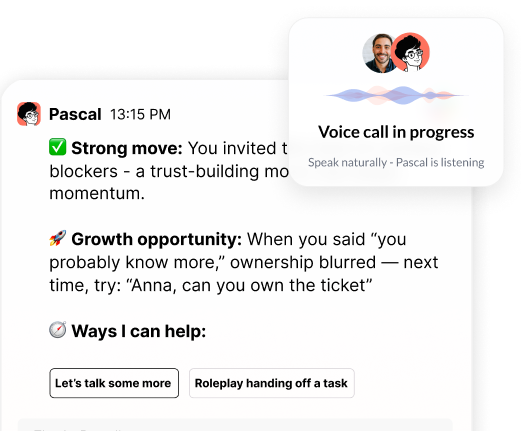
Observation in context. The system identifies moments where AI could help or where the manager's AI use needs refinement. This happens during actual work—in meetings, Slack conversations, and decision points.
Real-time feedback. Guidance arrives during the work itself: before a meeting, while drafting a prompt, when evaluating AI-generated content. The manager learns by doing, with immediate correction.
Repeated practice. Fluency requires repetition. AI coaching creates dozens of practice opportunities weekly, building muscle memory about when and how to use AI effectively.
A manager preparing performance reviews can test prompts, evaluate tone and specificity, and learn to catch AI errors in a practice environment before generating actual reviews. This rehearsal in a safe space accelerates skill development without real-world consequences.
Managers develop fluency fastest when they can experiment without fear of costly mistakes. AI coaching creates judgment-free experimentation. Managers test prompting strategies, evaluate outputs, and refine their approach before applying skills in situations that matter.
The practice environment includes feedback on prompt quality, helps managers recognize when outputs need human judgment, and suggests improvements. Moderation flags and escalation protocols ensure experimentation stays within organizational guardrails.
The most effective learning happens at the moment of need—when a manager is drafting a prompt, evaluating an output, or deciding whether to delegate a task to AI.
AI coaching integrates into tools managers already use (Slack, Teams, Zoom, Google Meet), removing the friction of context-switching to a separate learning platform. Guidance arrives where work happens.
The system observes meetings and Slack conversations, offering suggestions when managers could use AI or improve their approach. It builds understanding of individual manager challenges and team dynamics, enabling contextual rather than generic advice.
A sales manager receives different guidance than an engineering manager, reflecting distinct AI tools and use cases in each function. Consistent feedback across situations builds intuition about effective AI use.
Every manager starts with different AI experience and faces different challenges based on their team, industry, and role. One-size-fits-all training wastes time teaching skills managers already have while missing critical gaps.
AI coaching adapts to individual context. It recognizes when managers struggle with specific capabilities (prompt engineering, output evaluation, delegation decisions) and adjusts coaching intensity. It identifies which managers build fluency quickly and which need additional support.
The system can reflect company-specific leadership frameworks, values, and AI adoption priorities.
Focus on behavior change, not completion rates or satisfaction scores. The meaningful indicators:
Application frequency. How often do managers use AI tools? Are they experimenting with new use cases or stuck in narrow patterns?
Output quality. Can managers craft effective prompts? Do they catch AI errors before outputs reach customers? Do they know when to apply human judgment?
Team adoption. Can managers coach their own teams through AI use? Do they recognize when team members could benefit from AI assistance?
Data Breakdown:
• Category: Efficiency Gains | What to Measure: Time saved through effective AI delegation | Examples: Faster decision-making enabled by AI-generated insights; Reduced time spent on routine tasks that AI handles well
• Category: Quality Improvements | What to Measure: Better outputs when managers prompt AI effectively and apply human judgment appropriately | Examples: Customer satisfaction scores; Project completion rates; Error rates in AI-assisted work
• Category: Risk Reduction | What to Measure: Fluent managers catch AI errors before they reach customers | Examples: Avoided inappropriate AI use cases; Better decisions about when human judgment is required
Also track adoption velocity—how quickly managers move from initial AI exposure to confident, regular use. Faster adoption curves indicate more effective fluency-building approaches.
• AI fluency requires practice in real work situations with immediate feedback on actual decisions, not training disconnected from application
• Coaching that integrates into Slack, Teams, and meetings delivers guidance at the moment managers need it most, closing the knowing-doing gap
• Safe experimentation spaces accelerate learning by removing fear of mistakes in front of teams or stakeholders
• Personalized coaching addresses each manager's specific gaps, making development more efficient than generic training
• Track behavior change (application frequency, output quality, team adoption) rather than completion rates to measure fluency development
The question isn't whether to invest in fluency development, but how to do it effectively at scale.
See how Pascal works inside Slack to build AI fluency through real-time, contextual coaching.

.png)
.webp)
“Thank you for setting the great foundation for my promotion; now I have a plan!"

Curious to see how AI Coaching can 10X the impact and scale of your development initiatives. Book a demo today for: