

AI coaching transforms managers into confident AI users by embedding personalized guidance into daily workflows, enabling hands-on practice with real-time feedback, and creating safe spaces to experiment—turning abstract AI concepts into applied skills that stick.
AI fluency is the ability to recognize when and how to use AI effectively, interpret its outputs critically, and make sound decisions based on AI-generated insights. For managers, this means knowing which tasks to delegate to AI, which require human judgment, and how to validate AI recommendations before acting on them.
The distinction matters because awareness doesn't equal capability. According to BCG research, 79% of employees receiving more than five hours of AI training become regular users, compared to 67% with less exposure. But training hours measure input, not outcome—managers can complete workshops and still freeze when deciding whether to use AI for performance reviews or team planning.
Managers need fluency to guide teams through AI adoption, evaluate AI tool recommendations, and make strategic decisions about human-AI collaboration. Without it, they become bottlenecks in their organizations' AI transformation efforts. Your team needs time to play with AI, not just lectures about it.
AI Literacy vs. AI Fluency
Data Breakdown:
• Dimension: Definition | AI Literacy: Understanding what AI is and how it works | AI Fluency: Knowing when, how, and why to use AI in context
• Dimension: Learning method | AI Literacy: Workshops, courses, documentation | AI Fluency: Hands-on practice with feedback
• Dimension: Outcome | AI Literacy: Conceptual knowledge | AI Fluency: Applied capability
• Dimension: Measurement | AI Literacy: Quiz scores, completion rates | AI Fluency: Behavioral change, decision quality
• Dimension: Time to value | AI Literacy: Weeks to months | AI Fluency: Days to weeks
AI coaching builds fluency through contextual integration (meeting managers where work happens), experiential learning (enabling safe practice with real scenarios), and continuous reinforcement (providing feedback loops that compound over time). These mechanisms work together to transform abstract AI concepts into muscle memory.
Contextual Integration: Embedding in Daily Workflows
Pascal integrates with Slack, Microsoft Teams, Zoom, and Google Meet—tools managers already use. Instead of asking managers to open another app, Pascal appears in existing conversations and meetings. When AI coaching lives where work happens, managers don't need to context-switch between "learning mode" and "work mode."
Managers build AI fluency by using AI in real situations, not hypothetical case studies. Where should your AI coach live? The answer determines adoption rates. A manager preparing for a difficult performance conversation in Slack can ask Pascal for framing suggestions without leaving the thread. The manager learns AI's coaching capabilities while solving an actual problem.
Experiential Learning: Safe Spaces for Practice
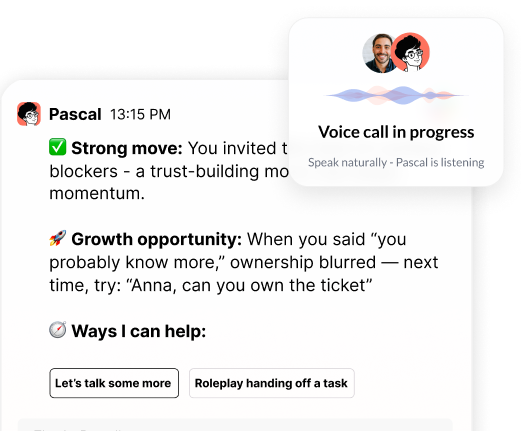
Pascal offers role-play scenarios where managers can practice difficult conversations before they happen. A manager can type out different approaches to delegation or conflict resolution and receive immediate coaching on each version. This creates a judgment-free environment where experimentation is encouraged.
The practice-feedback loop accelerates pattern recognition: managers learn which AI suggestions work in their specific context. They're not memorizing AI capabilities—they're developing intuition about when to use them. A mid-level manager at a 500-person tech company used Pascal to prepare for a conversation about missed deadlines. Pascal suggested three framing approaches, explained the psychological principles behind each, and let the manager test each version through text-based role-play. The manager chose the approach that felt authentic, practiced it twice, and entered the actual conversation with confidence.
Continuous Reinforcement: Real-Time Feedback Loops
Pascal observes manager behavior in meetings (through meeting transcripts and team communication patterns) and provides post-meeting feedback on communication effectiveness within 24 hours. This closes the loop between learning and application: managers see how their AI-assisted decisions played out.
Unlike annual reviews or quarterly check-ins, Pascal provides feedback the day after the behavior. This immediacy matters for adult learning. How to ask your team members for feedback becomes easier when managers have AI support to interpret and act on that feedback quickly. Over time, Pascal builds a knowledge graph of each manager's communication patterns, team dynamics, and decision contexts, enabling increasingly personalized coaching.
Adults learn best through application, not abstraction. Research shows that 70% of learning happens through on-the-job experience, yet most AI training focuses on conceptual frameworks delivered in classrooms. AI coaching inverts this model by making every management challenge a learning opportunity.
Managers develop AI fluency by solving real problems with AI support, not by memorizing AI capabilities. Jeff Diana, former CHRO at Calendly, Atlassian, and SuccessFactors, explains in his blueprint for CHROs leading AI transformation: "Real learning and value come from in-context coaching—solving problems in the moment, not in a classroom."
When managers use AI to prepare for a performance conversation, they're learning AI capabilities and improving their management skills simultaneously. The cognitive load is lower because they're not context-switching. They're building fluency the same way they built fluency in their native language—through repeated use in meaningful contexts.
Traditional training teaches managers that AI can help with difficult conversations. AI coaching lets them practice a difficult conversation, receive feedback on their approach, and refine it before the actual meeting. The difference between knowing AI exists and knowing when to use it closes through repetition in real scenarios.
AI coaching works best when three organizational conditions align: leadership modeling (executives using AI coaching visibly), psychological safety (permission to experiment without penalty), and integration depth (AI coaching embedded in existing workflows, not bolted on).
Leadership modeling matters because managers watch what executives do, not what they say. When C-suite leaders share how they're using AI coaching to prepare for board presentations or navigate team conflicts, it normalizes the practice. At one Fortune 500 technology company, AI coaching adoption jumped from 23% to 67% over six months after their CEO mentioned using Pascal in an all-hands meeting and shared a specific example of how it helped him reframe a difficult message to the board.
Psychological safety determines whether managers experiment with AI suggestions or ignore them. Organizations that frame AI coaching as a learning tool—not a surveillance mechanism—see higher engagement. Pascal's privacy-first architecture helps: it's SOC2 compliant and never uses customer data to train models. Managers need to know their experiments won't be weaponized in performance reviews.
Integration depth separates effective AI coaching from abandoned chatbots. When AI coaching requires managers to open a separate app, adoption stalls. When it appears in Slack threads where managers are already discussing team challenges, it becomes part of the workflow. According to Pinnacle internal data from 2024, proactive AI coaching (appearing in meetings and offering unsolicited feedback) drives 3x higher engagement than on-demand chatbots that require managers to initiate every interaction.
The most common mistake is treating AI coaching like traditional training—rolling it out with a launch event, then expecting managers to self-serve. AI coaching requires ongoing reinforcement, not a one-time announcement. Organizations should plan for executive modeling, team discussions about early experiences, and regular reminders about specific use cases.
Organizations also fail by deploying generic chatbots instead of purpose-built coaching systems. A custom GPT trained on leadership articles isn't the same as an AI coach trained by ICF-certified coaches on real management scenarios (Pascal's training process involves ICF-certified coaches reviewing thousands of real management conversations and coding effective coaching responses, which then inform the AI's training data). The difference shows in adoption rates: according to Pinnacle internal data from 2024, generic chatbots see 11% sustained usage after 90 days, while Pascal maintains 60%+ weekly active users.
Another mistake is measuring the wrong outcomes. Organizations track completion rates and quiz scores when they should track behavioral change and team feedback. Pinnacle customers measure manager effectiveness through direct report surveys, not through how many role-plays managers completed. The goal is better managers, not higher training metrics. According to Pinnacle internal data from 2024, customers report 83% of direct reports see improvement in their managers after 90 days of Pascal usage.
Organizations also underestimate the importance of cultural alignment. AI coaching that contradicts your organization's leadership principles creates confusion. Pascal allows companies to customize coaching to reflect their specific frameworks and values, ensuring managers receive guidance that aligns with how your organization works.
• AI fluency develops through hands-on practice with real-time feedback, not through conceptual training delivered in workshops weeks before managers need it
• AI coaching builds fluency through three mechanisms: contextual integration in daily tools, experiential learning through safe practice, and continuous reinforcement via feedback loops
• Organizations maximize AI coaching effectiveness through leadership modeling, psychological safety, and deep integration into existing workflows—not through one-time launch events
• The gap between AI literacy (knowing what AI is) and AI fluency (knowing when to use it) closes when managers practice with AI in real scenarios, receive feedback, and refine their approach over time
• Purpose-built AI coaching platforms trained by professional coaches deliver 3x higher engagement than generic chatbots or custom GPTs (Pinnacle internal data, 2024)
Building AI fluency in your managers isn't about adding more training hours. It's about embedding coaching in the moments that matter—when they're preparing for a difficult conversation, navigating a team conflict, or deciding whether to delegate a task to AI. See how Pascal works inside Slack, Teams, and meetings to turn every management challenge into a learning opportunity.
Header photo by Vitaly Gariev on Unsplash

.png)
.webp)
“Thank you for setting the great foundation for my promotion; now I have a plan!"

Curious to see how AI Coaching can 10X the impact and scale of your development initiatives. Book a demo today for: