

Organizations fill leadership roles from internal candidates while cutting development costs. The difference: feedback during actual management decisions (performance conversations, delegation, conflict resolution) instead of quarterly workshops.
54% of organizations report weak leadership bench strength (DDI 2024 Global Leadership Forecast). External hires cost 18-20% more than internal promotions and take 30% longer to reach productivity. Traditional approaches (quarterly workshops, annual cohorts, executive coaching for the top 5%) can't keep pace with promotion needs.
The gap isn't knowing what good leadership looks like. It's building those capabilities at scale and speed. Critical roles remain unfilled for months. High-potential employees leave for better development opportunities. Organizations rely on expensive external hires who may not fit the culture.
AI coaching delivers feedback during actual leadership moments. A manager preparing for a difficult performance conversation gets specific coaching on that conversation, not generic feedback skills from a workshop six months ago.
Human coaching costs $200-500 per hour and reaches fewer than 5% of leaders. AI coaching reaches 100% of managers at roughly 1% of traditional coaching cost. This democratization of coaching access changes how organizations build leadership capability at scale.
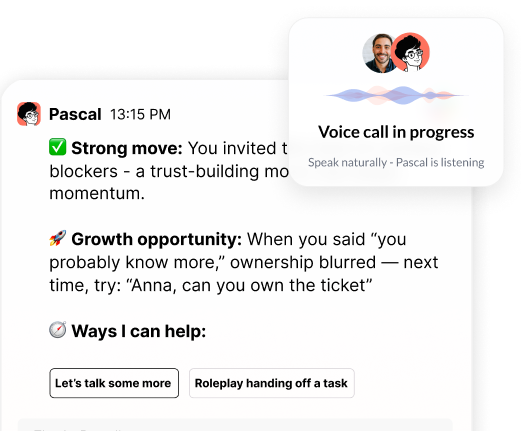
Here's what this looks like in practice. Pascal (Pinnacle's AI coach) integrates with Slack, Teams, and calendar systems. When a manager schedules a performance review, Pascal sends a message: "I see you have a performance conversation with Sarah tomorrow. Based on your recent interactions, here are three specific points to address and how to frame them constructively." After the meeting, Pascal follows up: "How did the conversation go? Here's what to watch for in Sarah's response over the next week."
The AI analyzes text from emails, chat messages, and meeting transcripts (not tone or body language). It identifies patterns: a manager who avoids giving critical feedback, delegates tasks without context, or misses signs of team conflict. The coaching addresses these specific behaviors with concrete suggestions, not abstract principles.
New managers using Pascal reach baseline effectiveness in 60-90 days versus 12-18 months with traditional onboarding, based on data from 15 Pascal customers (500-5,000 employees, primarily tech and life sciences). These are not industry-wide benchmarks. Your results will depend on implementation approach, manager engagement, and existing development infrastructure.
The acceleration comes from continuous practice with feedback, not waiting for the next scheduled training session. Managers receive guidance when they need it, creating a tight feedback loop that accelerates skill development.
Organizations adopting AI coaching see three changes: faster promotion velocity, higher internal fill rates, and reduced attrition among high-potentials.
A life sciences company with 1,200 employees reduced time-to-promotion for senior managers from 18 months to 11 months after implementing Pascal. A tech company with 500 employees filled 8 of 10 director-level roles internally within 90 days, compared to their historical 3 of 10 rate.
These outcomes share a mechanism: AI coaching changes specific behaviors that drive leadership effectiveness. Managers delegate more effectively, reducing their own workload while developing direct reports. They deliver clearer feedback, improving team performance. They handle conflict earlier, preventing escalation.
Important context: These examples come from Pascal customers. We don't have data on organizations using other AI coaching tools or those that implemented AI coaching and saw no improvement. The companies adopting Pascal are tech-forward, well-funded organizations already focused on talent development. We can't separate the impact of AI coaching from other factors (strong existing culture, high manager engagement, adequate development budgets).
Track four indicators: manager effectiveness scores from direct report feedback, internal promotion rates, time-to-readiness for identified successors, and high-potential retention.
Manager effectiveness serves as an early indicator of coaching impact. Measure quarterly through short surveys sent to direct reports. Ask specific questions: "Has your manager's communication improved?" "Do you receive clearer feedback?" "Does your manager delegate effectively?" Track trends over time rather than absolute scores (company cultures vary, making cross-company comparisons unreliable). Improvement trajectories reveal whether coaching is driving sustained behavior change.
Internal fill rate measures the outcome of improved leadership development. Track the percentage of leadership roles filled by internal candidates. Also track time-to-fill and performance of promoted candidates in their first year. A high internal fill rate with poor subsequent performance indicates premature promotions.
Time-to-readiness captures velocity of leadership development. Track months from succession identification to promotion readiness. If your succession planning identifies someone as "ready in 18 months," measure whether that timeline compresses.
High-potential attrition reveals retention impact of development investments. Monitor voluntary turnover among the top 10% of talent. Exit interviews should show fewer departures citing "lack of development opportunities."
Establish baseline measurements before implementing AI coaching to enable accurate before-and-after comparisons. Many organizations discover their baselines are worse than assumed.
Data Breakdown:
• Metric: Manager effectiveness | Baseline: 52% positive | 90-Day Target: 60% positive | 12-Month Target: 75% positive | Data Source: Quarterly pulse survey
• Metric: Internal fill rate | Baseline: 45% | 90-Day Target: 50% | 12-Month Target: 60% | Data Source: HRIS promotion data
• Metric: Time-to-readiness | Baseline: 18 months | 90-Day Target: 15 months | 12-Month Target: 11 months | Data Source: Succession planning system
• Metric: High-potential attrition | Baseline: 18% | 90-Day Target: 15% | 12-Month Target: 12% | Data Source: HRIS turnover data
The primary challenges are adoption resistance, trust-building, and integration with existing talent systems. Together's 2026 L&D Report shows 61% of organizations have adopted AI in learning and development strategies, but only 11% feel confident in their skills-building approach.
Adoption resistance emerges when managers view AI as surveillance rather than support. Frame AI coaching as an always-available thought partner, not a replacement for human coaches. Communicate clearly that AI coaching handles routine guidance, freeing human coaches to focus on complex situations that require human judgment.
Managers may fear AI will expose their weaknesses or that coaching recommendations will be shared with their supervisors. Address these concerns directly by establishing clear data governance policies. Emphasize that AI coaching is a development tool, not a performance evaluation mechanism.
Trust and privacy concerns are acute in regulated industries (healthcare, financial services, life sciences). For regulated industries, work closely with legal and compliance teams to ensure AI coaching implementation meets all regulatory requirements. Pascal maintains SOC2 compliance and never trains on customer data. Customer data stays within the customer's environment.
Integration complexity surfaces when AI coaching must connect to HRIS, performance management systems, and learning platforms. Organizations succeed by starting with standalone capabilities where managers access coaching through Slack or Teams without requiring full system integration. Add deeper integrations over time as value becomes clear.
Cultural fit matters more than organizations expect. AI coaching must align with company values and leadership principles to feel authentic. Pascal trains on company-specific frameworks, competency models, and cultural norms. Invest time upfront to ensure the AI coach understands and reflects your culture, not generic leadership advice that may conflict with established norms.
Start with volunteer managers who are already strong performers and open to development. Their success creates proof points that drive broader adoption. Early adopters become champions who can speak authentically about benefits and address concerns from peers.
• AI coaching delivers feedback during actual leadership moments (performance conversations, delegation decisions, conflict resolution) instead of quarterly workshops.
• New managers using Pascal reach baseline effectiveness in 60-90 days versus 12-18 months traditionally, based on data from 15 Pascal customers in tech and life sciences. These are not industry-wide benchmarks.
• Measure four indicators: manager effectiveness scores, internal promotion rates, time-to-readiness for successors, and high-potential retention.
• Implementation challenges (adoption resistance, trust-building, system integration) are addressed by starting with volunteer managers, establishing clear data governance, and demonstrating quick wins.
• The data in this article comes from Pascal customers. We don't have comparison data from organizations using other AI coaching tools or those that saw no improvement.
See how Pascal strengthens leadership pipelines at scale. Pascal delivers proactive, personalized coaching inside Slack, Teams, and meetings while protecting your data with SOC2 compliance. Learn more at https://www.heypinnacle.com/pascal.

.png)
.webp)
“Thank you for setting the great foundation for my promotion; now I have a plan!"

Curious to see how AI Coaching can 10X the impact and scale of your development initiatives. Book a demo today for: