

Improving manager effectiveness across a large organization starts with a short list of behaviors that matter most to your business, each with a rubric that describes strong, adequate and weak performance. Those behaviors then need reinforcement in the meetings where managers lead, across every team and location, because a message delivered once at a kickoff fades within weeks.
A large organization cannot improve every leadership habit at once. The program team should name the few behaviors that matter most to the business, then describe what strong, adequate and weak performance looks like for each one. For a behavior like delegating clearly, strong means the manager names the owner, the deadline and the decision rights in the meeting itself, adequate means the owner is named and the rest is left vague, and weak means the task leaves the meeting with nobody's name on it. That written rubric becomes the shared standard for the whole organization. A frontline team lead and a director can be held to the same behaviors, even when their work looks different from week to week.
The list should be short enough that managers can remember it in a live meeting. A rubric shapes behavior once managers carry it into the conversations where leading happens, and a short list is what makes that possible. Writing it down also gives the coaching and the reporting one standard to point at.
A kickoff introduces the standard, and feedback in the weeks after it keeps the standard alive. That feedback has to land close to the conversations managers lead, tied to the same behaviors, or managers drift back to whatever felt familiar.
This is hard at organizational scale because the same standard has to reach people who sit in different functions, different time zones and different kinds of meetings, in the same week. So the reinforcement has to travel with each manager into the next meeting, and the one after that.
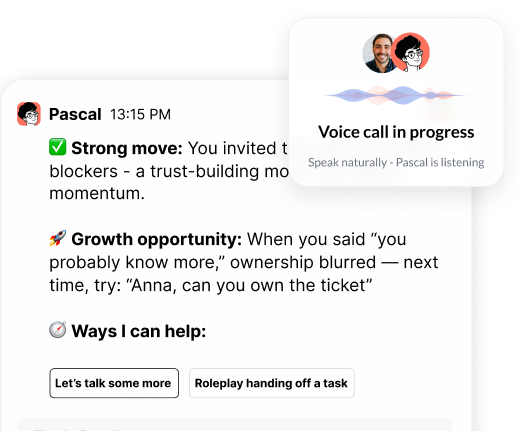
Pascal is an AI coach for every manager: a leadership companion who accompanies them in their meetings and work, and coaches from what actually happened. In those meetings, Pascal gives each person feedback tied to the shared behaviors, so the same standard reaches a frontline team lead and a director in the same week. Each person's coaching conversations with Pascal stay private. HR and executives see aggregated, anonymized insights, and only for groups large enough to protect anonymity.
The coaching stays with the person who received it. The organization still gets a way to see whether the standard is taking hold, without opening anyone's coaching conversation. That separation is what lets a program team work at scale without turning coaching into surveillance.
Pascal's scoring against the rubric rolls up into a live view of where each behavior is strong and where it lags, by cohort, function or level. A program team can spot, for example, that one behavior is lagging among directors in a single function. Turning those signals into quarterly program updates is its own step, covered in how a manager effectiveness feedback loop works.
The program team can then point a campaign at one gap, which tells Pascal to give that skill more attention in its feedback, and check whether the focus moved behavior. The campaign is a way to concentrate reinforcement without rewriting the whole rubric. After a period of focus, the same live view shows whether the lagging behavior has moved where the gap first showed up.



“Thank you for setting the great foundation for my promotion; now I have a plan!"

Curious to see how AI Coaching can 10X the impact and scale of your development initiatives. Book a demo today for: