

Can Enterprise Coaching Improve Internal Mobility?
Enterprise coaching can improve internal mobility by helping managers lead clearer career, feedback, and development conversations before employees pursue lateral moves, stretch assignments, or promotions.
Key Takeaways
Yes. Enterprise coaching can improve internal mobility by helping managers lead clearer, more consistent career and development conversations. The strongest approach supports managers in the flow of work, before 1:1s, feedback discussions, talent reviews, and stretch assignments, while keeping promotion and hiring decisions with people.
Yes. An enterprise talent coaching platform can improve internal mobility when it helps managers lead stronger, more consistent career, feedback, and development conversations in the moments that shape employee growth. Internal mobility depends on more than open roles or career frameworks. Employees also need managers who can spot strengths, discuss readiness, create practical development plans, and prepare people for new opportunities.
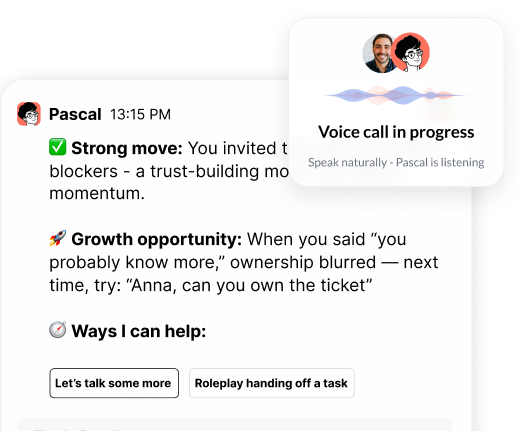
We often see mobility break down at the manager level, not because employees lack ambition. Vague growth conversations, uneven coaching, and delayed feedback can leave capable people unsure how to prepare for a lateral move, stretch assignment, or promotion. Pascal gives managers real-time support inside Slack, Teams, 1:1s, and meetings, where these conversations already happen.
An enterprise talent coaching platform does not replace talent reviews, mentors, HR business partners, or human judgment. It helps managers arrive more prepared for the everyday conversations that make internal movement more realistic.
Managers shape internal career moves because they turn broad organizational opportunities into specific development actions. They help employees understand what strong performance looks like now, which skills matter for an adjacent role, and what experiences can build credibility before an opening appears.
Practical manager coaching makes a difference in several ways:
Without this support, career development can become uneven. Some managers are confident asking thoughtful questions and giving direct feedback. Others may avoid career conversations, overpromise on advancement, or struggle to explain why readiness is still developing. That inconsistency can limit access to opportunities for employees who may be fully capable of growing.
Consider a manager whose employee wants to move from customer success into product operations. Rather than offering a generic answer, the manager can use real-time coaching guidance to explore transferable skills, clarify gaps, identify relevant projects, and agree on next steps. The employee leaves with more than encouragement. They leave with a clearer development plan.
The same need exists at senior levels. A VP of Engineering with 12 direct reports may need to retain high performers seeking broader scope, prepare leaders for larger roles, and have candid conversations with employees whose readiness is still emerging. We designed Pascal to help leaders prepare language, practice their approach, and follow through on development commitments.
Real-time coaching builds promotion readiness by helping managers practice difficult conversations, give timely feedback, and turn vague goals into specific actions. A strong development conversation is not a promise of a future role. It is an honest discussion about expectations, evidence of readiness, and the experiences that can help someone grow.
Before a 1:1, managers can use Pascal to structure a discussion about an employee’s interest in a new role. The guidance can help them define what readiness looks like, ask better questions, and avoid broad encouragement that does not lead anywhere.
AI role-play also gives managers space to practice before a high-stakes conversation. That may include explaining why an employee is not ready for promotion yet, discussing a lateral move with uncertain timing, or giving feedback after a stretch assignment. The goal is simple: clearer language, more empathy, and better follow-through.
For example, a people leader may need to tell a high-performing employee that there is no immediate opening in their preferred function. A thoughtful conversation can acknowledge the employee’s ambition, outline realistic development steps, and identify ways to build relevant experience without making commitments the organization cannot keep.
Organizations should connect coaching support to the moments and processes where career growth already happens. A mobility strategy is more likely to work when managers know how to use existing career frameworks, internal job information, development resources, and talent processes in their everyday conversations.
Start by identifying the manager moments that have the greatest effect on mobility. These may include onboarding a new manager, preparing for quarterly development conversations, debriefing a stretch assignment, discussing an employee’s interest in another function, or preparing for talent review. Each moment calls for different manager behaviors, but all require clarity, fairness, and follow-through.
A practical rollout can focus on a specific business need rather than attempting to change every manager behavior at once. For instance, a large operations organization that is hiring internally for frontline leadership roles may begin with managers of high-performing individual contributors. Coaching guidance can help those managers explain role expectations, identify relevant experiences, and give timely feedback after employees lead a shift, train a peer, or manage a process improvement effort.
Another enterprise scenario involves a global technology company reorganizing product teams. Employees may have new opportunities to move across engineering, design, product management, and customer-facing functions, but their managers may not understand the skills required beyond their own discipline. In that setting, managers need support to ask useful questions, separate demonstrated strengths from assumptions, and help employees identify experiences that build credible evidence of readiness.
Consistency matters most when internal opportunities are limited or highly visible. Managers should understand that their role is not to advocate only for the employees they know best. It is to ensure every employee has access to clear expectations, constructive feedback, and realistic information about possible paths. HR can reinforce this expectation by providing common guidance on career discussions, readiness language, and escalation points for questions involving internal hiring or performance concerns.
Leaders should measure internal mobility through a combination of manager behavior, employee experience, opportunity access, and movement outcomes. Promotion and transfer rates alone can be misleading because hiring demand, organizational design, and available roles change over time.
Leading indicators help teams see whether the conditions for mobility are improving before movement occurs. For example, HR and L&D teams can review whether managers are holding development discussions on schedule, whether employees can describe the skills needed for their next role, and whether stretch assignments are being distributed across teams. Short employee pulse questions can also reveal whether people understand their career options and receive useful feedback about readiness.
Quality matters alongside completion. A manager checking a box after a career conversation does not necessarily mean the employee received a usable development plan. Organizations can assess quality through manager self-reflection, employee feedback, HR business partner observations, and periodic review of whether development goals are specific, connected to role expectations, and revisited over time.
Outcome measures should be segmented to identify uneven access. Review lateral moves, internal applications, promotions, stretch assignments, and participation in development opportunities by function, geography, level, tenure, and other appropriate workforce groups. A single increase in internal movement is not automatically positive if only a narrow group of employees can access opportunities.
Context is essential when interpreting results. A business unit with few open roles may show strong career-conversation quality but little movement in a given quarter. Another unit may have high transfer volume because of a restructuring, without stronger development practices. Looking at several quarters and combining quantitative trends with manager and employee feedback creates a more accurate picture.
An enterprise talent coaching platform should protect customer data, keep people accountable for talent decisions, and give HR teams useful ways to assess manager behavior. Coaching tools may support preparation and practice, but managers, HR leaders, and talent committees remain responsible for promotions, succession planning, performance processes, and internal hiring decisions.
Privacy matters because career and performance conversations can involve sensitive workplace context. Pascal is built for enterprise use, with privacy controls around customer data and model training.
We recommend measuring progress through practical signals rather than assuming a single tool causes every mobility outcome. HR and L&D teams can track:
A focused rollout can help leaders learn what works. Start with a manager group facing rapid growth, frequent internal hiring, or known capability gaps. Establish a baseline, then examine whether managers are having more consistent development conversations and whether employees have clearer paths to build toward future roles.
Pinnacle helps managers turn career conversations into clearer next steps through real-time guidance in Slack, Teams, and 1:1s. Learn how an enterprise talent coaching platform can help your managers practice difficult conversations, give more useful feedback, and support development without adding another course or login. Pascal brings scalable, enterprise-grade coaching into the moments where internal mobility decisions take shape.
No. AI coaching supports managers as they prepare for and lead career conversations. It does not replace mentors, HR business partners, talent leaders, or the human judgment needed for internal talent decisions. Employees still benefit from relationships, sponsorship, and direct conversations with people who understand their work and goals.
Yes. First-time managers often need practical help with feedback, development planning, and difficult career conversations. In-the-flow coaching can help them prepare in the moments that matter, without requiring another course or a separate learning portal.
Leaders can measure manager adoption, employee clarity on development paths, participation in internal opportunities, the consistency of career conversations, and movement trends over time. The most useful view combines these signals with human review, so leaders can understand not only whether employees are moving, but whether managers are helping them prepare fairly and realistically.



“Thank you for setting the great foundation for my promotion; now I have a plan!"

Curious to see how AI Coaching can 10X the impact and scale of your development initiatives. Book a demo today for: