

Josh Bersin's 2026 corporate learning research found that 76% of organizations are stalled at the lowest levels of learning maturity. Only 5% have reached what Bersin calls dynamic enablement, where learning is woven into work. Embedded leadership coaching is one practical way to close that distance, because it ties a manager's development to the meetings and decisions already on their calendar.
Embedded leadership coaching is coaching attached to the work a manager is already doing: the Tuesday 1:1, the Thursday project review, and the performance conversation that has been sitting on the calendar for two weeks. The material for the coaching comes from those moments, so the feedback refers to a specific meeting, a specific decision and a specific person in the room. The goals come from the company's own competency model and values, which keeps every piece of feedback tied to behaviors leadership has already said it wants.
That definition puts the weight on timing and context. Coaching becomes embedded when it arrives close to the moment it matters and talks about what happened there. A manager who gets feedback on yesterday's 1:1 has a concrete thing to repeat or adjust in the next one, and that kind of feedback is what turns a program into a habit.
In 1885, Hermann Ebbinghaus showed that memory decays quickly after learning unless it is reinforced. Leadership programs run into the same curve, since a manager can leave a two-day workshop with a clear feedback model and then meet the first hard conversation three weeks later, when most of that model has already faded.
The gap sits in the sequence of most programs, since the practice comes long before the moment that needs it. Static training persists for understandable reasons: completions are easy to count, and a scheduled program is easy to defend in a budget cycle. The cost shows up later, in the distance between what managers learned and what they do in the next meeting.
Behavior change happens in the small moments after a workshop: the meeting where a manager almost interrupts, the 1:1 where they ask a harder question, and the review where they name a missed commitment plainly. Each of those moments is a rep, and a rep followed quickly by specific feedback is the one that teaches. Bersin borrows the term organizational neuroplasticity from neuroscience to describe this, since a brain rewires through repeated practice and feedback applied in context.
Coached reps add up over a quarter, each tied to a real conversation, and steady repetition is what lets a new habit hold. Multiply that by every manager in a sales or engineering organization, and the leadership program starts to show up in how teams run their meetings.
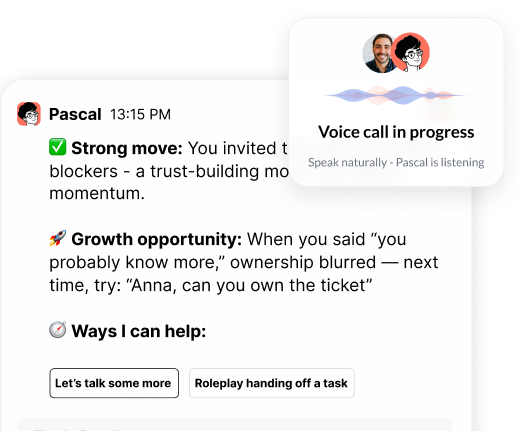
An AI coach makes it practical to follow up with every manager after every important meeting, across a whole organization. Pascal, Pinnacle's embedded AI coach for managers, joins Zoom, Google Meet and Microsoft Teams meetings and follows up afterward in Slack or Teams with private, specific feedback tied to the manager's goals, usually within a few minutes. He can also start the day with a summary of the calendar and preparation suggestions, and end it with patterns across the day's meetings.
Each manager picks the cadence, after every meeting or as daily or weekly roundups, and during a meeting Pascal stays quiet unless the manager messages him. Between meetings, managers can ask him to help prepare a 1:1, role-play a difficult conversation or draft a performance review. Because he is built around the company's competencies and values, the reinforcement points at the same behaviors the leadership program was designed to teach.
Managers practice honestly when they know the practice belongs to them. Individual data stays private, and HR sees only aggregated, anonymized patterns. Those patterns, shown only for groups large enough to keep every person anonymous, show where behaviors are starting to shift across a function or the whole organization, which gives L&D a clear view of where a program is landing. Pinnacle does not train its models on customer data.
For CHROs and heads of L&D, the planning work ahead is choosing the two or three behaviors that matter most and deciding where in a manager's week each one should be reinforced. The answer will look different for every company, and it usually starts with the meetings managers already run.



“Thank you for setting the great foundation for my promotion; now I have a plan!"

Curious to see how AI Coaching can 10X the impact and scale of your development initiatives. Book a demo today for: