

Workplace coaching technology only helps if managers actually use it. Many do not, and it is usually not because they are lazy or against growth. They are busy, under pressure, and tired of tools that feel like extra work or quiet monitoring.
In this article, we focus on one group that decides the success of any coaching rollout: skeptical managers. When we design for their real fears and needs, adoption gets easier, outcomes get better, and HR does not have to push so hard from the top-down.
Skeptical managers typically resist coaching technology because they worry about loss of control, lack of time, and low credibility of the tool. If we ignore those three concerns, even the smartest AI coach will sit unused.
First, there is control. Many managers worry that AI coaching will turn into a way to judge them. They ask things like: Who can see this? Is this going to show up in my performance review? If they are not sure, they will stay at the surface and never bring real issues into the tool.
Then comes time. Managers already juggle back-to-back meetings, Slack messages, and Q4 planning. When they hear “new coaching platform,” they often think:
Credibility is the third concern. Managers doubt that a digital coach can understand context, power dynamics, or the history behind a conflict. They worry it will give generic “manager 101” advice that does not fit their team or culture.
So we need to prove value fast. If a manager feels, within the first few weeks, that:
then the tool starts to earn its place. At Pinnacle, we design Pascal with that in mind: we start from managerial skepticism and design for it directly, rather than treating it as an afterthought.
Managers need coaching support that helps them in the exact moments they are stuck, not another standalone platform to manage. Coaching technology works when it turns real, messy situations into better decisions and clearer words.
In our work with leaders, we see three practical needs again and again:
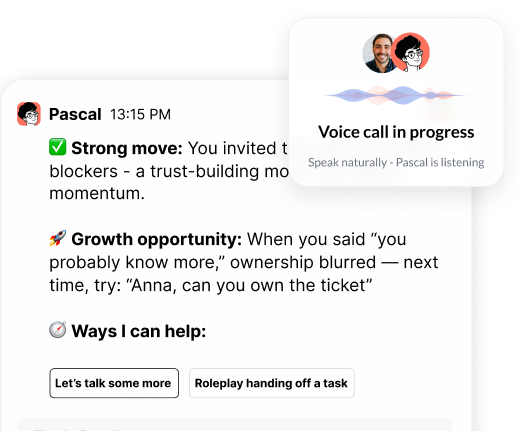
Think about a first-time manager heading into year-end reviews in late fall. They are in Slack, trying to write a message to set expectations for a tough conversation. With Pascal sitting inside Slack, they can paste a draft, ask for help, and:
Or picture a senior manager leading a cross-functional project. Before the kickoff, they use AI coaching to write an alignment message that:
When coaching tech does this kind of real-time work, it quietly becomes a delivery channel for your leadership frameworks. HR and L&D still set the principles, but managers practice them in live situations, not just in workshops.
We build trust in AI coaching by setting clear rules on data, explaining how advice is generated, and positioning the AI as support for human judgment rather than a replacement. Trust does not come from big promises; it comes from clear limits and daily usefulness.
We focus on a few design choices:
Here is how that can look in Slack. A manager asks Pascal, “How do I handle this underperformer?” Instead of one “correct” script, Pascal:
Control also matters. Managers should be able to:
The more choice they have, the more likely they are to bring real, high-stakes issues to the AI coach, not just safe, low-impact topics.
Coaching technology should live inside the tools managers already use, or it will lose attention to email, Slack, and meetings. To reach skeptical managers, coaching support has to show up exactly where work happens.
For most teams, that means:
For example, a manager drafts a message about shifting Q4 priorities. Pascal, sitting in Slack, can:
After a tense meeting, a team lead can pull Pascal into the channel, paste a rough follow-up note, and get help balancing accountability with empathy. The experience feels less like launching a separate tool and more like having a quiet coach alongside their main communication app.
This kind of integration also gives HR and L&D a reliable way to reinforce shared language around feedback, performance, and values, without rolling out yet another platform managers have to remember.
We measure the value of workplace coaching technology by tracking patterns and outcomes in aggregate, not by monitoring individual conversations. Measuring impact is important, but surveillance will quickly destroy trust.
Responsible measurement usually includes:
A healthy pattern might look like this: over a quarter, more managers use Pascal to plan 1:1s and set expectations early, not just to handle crises. At the same time, HR notices fewer emergency performance issues and more consistent use of the agreed feedback model.
To keep coaching from feeling like surveillance, it helps to:
When leaders help shape those guardrails, they are more willing to bring honest questions and rough drafts into the tool.
We avoid backlash by positioning coaching tech as an ally for managers in difficult situations, not as another HR initiative to comply with. A careful rollout makes the tool feel directly useful on hard days.
We often suggest a phased approach:
Targeted internal communication matters. For example, a CHRO might write a simple note along these lines: Pascal is a private coaching companion in Slack to help you prepare for hard conversations and decisions. It supports your judgment; it does not replace it. We only see patterns, not your individual chats.
Peer stories help as well. When respected managers share that they used an AI coach to rework a message they were dreading and felt calmer walking into the meeting, others pay attention. Recognize better leadership moments, not “top users.” Adoption should grow from trust and visible value, not from pressure.
At Pinnacle, we design Pascal with this lens. Our goal is to earn the trust of your most skeptical managers first, by helping them handle real, high-stakes moments quietly inside the tools they already use.
If you are ready to turn everyday conversations into measurable growth, we can help you put AI to work for your teams. Explore how our workplace coaching technology makes feedback more timely, consistent, and actionable. At Pinnacle AI, we partner with you to design coaching flows that fit your culture and goals. Start optimizing your coaching today so your managers can focus on people, not paperwork.



“Thank you for setting the great foundation for my promotion; now I have a plan!"

Curious to see how AI Coaching can 10X the impact and scale of your development initiatives. Book a demo today for: