
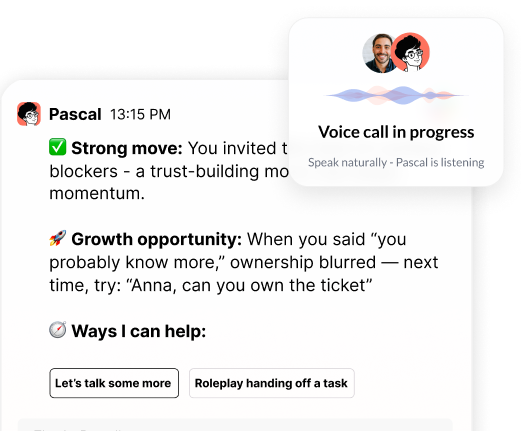
AI coaching systems embed in daily work tools (Slack, Teams, Zoom) to deliver personalized development guidance while maintaining privacy through encrypted data isolation and user-controlled permissions.
AI coaching systems accompany employees through their workday—joining meetings, analyzing communication patterns, delivering development feedback—while maintaining privacy through data isolation and user-controlled access.
Traditional coaching costs $300–$500 per hour and serves only senior executives. Sessions happen weeks in advance where coaches hear secondhand accounts of workplace challenges. AI coaching costs $300–$600 per year per employee, operates 24/7, and observes actual work interactions (with explicit permission), providing context-aware guidance immediately after meetings.
A single executive coach supports 20–50 clients maximum. AI coaching platforms serve unlimited employees simultaneously while maintaining personalized frameworks for each individual. Organizations extend coaching beyond the C-suite to first-time managers, individual contributors preparing for leadership roles, and high-potential employees across all locations.
How the models compare:
Data Breakdown:
• Feature: Availability | Traditional Coaching: Scheduled sessions | AI Coaching: 24/7 in workflow
• Feature: Cost per employee | Traditional Coaching: $10,000–$25,000/year | AI Coaching: $300–$600/year
• Feature: Context awareness | Traditional Coaching: Limited (secondhand) | AI Coaching: Full (observes work)
• Feature: Scalability | Traditional Coaching: 20–50 employees max | AI Coaching: Unlimited
Real-world scenario: A mid-level manager at a 500-person technology company prepares for a difficult performance conversation. Her AI coach has observed her communication style across 40+ previous meetings, knows the specific employee's performance history, and understands the company's feedback framework. It provides a customized conversation guide and suggests specific language aligned with company values.
AI coaching integrates into existing work tools—Slack, Microsoft Teams, Zoom, Google Meet. The technical workflow:
Calendar integration: The system connects to Google Calendar or Outlook to identify upcoming meetings, then joins video calls through native integrations. Employees control which meetings the AI attends and can exclude sensitive conversations.
Data collection during meetings: The platform collects three types of information. First, company documentation (values statements, competency frameworks, culture guides) establishes organizational expectations. Second, individual employee data (performance reviews, personality assessments, career goals) creates personalization. Third, real-time interaction data captures meeting dynamics, communication patterns, and relationship contexts.
Memory infrastructure: All observed data flows into a user-specific knowledge graph (a database that maps relationships between information) tracking relationships, communication styles, recurring challenges, and behavioral patterns over time. This memory enables increasingly relevant guidance as the system learns how each employee works.
Coaching delivery: Post-meeting feedback arrives automatically via Slack or Teams within minutes. On-demand coaching is available through chat interfaces. Proactive nudges surface before high-stakes conversations.
The privacy question matters most. Here's what separates coaching from surveillance:
What employees control: You choose which meetings the AI joins by default, can exclude specific conversations before they happen, and can delete past interactions from your coaching history. The AI coach works for you, not your organization.
What stays private: No manager or HR leader can access your coaching conversations, meeting feedback, or development discussions. Your individual coaching data is encrypted and accessible only to you. This separation is absolute and verified through SOC2 compliance audits (independent verification that customer data security meets enterprise standards).
What companies see: Organizations receive anonymized, aggregated insights only when at least 20 active users exist. Reports show patterns across groups—common development themes, skill gaps that appear frequently, engagement trends based on coaching usage patterns. If a query would reveal individual information, the system blocks it automatically.
What companies never see: Individual coaching conversations, specific feedback given to any employee, which meetings you excluded from observation, personal development goals or career aspirations, or performance concerns discussed in coaching sessions.
Effective AI coaches require four data layers but maintain confidentiality through strict separation between individual coaching data (never shared) and anonymized organizational insights (aggregated only when privacy-safe).
Individual employee data (user-controlled): Role, tenure, career aspirations, performance review history, personality assessments (DISC, StrengthsFinder), personal development goals, communication preferences. You control what the system can access and can revoke permissions anytime.
Organizational knowledge (company-wide): Company values, leadership competency frameworks, management best practices, organizational structure, industry-specific context. This layer ensures coaching aligns with how your organization defines effective leadership.
Real-time work patterns (observational, permission-based): Meeting attendance and participation patterns, communication style in different contexts (1:1s versus team meetings), relationship dynamics with specific colleagues, response to feedback and coaching suggestions, behavioral trends over time. This observational data transforms generic advice into contextual guidance.
Temporal context (calendar-aware): Upcoming performance review cycles, goal-setting seasons, high-stakes events (board presentations, customer meetings), team transitions or organizational changes. Guidance before a performance review differs from guidance during onboarding.
Companies receive real-time visibility into cultural trends, skill development needs, engagement patterns, and behavioral competency alignment—all anonymized and aggregated to protect individual privacy. This replaces static quarterly engagement surveys with continuous organizational pulse data.
Cultural hotspots: Aggregated coaching conversations reveal teams struggling with specific company values or behavioral expectations. HR leaders identify where cultural transformation initiatives succeed or stall without knowing which individuals struggle.
Skill development patterns: Leadership competencies that appear most frequently in coaching requests across different levels or departments reveal where to focus development resources.
Engagement trends: Coaching usage patterns and conversation themes surface systemic issues. When managers stop using their AI coach or coaching conversations shift toward disengagement topics, HR leaders can investigate before problems appear in retention data.
Behavioral competency tracking: Instead of annual reviews asking people to self-assess against competencies, AI coaches observe actual behaviors and aggregate trends across the organization.
The aggregation protects privacy while providing actionable intelligence. If only three managers in a department use the system, no departmental reporting is available. Once 20+ managers engage regularly, trends become visible without revealing individual behaviors.
Embedding AI coaching directly into Slack, Teams, and Zoom drives higher adoption because employees access coaching where they already work, eliminating the friction of context-switching while maintaining the same confidentiality protections regardless of platform.
Standalone learning portals require employees to remember to visit them, explain their situation without context, and apply generic advice back to their actual work. This activation energy kills adoption.
AI coaching embedded in workflow tools achieves higher usage because the coach comes to employees. The system joins meetings employees already attend, delivers feedback in Slack channels employees already monitor, and surfaces guidance before calendar events employees already scheduled. No new habits required.
The confidentiality model remains identical regardless of platform. Whether the system delivers coaching through Slack, Teams, or a dedicated interface, the same SOC2-compliant encryption, user-controlled permissions, and aggregation thresholds apply. Embedding doesn't compromise privacy—it reduces friction.
Adoption patterns:
Organizations that deploy AI coaching as a standalone portal see initial enthusiasm followed by declining usage. Managers try the tool, find it helpful, but forget to return when actual coaching moments arise.
Organizations that embed AI coaching in Slack or Teams see sustained engagement. Managers receive post-meeting feedback automatically, ask questions without leaving their communication hub, and develop habits around the coaching relationship.
We don't change our tools to access development resources. We use development resources that meet us where we already work.
• AI coaching embeds in daily workflow tools (Slack, Teams, Zoom) to deliver personalized development guidance while maintaining privacy through SOC2-compliant data isolation and user-controlled permissions
• Effective AI coaches require individual employee information, organizational knowledge, real-time work patterns, and temporal context—but separate individual coaching data (never shared) from anonymized organizational insights (aggregated only when at least 20 users exist)
• Organizations receive real-time visibility into cultural trends, skill development needs, and engagement patterns without accessing individual coaching conversations
• Embedding AI coaching in workflow tools drives higher adoption because employees access coaching where they already work, eliminating the friction of standalone portals
• AI coaching costs $300–$600 per year per employee (compared to $10,000–$25,000 for traditional executive coaching) while providing 24/7 availability and context-aware guidance
Ready to see how AI coaching works for your organization? Explore how Pascal delivers personalized development at scale while maintaining enterprise-grade privacy and security.
Header photo by Proxyclick Visitor Management System on Unsplash

.png)
.webp)
“Thank you for setting the great foundation for my promotion; now I have a plan!"

Curious to see how AI Coaching can 10X the impact and scale of your development initiatives. Book a demo today for: