

Leadership development ROI feels fuzzy because most organizations track activity, not impact. You can usually report how many people took a course or finished a program; it is much harder to show how manager behavior changed and how that affected real business results.
Late summer makes this even sharper. HR and L&D are locking in next year’s plans, pressure is high, and anything labeled “soft” is on the chopping block first. Leadership development often lands in that bucket.
Leadership development gets clearer when you treat it like any other performance investment. That means:
At Pinnacle, we build Pascal, an AI coaching platform that sits inside Slack, Teams, and live meetings. We see where managers struggle in real time, what they ask for help with, and which shifts actually predict value. In this article, Pascal walks through the biggest leadership development ROI myths we still hear, how they distort decisions, and what to measure instead.
No. Leadership development ROI is measurable when you connect specific behavior changes to specific business outcomes on a realistic timeline. It only feels “too soft” when the goals are vague, like “create better leaders” or “improve communication.”
This myth shows up when
A more useful framing sounds like this: “We want frontline managers to run better 1:1s so we reduce regrettable attrition in engineering by a few points over the next year.” That is clear, local, and connected to an outcome your CFO already cares about.
To Get There, You Can:
Because we designed Pascal to live in Slack, Teams, and meeting workflows, it can see real-time behavior signals. For example, how often a manager asks for help with a tough conversation, uses a feedback prompt, or practices a role-play before a high-stakes meeting. Those patterns create a sharper picture of leadership behavior than one long survey at the end of the year.
As you shape your operating plan, the shift is simple: stop treating leadership as a soft extra, and start describing it as a small set of manager behaviors that protect next year’s headcount, performance, and execution risk.
No. Some leadership benefits compound over years, but you should see early ROI signals within 30 to 90 days if you are measuring the right leading indicators. If nothing is visible for months, the issue is the design and instrumentation, not the concept of leadership ROI.
The common story sounds like this: “We will invest now and hope it pays off in a few years.” That story makes CFOs nervous, and it gives your program no short-term wins to point to.
Skill mastery does take time. But early behavior shifts are visible almost right away. A manager can run a different style 1:1 next week. They can respond to conflict in a new way tomorrow. Those changes are trackable.
Useful leading indicators include:
Think about a VP of Engineering during performance review season. With Pascal in the mix, managers can get live prompts as they draft reviews or prep for 1:1s. Within a couple of months, HR can see fewer last-minute surprises, more consistent ratings, and cleaner documentation. Those are early ROI signals that you can later connect to attrition and performance trends.
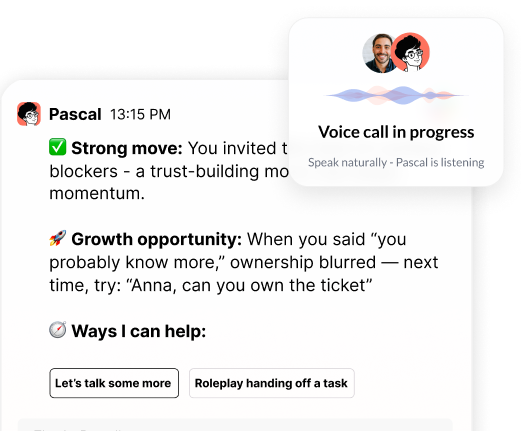
Because Pascal sits in the flow of work, it also tracks how managers interact with it. How often they role-play, ask for alternate phrases, or rehearse a hard message is data you can correlate with downstream outcomes like retention and time to ramp.
Yes. In many cases, leadership development ROI improves when you stop pulling managers away for long events and start coaching them inside their actual work. The value comes from learning transfer, not seat time.
A common assumption is that if managers are not in a classroom, they are not really developing. The hidden costs are real:
Embedded coaching flips that pattern. Short, timely nudges show up when the manager is actually doing the thing, like:
This kind of coaching is more contextual, because it knows the moment and the channel. It creates more data, because you see many small interactions instead of one big event. And there is less friction, because managers do not have to learn yet another tool or remember another login.
For HR and L&D, that makes measurement simpler. You can:
No. AI coaching can be low risk and high value when it is built for enterprises, respects privacy, and stays in the lane of skill development. The bigger risk is using consumer tools for sensitive work, or pretending AI can replace real human connection.
The fear usually sounds like this: “AI coaching will say the wrong thing, leak our data, or replace our managers.” The answer starts with clear boundaries. Leadership AI should focus on:
It should not try to act as a therapist, diagnose people, or give advice on personal life issues.
Data is the next concern. Enterprise-grade platforms are designed so customer data is not used to train models, and guardrails are in place to keep guidance appropriate and aligned with legal, security, and compliance expectations.
In practice, AI makes human coaching more valuable. An HR business partner can focus on strategy, nuance, and context, while AI covers the repetitive parts. A manager can get a first draft of talking points, then adjust it to fit team culture and their own voice.
When you evaluate AI coaching vendors, ask:
Safe, contextual AI lets managers practice more often, in more moments, which leads to faster and more consistent behavior change.
How Should We Redefine Leadership Development ROI for Next Year?
To reset leadership development ROI, narrow your focus. Anchor it to a small set of critical manager behaviors, measure those behaviors with real-time signals, and use AI coaching in the flow of work to close gaps quickly.
A Simple Path Looks Like This:
At Pinnacle, we designed Pascal to sit inside the tools managers already use. It nudges, role-plays, and guides them in real time, so everyday work becomes leadership practice. Because it is in the flow of work, it also generates frequent, contextual data on what managers are actually doing, which helps you tell a sharper ROI story to your executive team when the next planning season rolls around.
If you are ready to turn insights from this article into tangible performance gains, we can help you connect every program directly to leadership development ROI. At Pinnacle AI, we use data-driven frameworks to tie leadership behaviors to productivity, engagement, and bottom-line impact. Let’s define your success metrics up front and build a leadership roadmap that proves its value in clear numbers. Reach out today so we can prioritize the actions that will create the strongest returns for your organization.

.png)
.webp)
“Thank you for setting the great foundation for my promotion; now I have a plan!"

Curious to see how AI Coaching can 10X the impact and scale of your development initiatives. Book a demo today for: