

Workday-integrated coaching platforms deliver personalized development without forcing managers into separate systems. These platforms pull performance data, goals, and org structure from Workday while embedding coaching in Slack, Teams, and Zoom. Integration depth determines whether coaching scales or becomes shelfware.
Coaching platforms that integrate with Workday connect to your HRIS to pull employee data, performance reviews, goals, and organizational structure, then use that context to deliver personalized development guidance. The most effective solutions embed coaching into the tools managers use daily while maintaining SOC2 (Security Organization Control 2, an auditing standard for data security) compliance and zero-day data retention options for regulated industries.
Key integration types:
Data sync integrations pull role, level, performance reviews, development plans, goals, and 360 feedback from Workday. This foundation enables coaching that references performance history rather than generic frameworks.
Workflow integrations embed coaching in Slack, Teams, Zoom, and calendar tools where managers work. Requiring managers to visit a separate portal creates friction that kills adoption.
Authentication integrations enable single sign-on through Workday credentials, reducing login barriers and maintaining security standards.
Reporting integrations push coaching engagement and impact metrics back to Workday or analytics platforms, creating closed-loop measurement of development investments.
According to TalentLMS research, AI coaching platforms fall into three categories: knowledge coaching (answering factual questions), behavioral coaching (developing leadership skills), and simulation coaching (practicing scenarios). Behavioral coaching platforms designed for leadership development benefit most from deep Workday integration.
Workday-integrated coaching platforms sync employee context from your HRIS, then apply that context to deliver personalized guidance in real-time work moments. The platform knows who reports to whom, what competencies matter for each role, and where each manager stands in their development journey.
The integration workflow:
Initial data sync pulls organizational structure, employee profiles, role frameworks, competency models, and performance review data from Workday.
Ongoing updates capture goal changes, new performance feedback, role transitions, and team structure shifts through continuous sync. Real-time or daily updates ensure coaching reflects current organizational reality.
Contextual coaching delivery references Workday data to personalize guidance. When a manager prepares for a performance review conversation, the platform surfaces the employee's goals from Workday, references their recent 1-on-1 patterns, and suggests coaching questions aligned with the company's competency framework.
Behavioral insights analyze meeting patterns, communication style, and development progress, then write insights back to Workday or separate analytics dashboards for HR measurement.
A tech company with 800 employees uses Pascal by Pinnacle (we'll discuss Pascal in detail below) integrated with Workday. When managers prepare for performance reviews, Pascal surfaces employee goals from Workday, references recent 1-on-1 patterns, and suggests coaching questions aligned with the company's competency framework.
Companies in life sciences, financial services, and healthcare require zero-day data retention (conversation transcripts are deleted immediately while behavioral insights are preserved). The best Workday-integrated platforms can delete meeting transcripts while extracting behavioral insights, maintaining compliance without sacrificing coaching value.
The coaching platform market includes native Workday tools, employee support platforms, and purpose-built coaching solutions. Each category serves different needs.
Workday Illuminate (native integration)
Workday expanded Illuminate with new AI agents for HR in September 2025. The platform is bundled into every Workday subscription via Flex Credits (Workday's consumption-based pricing model), making it financially accessible for existing customers.
Illuminate is designed for HR process automation, not behavioral coaching for managers. It excels at workflow efficiency but lacks the coaching frameworks and real-time feedback capabilities that drive manager behavior change.
Best for companies already invested in Workday ecosystem seeking basic AI assistance for HR operations.
Moveworks (employee support integration)
Moveworks offers built-in Workday capabilities. The platform operates as a conversational interface for employee questions, reducing support ticket volume through intelligent routing and knowledge retrieval.
Moveworks focuses on knowledge retrieval and ticket deflection, not leadership development. It answers "How do I submit PTO?" but doesn't coach managers through performance conversations.
Best for IT and HR teams seeking to reduce support ticket volume and improve employee self-service.
BetterUp (coaching marketplace integration)
BetterUp combines human coaches with AI-powered tools. The platform integrates with Workday to pull employee data and track coaching engagement. BetterUp focuses on 1-on-1 human coaching sessions supplemented by digital resources.
The platform serves companies seeking traditional coaching at scale but comes at a higher price point than AI-first solutions. BetterUp charges per coaching session, making it cost-prohibitive for reaching all managers.
Best for companies with budget to provide human coaching to leadership populations.
Torch (blended coaching integration)
Torch offers a mix of human coaching, peer learning, and digital resources. The platform integrates with Workday for data sync and reporting. Torch emphasizes cohort-based learning programs alongside individual coaching.
The platform requires more administrative overhead to manage cohorts and match coaches. Implementation timelines run longer than AI-first platforms.
Best for companies seeking structured leadership development programs with human coaching components.
Sounding Board (human coaching integration)
Sounding Board provides human executive coaches matched to leaders through an AI-powered platform. The platform integrates with Workday for engagement tracking and impact measurement.
Sounding Board focuses on senior leadership populations rather than frontline managers. The human coaching model limits scalability and increases cost per participant.
Best for companies seeking executive coaching for senior leadership teams.
CoachHub (global coaching integration)
CoachHub offers human coaching in 90+ languages with Workday integration for data sync and reporting. The platform emphasizes global reach and cultural adaptation.
CoachHub requires longer implementation timelines to match coaches across regions. The human coaching model limits how many managers can be served simultaneously.
Best for multinational companies seeking human coaching across diverse geographic regions.
Pascal by Pinnacle (purpose-built AI coaching integration)
Full disclosure: Pascal is built by Pinnacle, the company publishing this guide. We're including it because it represents a different approach to Workday integration than the platforms above.
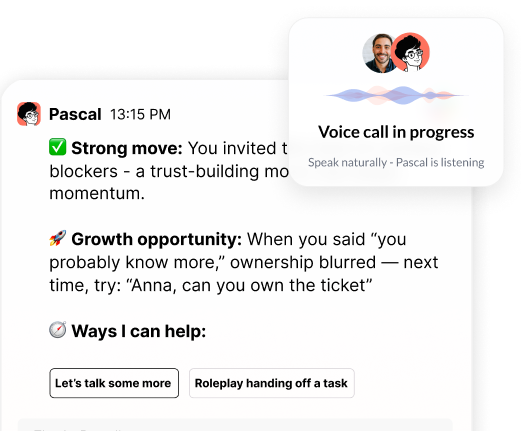
Pascal pulls performance reviews, goals, competency frameworks, and org structure from Workday, then embeds coaching in Slack, Teams, and Zoom. The platform joins meetings, provides real-time feedback, and suggests preparation strategies based on Workday context.
Pascal is SOC2 compliant with zero-day retention options for regulated industries. The coaching models are trained by ICF-certified coaches (International Coaching Federation, the leading coaching credential), not generic language models.
According to Pascal's 2024 customer survey of 47 enterprise clients: 83% of direct reports report manager improvement, managers save an average of 150 hours annually, and companies see a 20% increase in manager NPS (Net Promoter Score, a measure of manager effectiveness). Advisory board includes CHROs from Mastercard, Okta, Royal Caribbean, HP, and Johnson & Johnson.
"If we can democratize coaching—make it specific, timely, and integrated into real workflows—we solve one of the most chronic issues in the modern workplace." — Melinda Wolfe, Former CHRO at Bloomberg, Pearson, and GLG (member of Pascal's advisory board)
The features that determine whether a Workday-integrated coaching platform drives behavior change are contextual awareness, proactive engagement, workflow embedding, and compliance guardrails.
Bi-directional data sync
The platform should read performance reviews, goals, competency models, 360 feedback, org structure, and role frameworks from Workday. It should write coaching engagement metrics, development progress, and skill assessments back to your HRIS or analytics platforms.
Frequency matters: real-time or daily sync, not monthly batch updates. Stale data produces irrelevant coaching.
Contextual personalization
Coaching must adapt to individual manager's role, level, performance history, and development goals. The platform should reference company-specific competency frameworks and values, not generic leadership principles.
Understanding team dynamics matters. When a manager's team structure changes in Workday, coaching should reflect the new reporting relationships and development priorities.
Proactive engagement
The best platforms don't wait for managers to ask questions. They join meetings, analyze communication patterns, and surface coaching in the moments that matter (before a difficult conversation, during goal-setting, when delegation opportunities appear).
Reactive chatbots require managers to remember to seek help. Proactive coaches become daily habits.
Workflow embedding
Coaching must live in Slack, Teams, Zoom, and calendar tools where managers work. Requiring managers to visit a separate portal creates friction that kills adoption.
Integration with existing note-taking tools (Zoom Companion, Teams recording) addresses enterprise privacy concerns while maintaining coaching effectiveness.
Compliance guardrails
For regulated industries, platforms must offer zero-day data retention. This allows organizations to benefit from AI coaching while maintaining compliance with data retention and privacy regulations.
SOC2 compliance is table stakes. Customer data should never be used to train models.
Sensitive topic escalation
The platform should recognize when conversations involve mental health, legal issues, or HR violations, then escalate to human support rather than attempting to coach through sensitive situations.
ROI measurement for Workday-integrated coaching platforms requires tracking three layers: engagement metrics (are managers using it?), behavior change indicators (are managers improving?), and business outcomes (does improvement drive results?).
Engagement metrics
Track monthly active users, coaching sessions per manager, and retention rates. According to Pascal's internal data from 47 enterprise clients, purpose-built AI coaches deliver 94% monthly retention, while embedded tools see engagement drop to 10-20% within months (based on customer reports of previous platform attempts).
Measure time saved: the best platforms save managers 150+ hours annually through meeting preparation, real-time feedback, and development planning support (Pascal customer survey data, 2024).
Behavior change indicators
Survey direct reports on manager improvement. Pascal customers report 83% of direct reports notice manager improvement within 90 days (2024 customer survey).
Track manager NPS changes. Companies using integrated coaching platforms see 20% increases in manager NPS scores (Pascal customer data, 2024).
Monitor 1-on-1 quality through frequency, duration, and follow-through on development commitments tracked in Workday.
Business outcomes
Connect manager development to retention rates, promotion readiness, and team performance metrics tracked in Workday.
Calculate cost per manager developed: AI coaching delivers development at a fraction of traditional coaching costs (which typically run $3,000-$15,000 per participant for human coaching programs) while reaching all managers instead of the top 5%.
Measure time-to-productivity for new managers. Integrated coaching platforms reduce new manager ramp time by providing immediate, contextual guidance rather than waiting for scheduled training.
The questions that reveal whether a platform is purpose-built for coaching, contextually aware of your people, proactively engaged, integrated into daily work, and equipped with guardrails for sensitive topics.
Purpose-built coaching expertise
Ask: "Who trained your coaching models? Are they ICF-certified coaches or general-purpose language models?" Generic AI tools pattern-match responses. Purpose-built platforms embed proven coaching frameworks.
Ask: "Can you show me how your platform handles a difficult performance conversation versus a career development discussion?" The depth of coaching methodology becomes visible.
Contextual awareness
Ask: "What data do you pull from Workday, and how do you use it in coaching?" Platforms that only sync basic profile data deliver generic advice. Deep integration uses performance reviews, goals, competency frameworks, and 360 feedback to personalize guidance.
Ask: "How does your platform adapt coaching when an employee's role, team, or goals change in Workday?" Real-time context updates separate effective platforms from stale systems.
Proactive engagement
Ask: "Does your platform wait for managers to ask questions, or does it surface coaching proactively?" Reactive chatbots require managers to remember to seek help. Proactive coaches become daily habits.
Ask: "Can you show me how your platform prepares managers for upcoming 1-on-1s using Workday data?" The best platforms analyze meeting history, pull employee goals, and suggest discussion topics before managers ask.
Workflow integration
Ask: "Where does coaching happen—in a separate portal or embedded in Slack, Teams, and Zoom?" Platforms that require separate logins see adoption collapse.
Ask: "How do you handle enterprise privacy concerns around meeting recording?" Integration with existing note-taking tools addresses security requirements while maintaining coaching effectiveness.
Compliance and guardrails
Ask: "Do you offer zero-day data retention for regulated industries?" Life sciences, financial services, and healthcare companies require transcript deletion while preserving behavioral insights.
Ask: "How does your platform handle sensitive topics like mental health, legal issues, or HR violations?" The best platforms escalate to human support rather than attempting to coach through situations requiring professional intervention.
Pricing and implementation
Ask: "What's your total cost of ownership including implementation, training, and ongoing subscription?" Some platforms charge per coaching session (human coaching models), while others charge per seat (AI-first models). Implementation timelines vary from 2 weeks (AI-first platforms with standard Workday integration) to 6+ months (human coaching marketplaces requiring coach matching and cohort design).
Ask: "What does your implementation timeline look like, and what resources do we need to commit?" Understanding the internal lift required helps you plan for successful adoption.
• Integration depth matters more than API connectivity. Platforms that pull performance reviews, goals, and competency frameworks from Workday deliver personalized coaching. Those that only sync basic profile data produce generic advice.
• Workflow embedding drives adoption. Coaching must live in Slack, Teams, and Zoom where managers work. Separate portals see engagement collapse to 10-20% within months (based on customer reports of previous platform attempts).
• Purpose-built platforms outperform adapted tools. AI coaches trained by ICF-certified coaches on proven frameworks drive measurable behavior change. Generic language models adapted for coaching produce pattern-matched responses that managers don't trust.
• Compliance capabilities enable enterprise adoption. Zero-day data retention, SOC2 compliance, and sensitive topic escalation allow regulated industries to benefit from AI coaching while maintaining security standards.
• ROI measurement requires three layers. Track engagement metrics (are managers using it?), behavior change indicators (are managers improving?), and business outcomes (does improvement drive results?). The best platforms provide all three measurement layers, not just engagement dashboards.
• The market offers multiple approaches. Native Workday tools (Illuminate) provide basic automation. Employee support platforms (Moveworks) reduce ticket volume. Human coaching marketplaces (BetterUp, Torch, Sounding Board, CoachHub) serve leadership populations. AI-first platforms (Pascal) embed coaching in daily workflow for all managers.
Ready to see how coaching works when it's embedded in your workflow and connected to your people data? See how Pascal works inside Slack with full Workday integration.
Header photo by Vitaly Gariev on Unsplash

.png)
.webp)
“Thank you for setting the great foundation for my promotion; now I have a plan!"

Curious to see how AI Coaching can 10X the impact and scale of your development initiatives. Book a demo today for: