

Manager feedback resistance stems from identity protection instincts and organizational cultures that punish vulnerability. Effective coaching requires building trust through private, behavior-specific guidance delivered in real-time rather than quarterly reviews. AI coaching platforms achieve 83% improvement rates among defensive leaders by removing the interpersonal dynamics that trigger resistance.
Managers resist feedback because they perceive it as a threat to their competence and fear exposure in front of peers or direct reports. Qualtrics research across millions of employees shows that managers who rarely solicit feedback create the strongest negative correlation with overall manager effectiveness.
The psychology reveals four core triggers. First, managers conflate feedback on behavior with judgment of their worth. When someone challenges their delegation approach, they hear "you're not good enough" rather than "here's a skill to develop." Second, companies that use feedback as ammunition during performance reviews train managers to avoid it. Third, most managers never learned how to receive feedback—only how to deliver it. Fourth, admitting developmental needs feels risky when promotions hinge on appearing confident.
The identity protection instinct runs deep. A manager who built their career on technical expertise now faces feedback about people skills. Accepting that guidance means acknowledging a gap in their leadership toolkit.
Coaching resistant managers requires building trust before delivering developmental feedback and offering practice opportunities in low-stakes environments. Traditional coaching approaches that assume openness fail immediately with defensive managers.
The difference is sequencing. With receptive managers, you can lead with developmental feedback. With resistant managers, you must demonstrate value first. Start with observation rather than judgment. Create psychological safety before tackling deeper patterns.
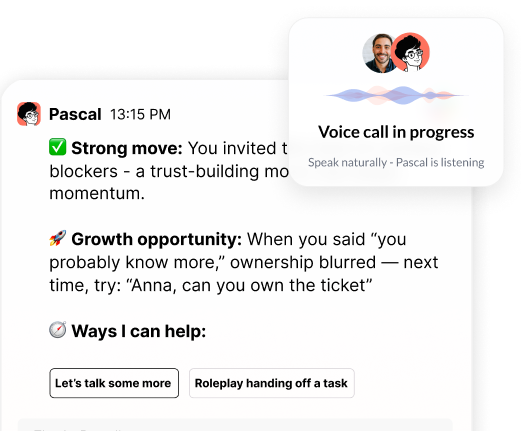
Provide private practice spaces where managers can test new approaches without witnesses. Pascal's roleplay features let managers rehearse difficult conversations with an AI standing in for their direct report, using context from past performance reviews. If you communicate poorly during the roleplay, Pascal corrects you and suggests alternatives—all in private.
Demonstrate immediate value through quick wins. Show better meeting outcomes before tackling deeper behavioral patterns. When an AI coach joins your meeting and provides private feedback afterward, managers receive guidance without the vulnerability of admitting they need help in front of others.
Data Breakdown:
• Approach Element: Entry Point | Receptive Manager Strategy: Direct developmental feedback | Resistant Manager Strategy: Observation and quick wins first
• Approach Element: Psychological Safety | Receptive Manager Strategy: Assumed | Resistant Manager Strategy: Must be built incrementally
• Approach Element: Practice Environment | Receptive Manager Strategy: Optional enhancement | Resistant Manager Strategy: Critical requirement
• Approach Element: Feedback Delivery | Receptive Manager Strategy: Public or private works | Resistant Manager Strategy: Private only initially
• Approach Element: Trust Building | Receptive Manager Strategy: Happens quickly | Resistant Manager Strategy: Requires proof of value
Yes, but only when resistance stems from skill gaps rather than unwillingness to lead. Poor managers drive 70% of the variance in team engagement according to Gallup research, and replacing them costs 150-200% of their salary.
The ROI calculation is straightforward. A single disengaged team of eight people can cost an organization $250,000 annually in lost productivity and turnover. Coaching that manager for $500 annually through AI coaching versus $25,000 for traditional executive coaching makes economic sense.
Identify coachability signals to distinguish between resistance (coachable) and refusal (performance management issue). Managers who resist feedback but care about team outcomes are prime candidates. Set clear boundaries and timelines. Give resistant managers 90 days to show measurable behavior change through 360 feedback data and direct report surveys.
Former CHRO Melinda Wolfe notes in her conversation about the manager problem: "If we have an innovation right now, it's incumbent upon us as HR leaders to show our companies an economic and effective way to help managers."
Delivering feedback in the moment, privately, and tied to specific observable behaviors breaks through resistance. Real-time coaching changes behavior because feedback delivered within hours of a meeting is three times more likely to stick than quarterly reviews. The manager remembers the exact moment, the specific words they used, the team member's reaction.
"In today's 1:1, you interrupted Sarah three times when she tried to explain the project delay" beats "You need to be a better listener" by providing concrete, actionable data.
Practice-based learning works because managers learn by doing. Pascal's roleplay feature lets managers rehearse difficult conversations before having them. If you need to address a team member named Frank who missed a deadline, Pascal helps you practice the conversation using context from past performance reviews about Frank. The AI corrects you if you communicate poorly, suggesting alternative approaches—all before you have the real conversation.
Build trust incrementally by starting with low-stakes feedback before tackling high-stakes issues. Begin with meeting facilitation tips ("You spent 40 minutes on updates and 5 minutes on the decision you called the meeting for") before addressing performance management gaps. Private AI coaching eliminates the shame factor that triggers resistance in group training or public feedback sessions.
Psychological safety is the foundation. Without it, resistant managers will never engage authentically with coaching. You must create an environment where admitting developmental needs doesn't threaten the manager's standing before any coaching intervention can succeed.
Build psychological safety through three mechanisms. First, guarantee confidentiality. Make it explicit that coaching conversations stay private unless the manager chooses to share them. Second, separate coaching from performance reviews. When managers know their coaching conversations won't appear in their annual review, they engage more honestly.
Third, normalize struggle and development. Share stories of senior leaders who worked through similar challenges. When the CEO talks openly about getting coaching on delegation, it signals that development is expected, not shameful.
Measure progress through observable behavior change validated by direct reports and peers, not through the manager's self-assessment. Resistant managers often overestimate their improvement while underestimating how their behavior impacts others.
Use 360 feedback data collected quarterly to track specific behaviors. Don't ask "Is Sarah a good manager?" Ask "In the past 30 days, how often did Sarah interrupt you during 1:1s?" or "How often did Sarah provide specific, actionable feedback on your work?" Behavioral questions yield actionable data.
Direct report surveys provide the clearest signal. Track Manager Net Promoter Score monthly. "How likely are you to recommend Sarah as a manager to a colleague?" correlates strongly with retention and engagement.
Monitor leading indicators like coaching engagement patterns. Resistant managers who start asking for help proactively rather than only responding to prompted feedback show readiness for deeper development. Track the types of questions they ask—moving from "How do I handle this specific situation?" to "How can I improve my overall approach to feedback?" signals growing self-awareness.
Set clear success criteria upfront. Define what "good enough" looks like for this manager within 90 days. Maybe it's reducing interruptions by 50%, or delivering feedback within 48 hours of observing an issue, or conducting weekly 1:1s consistently. Make the targets specific, observable, and validated by others.
When coaching fails to produce measurable behavior change within 90-120 days, transition from development to performance management. Not every resistant manager is coachable, and continuing to invest in someone who won't change wastes resources and damages team morale.
Distinguish between "can't" and "won't." Some managers lack the skills but want to improve—they're coachable with the right support. Others refuse to acknowledge gaps or change behavior despite clear feedback and support—they're performance management cases. The difference shows up in engagement with coaching. Managers who skip coaching sessions, dismiss feedback, or blame their team for problems rather than examining their own behavior signal unwillingness rather than inability.
Document the coaching journey meticulously. Track what support you provided, when you provided it, and what behavior changes you expected. This documentation protects the organization legally and provides clear evidence for performance conversations. When you can show "We provided coaching, training, and quarterly 360 feedback over six months, and your direct report scores declined," the performance conversation becomes straightforward.
Have the honest conversation early. Don't wait a year to tell a manager they're not improving. At the 90-day mark, share the data directly. "Your team's engagement scores are in the bottom 10% of the organization, and your 360 feedback shows no improvement in the specific behaviors we targeted. Here's what needs to change in the next 90 days, and here's what happens if it doesn't." Clarity is kindness.
Consider role changes before termination. Some resistant managers are excellent individual contributors who never should have been promoted into people management. Offering a lateral move to a senior IC role preserves their contributions while removing them from a role where they're causing damage. Not everyone is meant to manage people.
The hardest cases involve resistant managers who have power—senior leaders, founder's friends, revenue generators. In these situations, document everything, build coalition support among other executives, and present the business case for change. Show the cost of their resistance in turnover data, engagement scores, and lost productivity. Even powerful managers can be coached or moved when the evidence is overwhelming and the business case is clear.
• Manager feedback resistance stems from identity protection and organizational cultures that weaponize feedback—address the root causes before deploying coaching interventions
• Coaching resistant managers requires building trust incrementally through private, behavior-specific feedback delivered in real-time rather than periodic formal reviews
• Measure progress through observable behavior change validated by direct reports using 360 feedback and Manager NPS, not self-assessment or engagement metrics
• Transition from coaching to performance management when managers show unwillingness rather than inability to change after 90-120 days of documented support
• Document the coaching journey meticulously to protect the organization and provide clear evidence for performance conversations
Resistant managers aren't lost causes—they're leaders who need a different approach. See how Pascal works inside Slack to deliver the private, contextual coaching that breaks through resistance and drives measurable behavior change.
Header photo by Vitaly Gariev on Unsplash

.png)
.webp)
“Thank you for setting the great foundation for my promotion; now I have a plan!"

Curious to see how AI Coaching can 10X the impact and scale of your development initiatives. Book a demo today for: