

Most organizations have spent the last two years treating AI as a technology problem. They've funded it out of the CIO's office, measured it in deployments and licenses, and handed employees a set of tools with the expectation they'd figure the rest out. Gartner's research suggests most still haven't seen meaningful returns. That gap is less about the technology than about who's been asked to lead it.
Dave Barnett, chief administrative officer at DeVry University, put it plainly in a recent interview with HCA Magazine: "While AI and transformation have been largely driven out of the CIO's office, what we're seeing now is it moving into the CHRO's office, because this is a people matter. This isn't purely about technology or tools. This is about people working differently."
That shift reflects something that's been quietly building for years. AI adoption fails at the human layer, and the human layer belongs to HR.
Barnett describes what DeVry's own research uncovered: a "silent standoff" between employers and employees. Employees are waiting for their organizations to provide guidance, workflows, and guardrails. Employers are waiting for employees to experiment and self-direct. Neither side moves, and the ROI never materializes.
This standoff is familiar to anyone who has watched a well-resourced AI rollout go quiet six months after launch. The tools get licensed. The training deck gets shared. Then adoption plateaus because no one addressed the underlying question of how work actually changes when AI enters the picture.
That's a workforce transformation problem, and workforce transformation sits squarely in the CHRO's domain. Redesigning workflows, reclassifying tasks, rethinking what skills matter and which roles evolve: these are people decisions that require HR's organizational fluency. The CIO can deliver the infrastructure. The CHRO determines whether people use it.
Technical training alone doesn't produce adoption. Barnett argues that successful change requires two things happening at once: "Someone needs cognitive competence and emotional confidence."
Most organizations focus on competence. They run training programs, build learning paths, and track completion rates. What they underinvest in is confidence, specifically whether employees believe the tools are relevant to their specific work and whether they feel safe enough to experiment without fear of failure.
That distinction is not subtle. An employee who understands how a tool works but fears being judged for using it wrong will default to their old workflow every time. The same employee who feels genuinely supported to test, fail, and adapt builds a new one. The organizational conditions for that second outcome sit in culture and psychological safety, which HR shapes more directly than any technology function.
Barnett frames this clearly: "When thinking about what we need to do for people, we need to make sure we're addressing both competence and confidence in the way they work."
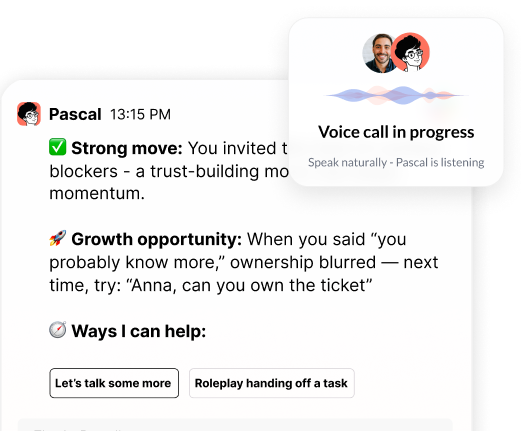
For organizations already investing in AI coaching tools, this is where the product-to-outcome gap often opens. An AI coach can surface insights, flag blind spots, and prompt reflection, but only when the person using it trusts the environment enough to engage honestly. Trust precedes use. Psychological safety is the activation condition, not a soft benefit layered on top.
A single AI strategy applied uniformly across an organization tends to serve no one particularly well.
Barnett recommends segmenting employees by function and proximity to change: most of the workforce needs practical, near-term guidance on how AI reshapes their current work; a smaller group takes on active testing and experimentation; a top tier of innovators scans the horizon for what comes next. "There's a mid-tier team doing testing and experimenting," he says. "And then you've got a top tier of innovators, your mavens, the people out front scanning the environment for the next move, the next change."
This segmentation logic has direct implications for how AI development tools get deployed. Frontline managers typically have the highest hunger for real-time feedback and contextual support. They face daily leadership decisions with limited backup and are often the first to engage with AI coaching when it's framed as a practical companion rather than an evaluation tool. Senior leaders, by contrast, tend to bring more skepticism and require a clearer case for why AI can offer something their experience and existing networks can't.
Getting that rollout right requires knowing your population, which is exactly what HR knows and IT typically doesn't.
Competence and confidence address whether someone will start. Getting behavior to actually change requires something more embedded.
The enduring failure of corporate learning is the knowing-doing gap: people complete training, retain fragments of it, and then return to their default patterns the moment the context shifts. Barnett makes this point directly, arguing that HR must be involved in workflow design, "looking at how we break jobs into tasks and tasks into skills and ensuring we're redesigning workflows to leverage this new collaborator in the workplace called AI."
Real-time, contextual support closes that gap in a way that scheduled sessions can't. When development is tied to what just happened in a conversation, a difficult decision, or a tense interaction, it becomes actionable rather than aspirational. The manager who receives a relevant nudge an hour after a hard one-on-one is being met in the moment of need. The manager who attends a quarterly leadership program and tries to apply it six weeks later is working against the grain of how learning actually sticks.
This is the direction the field is moving, and it's why the CHRO conversation matters beyond the question of org chart ownership. Whoever leads AI adoption in the enterprise needs to hold two things at once: "long-term direction and short-term acuity," as Barnett puts it. "We have to be clear and precise with people about the next three steps in front of them, while concurrently creating space for a longer-term vision."
That combination, the operational now and the strategic horizon, is what HR leaders have been trained to navigate. As AI reshapes work itself, the CHRO's seat becomes the seat where that navigation happens.
Source: "Move over, CIO: the CHRO is taking the wheel on AI," HCA Magazine, Chris Davis, May 15, 2026. Read the full article.

.png)
.webp)
“Thank you for setting the great foundation for my promotion; now I have a plan!"

Curious to see how AI Coaching can 10X the impact and scale of your development initiatives. Book a demo today for: