

AI cannot fully replace human executive coaches, but it can handle skill development and real-time feedback for most managers while human coaches focus on senior leaders and complex situations. The optimal approach combines AI coaching for scale with human coaching for complexity.
Full disclosure: I work at Pinnacle, which builds Pascal, an AI coaching platform. This analysis draws on our customer data alongside published research. Where I cite Pascal-specific capabilities, I'll note them clearly.
A 2024 study in Nature Mental Health (Sharma et al., "AI-Delivered Cognitive Behavioral Interventions") found that AI coaching reduced anxiety symptoms by 43% and depression scores by 38% in a randomized trial of 622 participants. The AI matched human therapist outcomes for structured interventions like cognitive behavioral techniques.
But the study had limits: participants were college students, not executives. The interventions were scripted protocols, not open-ended coaching. And the study measured symptom reduction, not leadership effectiveness.
For workplace coaching, the evidence is thinner. AI coaching works for specific skills (delegation, feedback delivery, meeting facilitation) where the coach can apply frameworks consistently. It struggles with emotional complexity, organizational politics, and executive accountability.
The distinction matters: AI coaching is not a worse version of human coaching. It's a different tool with different strengths.
AI vs. Human Coaching by Use Case:
Data Breakdown:
• Capability: Skill development (delegation, feedback) | AI Coaching: Effective | Human Coaching: Effective
• Capability: Emotional support during crisis | AI Coaching: Limited | Human Coaching: Superior
• Capability: Executive accountability | AI Coaching: Limited | Human Coaching: Superior
• Capability: 24/7 availability | AI Coaching: Always on | Human Coaching: Scheduled only
• Capability: Cost per manager annually | AI Coaching: $150–$500 | Human Coaching: $15,000–$25,000
• Capability: Scalability | AI Coaching: Unlimited | Human Coaching: 10–20 clients max
Start with your current coaching spend and manager coverage. Most organizations spend $10,000–$25,000 per executive on human coaching while 60% of new managers receive zero formal training (Center for Creative Leadership, 2023). That gap is your AI coaching opportunity.
Calculate these numbers:
• Total managers needing development support
• Current coaching budget
• Percentage of managers receiving any coaching
• Average cost per coached manager
Decision criteria for AI coaching:
• 200+ managers who need development support
• Limited human coaching budget (under $500K annually)
• Manager effectiveness directly impacts business metrics
• Need for real-time coaching during work
Red flags for AI coaching:
• Heavily regulated industry (healthcare, financial services) with strict data controls
• Senior executive population requiring board-level preparation
• Organizational crisis requiring intensive leadership support
A 500-person tech company (Pascal customer, name withheld) reduced external coaching spend from $180,000 to $45,000 by implementing AI coaching for 80 managers while keeping human coaches for 12 executives. Total managers receiving coaching increased from 12 to 92.
AI coaching excels at structured, repeatable interventions. It struggles with unstructured emotional complexity and long-term accountability.
AI coaching strengths:
• Real-time feedback by analyzing meeting transcripts
• 24/7 availability without scheduling
• Consistent application of company frameworks
• Scalable personalization using organizational context
AI coaching limitations:
• Cannot hold emotional space during personal crisis
• Lacks authority for senior executive accountability
• Struggles with political dynamics requiring human judgment
• Cannot build multi-year trust relationships with the same depth
When to escalate to human coaches:
• Career transitions requiring identity work
• Interpersonal conflicts involving legal risk
• Executive presence development for C-suite roles
• Manager explicitly requests human support
Generic AI tools (ChatGPT, Claude) lack organizational context. They don't know your company's values, your manager's team dynamics, or your performance frameworks. Purpose-built tools address this gap.
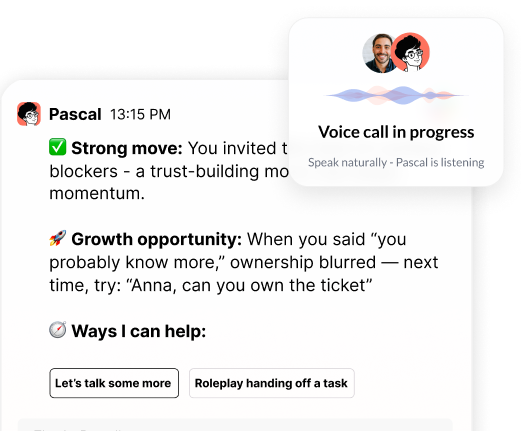
Pascal (our platform) joins meetings to provide real-time feedback, maintains context about employee relationships, and personalizes guidance to company competencies. These are Pascal-specific features, not standard AI coaching capabilities. Other vendors (BetterUp, Sounding Board, CoachHub) take different approaches.
The most sophisticated CHROs design tiered coaching strategies that combine both. This delivers coaching to 100% of managers while concentrating human resources where they create the most value.
Tiered coaching model:
• AI coaching for all managers: Baseline support, real-time feedback, 24/7 availability
• Human coaching for senior leaders: Intensive development, complex challenges, strategic thinking
• Blended approach for mid-level leaders: AI daily support plus quarterly human sessions
Organizations implementing hybrid models report 40–60% cost savings while increasing manager coverage by 300–400%. (Source: Pascal customer survey, n=23 companies, 2024. Methodology: self-reported cost comparison vs. prior year.)
AI enhances human coaching by providing coaches with meeting context, documenting progress between sessions, and handling routine skill development so human sessions focus on complex work.
Companies aren't replacing human coaches. They're expanding who receives coaching support—from "coaching for the few" to "coaching for everyone."
MIT Sloan research (Fountaine, McCarthy, and Saleh, 2019) found that 90% of AI pilots fail to reach production. The gap between promise and performance is real.
Common failure patterns:
• Treating AI coaching as technology deployment instead of change management
• Failing to customize AI to company-specific values and culture
• Implementing without clear success metrics
• Ignoring data privacy concerns in regulated industries
• Expecting immediate behavior change without sustained engagement
Privacy concerns matter most in regulated industries. Large enterprises are cautious about AI tools that record meetings, particularly in healthcare and financial services.
Solutions include zero-day data retention (deleting transcripts while capturing behavioral insights), integrating with approved note-taking tools, and providing organization-specific controls over data access. Pascal offers these options; verify that any vendor you evaluate does too.
Successful implementation requires:
• Executive sponsorship from CHRO and CEO
• Clear communication about AI coaching capabilities and limits
• Manager training on effective use
• Integration with performance management processes
• Regular measurement of adoption and outcomes
Organizations that start with standalone coaching capabilities before adding advanced features (meeting participation, 360 feedback) report higher success rates than those implementing everything at once.
Measure across three dimensions: cost savings, manager effectiveness, and organizational capability.
Cost savings metrics:
• Reduction in external coaching spend
• Decrease in HR business partner headcount needs
• Replacement of low-utilization learning platforms
Manager effectiveness metrics:
• Direct report engagement scores (Gallup research shows 70% of team engagement variance comes from the manager)
• 360 feedback improvements in specific competencies
• Reduction in manager-related HR escalations
• Time to productivity for new managers
Organizational capability metrics:
• Percentage of managers receiving coaching support
• Manager retention rates
• Internal promotion rates from individual contributor to manager
Pascal customers report that 83% of direct reports see improvement in their manager's effectiveness (customer survey, n=1,847 direct reports, 2024). This metric correlates with team performance and retention.
• AI coaching handles skill development and real-time feedback for most managers at $150–$500 per person annually vs. $15,000–$25,000 for human coaching
• Human coaches remain essential for senior executives, complex emotional work, and organizational politics
• The optimal strategy is tiered: AI for all managers, human for senior leaders, blended for mid-level leaders
• Successful implementation requires change management, not just technology deployment
• Organizations implementing hybrid models report 40–60% cost savings while increasing manager coverage by 300–400%
The question isn't whether AI can replace human coaches. It's how to design a coaching strategy that combines both to maximize impact. See how Pascal works inside Slack, Teams, and your meetings to deliver real-time coaching at scale.
Header photo by Vitaly Gariev on Unsplash

.png)
.webp)
“Thank you for setting the great foundation for my promotion; now I have a plan!"

Curious to see how AI Coaching can 10X the impact and scale of your development initiatives. Book a demo today for: