

A manager enablement platform delivers AI-powered coaching, performance tools, and development resources directly into managers' workflows. Unlike traditional LMS or engagement tools, these platforms provide real-time, contextual guidance when managers need it most.
Melinda Wolfe, former CHRO at Bloomberg, Pearson, and GLG, identifies the core problem: "We're asking more of managers with fewer resources."
Gallup research shows 70% of team engagement variance comes down to the manager. Executive coaching costs $15,000+ per person annually and reaches only senior leaders. Traditional training happens in classrooms, disconnected from daily work.
A manager enablement platform is an integrated system that combines AI coaching, performance management tools, and leadership development resources to support managers in real-time, directly within their daily workflows. As Jeff Diana, former CHRO at Calendly and Atlassian, notes, "Real learning and value come from in-context coaching—solving problems in the moment, not in a classroom."
The difference is architectural. Traditional tools provide what one CHRO called "low-fidelity occasional snapshots." Manager enablement platforms offer continuous, contextual support.
Key distinctions:
Data Breakdown:
• Traditional HR Tools: Quarterly engagement surveys | Manager Enablement Platforms: Real-time cultural insights from communication patterns
• Traditional HR Tools: Annual training workshops | Manager Enablement Platforms: 24/7 AI coaching in Slack, Teams, Zoom
• Traditional HR Tools: Generic LMS content libraries | Manager Enablement Platforms: Customized guidance based on company values and competencies
• Traditional HR Tools: Reactive performance reviews | Manager Enablement Platforms: Proactive feedback before, during, and after critical moments
• Traditional HR Tools: Siloed point solutions | Manager Enablement Platforms: Unified system across coaching, performance, development
The market has split into three categories: human coach networks (BetterUp, CoachHub), AI-first platforms (Valence, Pascal by Pinnacle), and hybrid systems (Torch, Exec). Each serves different buyer needs.
Platform Comparison:
Data Breakdown:
• Platform: Pascal by Pinnacle | Primary Model: AI-first, real-time coaching | Best For: Mid-market (200–4,000 employees) needing scalable, in-workflow coaching | Pricing Model: Per-user subscription | Estimated Annual Cost: $100–200/user
• Platform: Valence | Primary Model: AI-first (Nadia coach) | Best For: Fortune 500 companies prioritizing fast deployment | Pricing Model: Per-user subscription | Estimated Annual Cost: $150–250/user
• Platform: Torch | Primary Model: Hybrid (human + AI) | Best For: Organizations wanting human coaching with AI practice | Pricing Model: Tiered by coaching hours | Estimated Annual Cost: $200–400/user
• Platform: BetterUp | Primary Model: Human coach network | Best For: Enterprises prioritizing 1:1 human coaching for all | Pricing Model: Per-user subscription | Estimated Annual Cost: $300–500/user
• Platform: Hone | Primary Model: Live training + AI reinforcement | Best For: Companies preferring cohort-based learning | Pricing Model: Per-cohort pricing | Estimated Annual Cost: $150–300/user
• Platform: CoachHub | Primary Model: Human coach network | Best For: Global enterprises needing multilingual coaching | Pricing Model: Per-user subscription | Estimated Annual Cost: $300–450/user
According to Torch's 2026 platform comparison, AI-first coaching platforms like Valence have deployed across nearly 100 Fortune 500 companies with more than a million coaching conversations.
Yes, if your organization struggles with inconsistent manager quality, limited coaching budgets, or low engagement with existing learning tools.
Prioritize manager enablement platforms when:
• You have 200–4,000 employees and can't afford individual coaching for every manager
• First-time managers receive minimal support beyond onboarding
• Engagement survey results flag "manager effectiveness" as a top issue
• Your LMS shows under 20% utilization despite significant investment
• Managers in satellite offices or remote locations lack access to development resources
• You need to standardize management quality across geographies
Stick with traditional tools if:
• You have fewer than 50 managers and can afford 1:1 human coaching for all
• Your organization is risk-averse about AI adoption
• You lack basic HR infrastructure (HRIS, performance management process)
The best platforms combine five core capabilities: proactive coaching that anticipates manager needs, perceptive intelligence that learns from interactions, personalization to company culture, integration into existing workflows, and enterprise-grade data protection.
Essential feature categories:
Platforms must deliver guidance before high-stakes conversations, not just after. Look for systems that join meetings to observe and provide feedback, adapt recommendations based on manager's role and experience level, and deliver coaching at the moment of need.
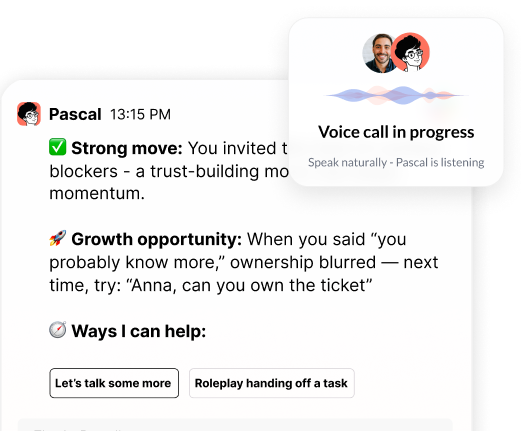
Real-time coaching means the AI provides guidance during actual work moments. For example, the platform might send a Slack message before a difficult 1:1 meeting with talking points, join a Zoom call to observe team dynamics and provide post-meeting feedback, or surface relevant company policies when a manager asks about a performance issue.
Generic chatbot logic fails in enterprise contexts. The platform should ingest company values, competency frameworks, and leadership models to align coaching to your specific management philosophy.
"Ingesting" means you upload PDFs of your leadership competencies, fill out forms about your company values, or have a kickoff workshop where the vendor configures the system to match your culture. The AI then references these materials when coaching managers.
Support for department-level customization matters for organizations with varied cultures across functions. ICF-certified coaches should train the coaching models, not just generic AI.
Native presence in Slack, Microsoft Teams, Zoom, and Google Meet is non-negotiable. Calendar integration prepares managers for upcoming meetings. HRIS connectivity (Workday, BambooHR, etc.) pulls performance data, goals, and org structure. No separate login required—coaching happens where work happens.
SOC2 Type II compliance is the minimum standard. The platform must never train AI models on customer data. Look for moderation flags for sensitive topics (mental health disclosures, legal issues, harassment claims), escalation protocols to HR for complex situations, and anonymous aggregated insights that protect individual privacy.
Track adoption metrics (daily active users, coaching session frequency), behavior change (delegation improvements, feedback quality), and business outcomes (manager NPS, team engagement, retention). ROI visibility should include hours saved and coaching cost comparison.
Use this decision tree to narrow your options, then evaluate finalists on coaching quality, contextual intelligence, and integration depth.
Step 1: Determine your budget and scale
• Budget under $50/user/year, fewer than 100 managers: Start with free tools (ChatGPT for managers) or delay purchase until you have budget for a real platform.
• Budget $100–200/user/year, 200–1,000 employees: Evaluate AI-first platforms (Pascal by Pinnacle, Valence).
• Budget $200–400/user/year, need human coaching element: Evaluate hybrid systems (Torch, Exec).
• Budget $300–500/user/year, want 1:1 human coaches: Evaluate human coach networks (BetterUp, CoachHub).
Step 2: Test coaching quality with real scenarios
Run typical manager challenges through demos: delegation conversations, performance feedback, conflict resolution. Ask vendors about their coaching methodology. ICF-certified coaches should train the models. Generic chatbot logic fails in complex leadership situations.
Step 3: Verify contextual intelligence
How does the platform learn about your company? Can it ingest values, competency frameworks, and leadership models? Does it understand individual manager contexts (role, experience level, past interactions)?
A "knowledge graph of manager interactions" means the platform tracks conversation history, meeting patterns, and past coaching topics to provide personalized guidance. For example, if a manager struggled with delegation last month, the AI remembers this context when coaching on workload management this month.
Step 4: Confirm integration depth
Native integrations matter more than API connections. The platform should live inside Slack, Teams, Zoom, and Google Meet—not require managers to context-switch. Calendar integration for meeting preparation is essential. HRIS connectivity enables performance data, goals, and org structure awareness.
Step 5: Validate security and governance
SOC2 Type II compliance is table stakes. Ask: Does the vendor train AI models on customer data? (The answer must be no.) What moderation and escalation protocols exist for sensitive topics? How are individual privacy and anonymized insights balanced? What controls do you have over data retention and deletion?
Step 6: Demand proof of outcomes
Ask for adoption metrics from current customers: daily active users, coaching session frequency, sustained engagement beyond 90 days. Request behavior change evidence: delegation improvements, feedback quality scores. Require business outcome data: manager NPS changes, team engagement shifts, retention impact.
Check funding, customer count, and advisory board composition. Platforms backed by experienced CHROs understand enterprise needs. Ask about product roadmap and integration plans.
Expect 60–70% manager adoption, measurable time savings, and early behavior change signals within 90 days. Full business outcomes (engagement, retention) take 6–12 months, but leading indicators appear quickly.
90-Day ROI Benchmarks:
• Adoption: 60–70% of managers using the platform weekly
• Time savings: 2–3 hours per manager per month (meeting prep, feedback drafting)
• Coaching cost comparison: 95–99% reduction vs. traditional executive coaching
• Behavior change signals: Increased feedback frequency, improved 1:1 quality (measured through platform data)
• Manager confidence: Self-reported confidence in handling difficult conversations
Red flags if you're not seeing results:
• Adoption below 40% after 60 days (indicates poor workflow integration)
• No measurable time savings (suggests the platform creates work instead of reducing it)
• Managers reporting generic, unhelpful guidance (indicates weak cultural customization)
• Manager enablement platforms deliver AI coaching, performance tools, and development resources directly into managers' workflows, replacing fragmented point solutions with unified systems that scale leadership effectiveness across 200–4,000 employee organizations.
• The market has split into three models: human coach networks ($300–500/user/year), AI-first platforms ($100–250/user/year), and hybrid systems ($200–400/user/year)—choose based on budget and whether you prioritize human touch, fast scale, or blended approaches.
• Use the decision tree to narrow options: Start with budget and scale, then test coaching quality with real scenarios, verify contextual intelligence, confirm integration depth, validate security, and demand proof of outcomes.
• Expect 60–70% manager adoption and measurable time savings within 90 days, with full business outcomes (engagement, retention) appearing within 6–12 months.
Ready to see how manager enablement works in practice? See how Pascal works inside Slack to deliver real-time coaching that scales leadership effectiveness across your organization.
Header photo by Vitaly Gariev on Unsplash

.png)
.webp)
“Thank you for setting the great foundation for my promotion; now I have a plan!"

Curious to see how AI Coaching can 10X the impact and scale of your development initiatives. Book a demo today for: