

When managers use AI coaching platforms in their daily work, their questions reveal patterns: which teams struggle with delegation, where new hires need support, which departments face cultural friction. These patterns, aggregated and anonymized, give HR leaders real-time intelligence about where to invest development resources.
This is different from engagement surveys. Surveys tell you how people felt last quarter. Coaching data shows what managers are trying to solve today.
When a manager asks an AI coach for help with a difficult conversation or feedback delivery, that interaction contains information. The individual details stay private, and the interaction still points to organizational patterns. If 40% of mid-level managers across three departments ask for delegation coaching within two weeks, that's a signal.
Anonymous organizational insights are these patterns, stripped of individual identifiers and aggregated at the team, department, or company level. The platform (like Pascal by Pinnacle) identifies recurring challenges across your organization without exposing who asked what.
What gets measured:
• Common coaching topics by function, level, and location
• Skill gaps appearing across multiple managers
• Communication patterns and behavioral trends
• Engagement depth (frequency, conversation length, topic diversity)
Privacy controls:
• Anonymized trend reports are only generated with 25+ users
• No individual conversations visible to HR or leadership
• SOC 2: Pinnacle has SOC 2, and our 2026 audit is finishing up.
• Customer data never used to train AI models
The system works through dashboards showing trends and themes, without revealing individual conversations.
A quarterly engagement survey might reveal that "managers need better communication skills." Coaching data can show that engineering managers requested guidance on delivering critical feedback in the past month.
Coaching insights:
• Continuous, generated daily or weekly
• Based on actual behavior in workflow
• Specific to exact skills and challenges
• Immediate (no lag time)
• Lower bias (based on real requests for help)
Traditional surveys:
• Quarterly or annual
• Self-reported sentiment
• General themes and broad categories
• Weeks or months from survey to action
• High bias (recency effects, social desirability)
The temporal difference matters. Coaching insights reveal what managers are trying to solve now. Surveys reveal how they felt about last quarter.
Coaching data surfaces patterns invisible to traditional HR tools.
Skill gaps:
• Which leadership capabilities are weakest at different levels
• Where new managers struggle in their first 90 days
• Technical and people management gaps by function
Cultural patterns:
• Alignment between stated values and actual management practices
• Communication style differences across departments
• Trust indicators (frequency of sensitive topic discussions)
Organizational health:
• Early warnings of team dysfunction (spikes in conflict-related requests)
• Manager burnout signals (increased stress management requests)
• Onboarding effectiveness (new hire coaching patterns in first 60 days)
You can identify which teams need which capabilities and deliver targeted interventions.
Development investments:
• Allocate budget to departments showing specific skill gaps
• Deploy training when coaching data reveals emerging needs
• Measure effectiveness by tracking whether requests decrease post-intervention
Succession planning:
• Track whether pipeline programs address actual capability needs
Cultural transformation:
• Measure whether stated values align with actual management behaviors
• Track adoption of new operating principles
• Identify cultural friction requiring executive attention
Organizational design:
• Detect structural issues causing manager overload
• Identify teams where span of control creates bottlenecks
• Surface integration challenges post-merger
When you see that first-time sales managers struggle with performance conversations at 2x the company average, you can intervene before turnover spikes.
Strict privacy protections earn employee trust. Trust drives authentic usage, and authentic usage is what gives the insights their value.
Required protections:
Aggregation thresholds: Anonymized trend reports are only generated with 25+ users. HR sees aggregated, anonymized statistics and never individual conversations.
Technical safeguards: Pinnacle has SOC 2, and our 2026 audit is finishing up. Customer data is never used to train AI models.
Transparency: Clear policies about what data is collected and how it's aggregated, and explicit consent for any use beyond core coaching.
Pascal is built this way. Only the user can see their chat transcripts, administrators get aggregated, anonymized statistics, and Pinnacle never uses your data to train AI.
The re-identification problem: If you're the only woman director in engineering, and the dashboard shows "directors in engineering are asking about X," you're identifiable. Population thresholds exist for this reason: anonymized trend reports are only generated with 25+ users.
Manager control: Managers can toggle Pascal on or off for specific meetings, or set him to be off by default.
Your data stays yours: Pinnacle never uses your company's coaching conversations to train AI, which prevents data leakage between customers.
The most compelling ROI comes from avoiding expensive company-wide programs that don't address actual skill gaps.
Cost avoidance:
• Reduced spending on generic training programs
• Fewer external consultants needed for organizational diagnostics
• Lower turnover costs from addressing manager issues before they escalate
Performance improvements:
• Manager effectiveness scores in populations receiving targeted interventions
• Team engagement metrics correlated with coaching adoption
• Time-to-productivity for new managers receiving proactive support
Strategic decision quality:
• Speed of identifying and addressing organizational issues
• Accuracy of talent development resource allocation
The measurement challenge: ROI is hard to calculate with precision. You're measuring counterfactuals (what would have happened without the intervention). The clearest signal is temporal: are coaching insights identifying issues before they appear in engagement surveys or exit interviews? That lead time is where value lives.
Coaching insights trade survey lag time and generic programs for real-time signals and targeted interventions. The savings are real and hard to measure with precision.
Aggregation groups coaching requests by topic, function, level and location. Anonymized trend reports are only generated with 25+ users.
The mechanism:
• Manager asks AI coach for help with delegation
• System tags the interaction by topic (delegation), function (engineering), level (mid-level manager)
• System counts similar interactions across the organization
• When count exceeds threshold, insight surfaces: "40% of mid-level engineering managers requested delegation coaching in the past 30 days"
• Dashboard shows the pattern without revealing individuals
Statistical validity: An anonymity threshold is a privacy bar, and a pattern that meets it could still be noise. That's why insights should prompt investigation before intervention.
You should ask managers what they need. Coaching insights complement that conversation.
Self-reported needs suffer from three problems:
• Awareness gap: People don't always know what they don't know. A manager might not realize they struggle with delegation until they're in the moment, asking for help.
• Social desirability bias: In a survey, managers might not admit they need help with "basic" skills like giving feedback. In a private coaching conversation, they ask.
• Timing: Annual or quarterly check-ins miss emerging needs. Coaching data captures them as they arise.
What managers ask for help with reveals different information from what they think they need. Both are valuable. Coaching insights show you where people are stuck right now, in their actual workflow. That's hard to get from a survey.
This article focuses on what HR learns from coaching data. The coaching and the insights work together.
The value proposition has two parts:
• Managers get 24/7 access to coaching on leadership challenges
• HR gets aggregated insights about organizational patterns
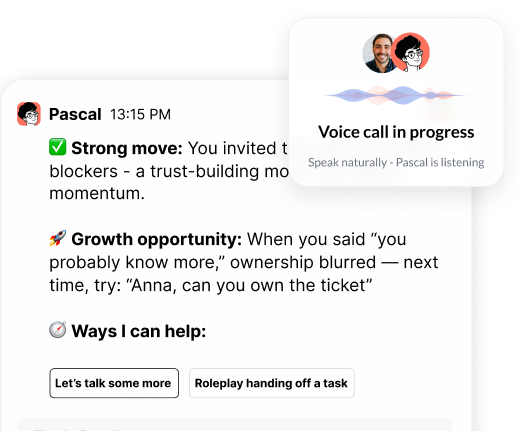
Pascal accompanies managers in their meetings and work and coaches from what actually happened, so the coaching each manager gets and the patterns HR sees come from the same real moments.
• Coaching insights show what managers are trying to solve today, which allows intervention before problems escalate
• Privacy protections (aggregation thresholds, SOC 2 compliance, no use of customer data for AI training) are required for trust, which is required for authentic usage, which is required for valuable insights
• Applications include targeted development investments, succession planning, cultural transformation measurement, and organizational design decisions
• ROI comes from cost avoidance (no more expensive company-wide programs that miss the mark) and the strategic advantage of identifying issues months earlier than traditional methods, though precise measurement is difficult
• Privacy mechanisms take care to get right, and insights should prompt investigation before intervention
Pascal by Pinnacle delivers anonymous organizational insights while providing 24/7 coaching to every manager in your organization. See how Pascal integrates with Slack, Teams, and your meetings to surface the patterns that drive strategic people decisions.
Header photo by Christina @ wocintechchat.com M on Unsplash



“Thank you for setting the great foundation for my promotion; now I have a plan!"

Curious to see how AI Coaching can 10X the impact and scale of your development initiatives. Book a demo today for: