
An AI employee coaching platform can sit on top of your existing HR stack, listen for patterns in everyday conversations, and trigger the right workflows without turning into another system of record. Coaching stays where the work happens, while your HRIS, case management, performance, and learning tools stay the source of truth.
When we say “from coaching to orchestration,” we mean something simple: coaching conversations surface moments that should lead to action, and our platform routes those moments to the right HR tools and teams. As HR and L&D leaders plan for the coming year, this is the choice in front of you: will AI coaching be one more siloed app, or will it be the connective tissue that helps everything else work better?
Most HR tech falls into one of two buckets:
An AI employee coaching platform like the one we’ve built sits in the second bucket. It plugs into the tools people already use at work, like Slack, Teams, email, and performance systems. It brings coaching into those channels, then turns what it learns into small, structured events instead of giant blobs of text.
Here is how that looks in practice:
Data governance is the key. Sensitive data should live in the systems that are already owned and controlled by HR, Legal, and IT. The coaching platform should:
With role-based access and audit trails, Legal, Employee Relations, and HRBPs see only what their role requires. That means we sit down with IT and Legal early, agree on what is private and what can be shared, and lock it into policy before launch.
Early risk shows up first in small coaching questions, not in formal complaints. That is where AI coaching can quietly help case management and Employee Relations.
Think about a few common patterns:
We coach the manager on expectation setting, check-ins, and workload. If the pattern repeats over time, the platform can flag that there may be an issue with role clarity, burnout, or a potential ER risk. That flag becomes a structured alert, not a long story.
The platform can help them name the issue, point them to clear policy language, and, if configured, offer a simple set of choices like “Do you want to talk to HR or Employee Relations?” If they say yes, a case is created in your existing tool.
Under the hood, orchestration looks like this:
To keep this from feeling like surveillance, you need firm guardrails:
The goal is to give HR an early warning and support system, not a digital informant that tracks every word.
Most managers already feel buried in forms during performance and talent cycles. An AI employee coaching platform can help without adding new screens or tasks.
As coaching happens in the flow of work, the platform quietly collects “skill signals”:
Those signals can then flow into your existing systems.
For performance:
For L&D:
All of this happens without forcing managers to log into another tool. The orchestration layer:
HR gets richer data, managers get support, and nobody has to fill out extra forms.
If managers and employees think every coaching chat becomes a ticket, they will stop using it. Trust is the hard line.
We work with clients on a few trigger design patterns:
When a conversation touches on discrimination, safety, or policy concerns, the platform can ask: “Do you want to loop in HR or your HRBP?” Nothing is sent until the person chooses, except where policy requires escalation.
If multiple people in a team talk about burnout, the platform can send HR an aggregated signal, like “Burnout concerns increasing in X group,” without naming names.
During reviews or promotion discussions, the platform can prompt managers to turn a coaching exchange into a short performance summary. Only that distilled, manager-approved summary flows into the performance system.
Governance and transparency keep this real:
Publish clear rules: what stays private, what might be shared, with whom, and why
Co-create those rules with HR, ER, managers, and employee representatives
Train people on examples of private coaching versus shared summaries
Review policies each year with Legal and IT as regulations and business needs shift
When people understand the rules, they are far more willing to use AI coaching for real issues.
You do not need a giant transformation project to start. A focused, 90-day rollout works well.
Phase 1, Weeks 1 to 4, integration and guardrail design:
Phase 2, Weeks 5 to 8, pilot with a specific group:
Phase 3, Weeks 9 to 12, refine and expand:
Helpful metrics to watch include:
Change management matters as much as tech. Many teams use:
That level of clarity goes a long way.
We built our AI coaching platform at Pinnacle to act as this kind of coaching and orchestration layer. We work closely with local and global clients who are balancing seasonal planning, tight budgets, and real human challenges across HR and L&D.
When you treat AI coaching as a practical entry point to better HR decisions, your existing tools stay your systems of record. Coaching becomes a system of insight and orchestration, turning everyday questions from managers and employees into faster, more consistent actions across HR.
If you are ready to turn everyday conversations into measurable growth, our employee coaching platform is built to help you do it consistently. At Pinnacle AI, we give your managers simple, actionable insights so they can coach with confidence instead of guesswork. Start transforming feedback into meaningful behavior change and stronger engagement across your teams. Take the next step today and see how a smarter coaching approach can elevate your entire organization.

.png)
.webp)
“Thank you for setting the great foundation for my promotion; now I have a plan!"

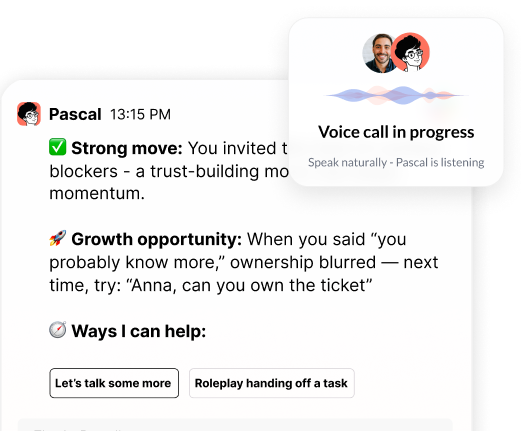
Curious to see how AI Coaching can 10X the impact and scale of your development initiatives. Book a demo today for: